Coffee station organizer types by style and storage layout
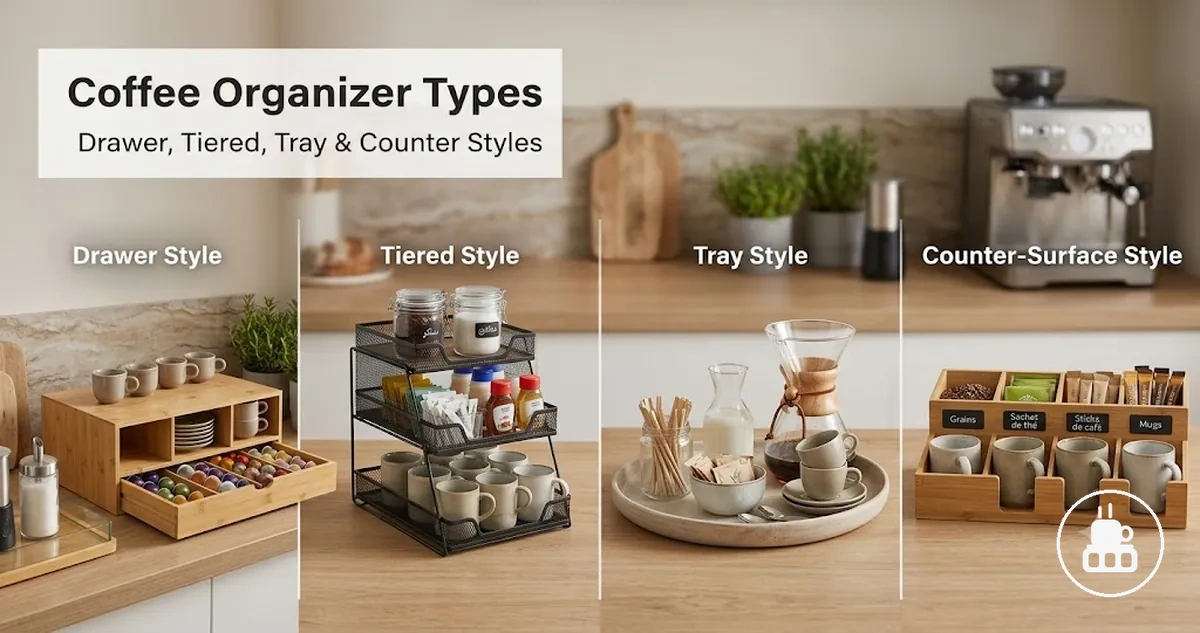
Coffee station organizer types are style-based storage layouts that group coffee supplies on a countertop, inside a drawer, across a tiered shelf, on a tray, in a caddy, or within a shelf-style format. The useful type depends on how the organizer controls access, visibility, compartments, and counter space for the supplies used most often.
Form changes the way a coffee station storage area works. A drawer may keep pods, packets, and stirrers less visible, while a tiered or countertop caddy can make cups and daily supplies easier to see; a tray may group items in one open place, but its fit and clutter control still depend on footprint, material, and the amount stored.
The first difference to understand is not which organizer style is superior, but how each storage layout changes daily access. Drawer, tiered, tray, caddy, and shelf formats each create a different path between stored supplies, counter space, and the final setup outcome.
This page frames coffee station organizer types as decision-support guidance, not as a product catalogue or setup workflow. Product examples may help illustrate a style later, but the main focus is the type, storage layout, access pattern, and fit implication.
How coffee station organizer types differ
Coffee station organizer types are categories of coffee station organizers that differ mainly by form, access, visibility, compartment layout, and counter footprint. These characteristics determine how supplies are arranged and reached during everyday use, making them the primary factors that separate one organizer type from another. Together, they define the storage effect and the decision implication for different countertop layouts and storage priorities.
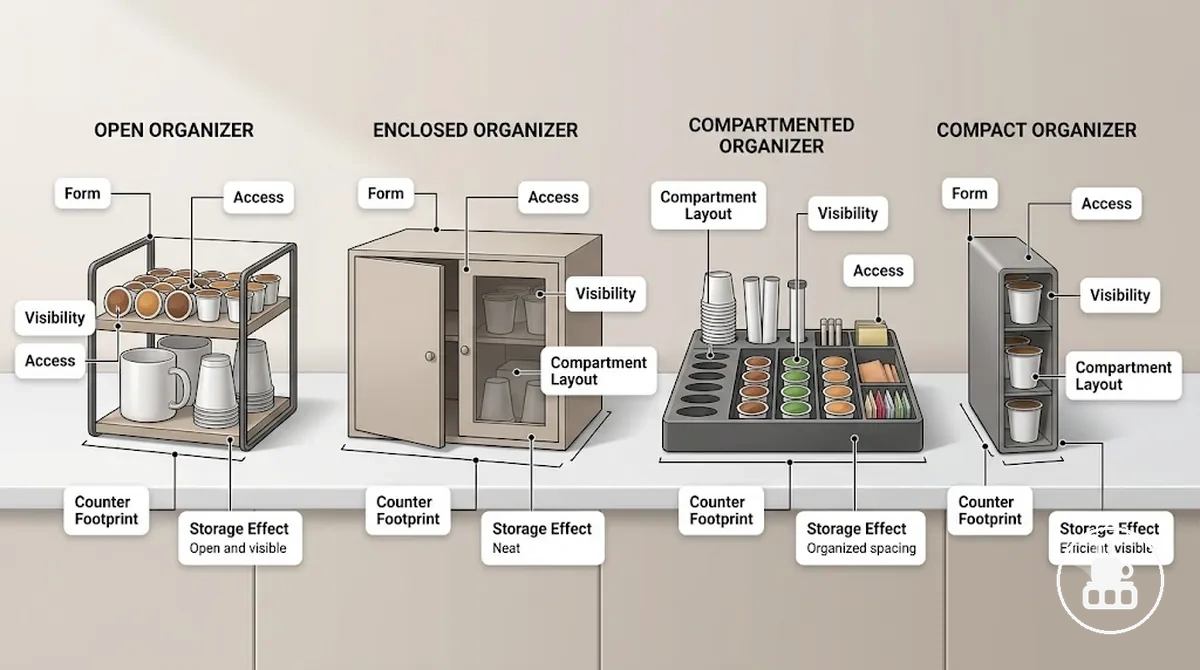
How coffee station organizer types differ becomes easier to understand when the focus stays on physical form rather than appearance alone. An organizer with a more open layout may improve visibility and access, while one with a more enclosed compartment layout may group supplies more discreetly. The resulting storage effect depends on how the organizer balances access, visibility, and counter footprint for the items being stored.
Type comparison helps explain category-level differences without defining exact fit or capacity. Organizer styles can indicate how storage formats may affect everyday use, but capacity and fit still depend on the specific supplies and available counter space, making those topics better suited to dedicated analysis.
Main coffee station organizer styles
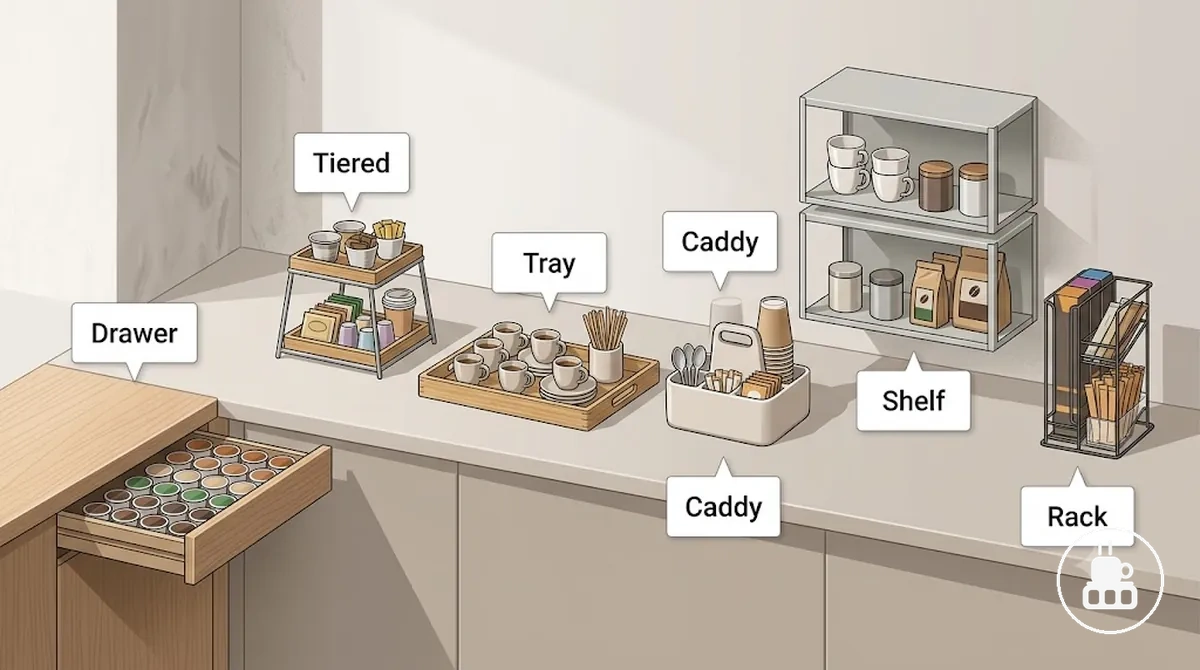
Main coffee station organizer styles are broad style families that classify organizers by form and usual storage role rather than by individual products. A drawer organizer, tiered organizer, tray organizer, countertop caddy, shelf organizer, and rack organizer each represent a distinct organizer format that prepares the more detailed H3 explanations. Together, these style families provide a structured way to compare organizers without ranking them.
Main coffee station organizer styles are easier to understand when grouped by form, access pattern, and usual storage role. The image labels the primary style families, and the table below organizes them into a compact overview before each style is explained individually.
| Style family | Typical form | Access pattern | Usual storage role |
|---|---|---|---|
| Drawer organizer | Drawer insert with dividers | Hidden access | Usually separates pods, packets, and small accessories. |
| Tiered organizer | Vertical stepped layout | Front-facing access | Usually keeps frequently used supplies visible. |
| Tray organizer | Open tray | Open access | Usually groups related coffee items in one place. |
| Countertop caddy | Compartmented holder | Direct access | May organize cups, pods, stirrers, and packets together, depending on the design. |
| Shelf organizer | Open shelving | Shelf access | Usually provides layered storage for larger coffee supplies. |
| Rack organizer | Framed rack | Open display access | May store and display selected coffee accessories, depending on the layout. |
Drawer coffee station organizers
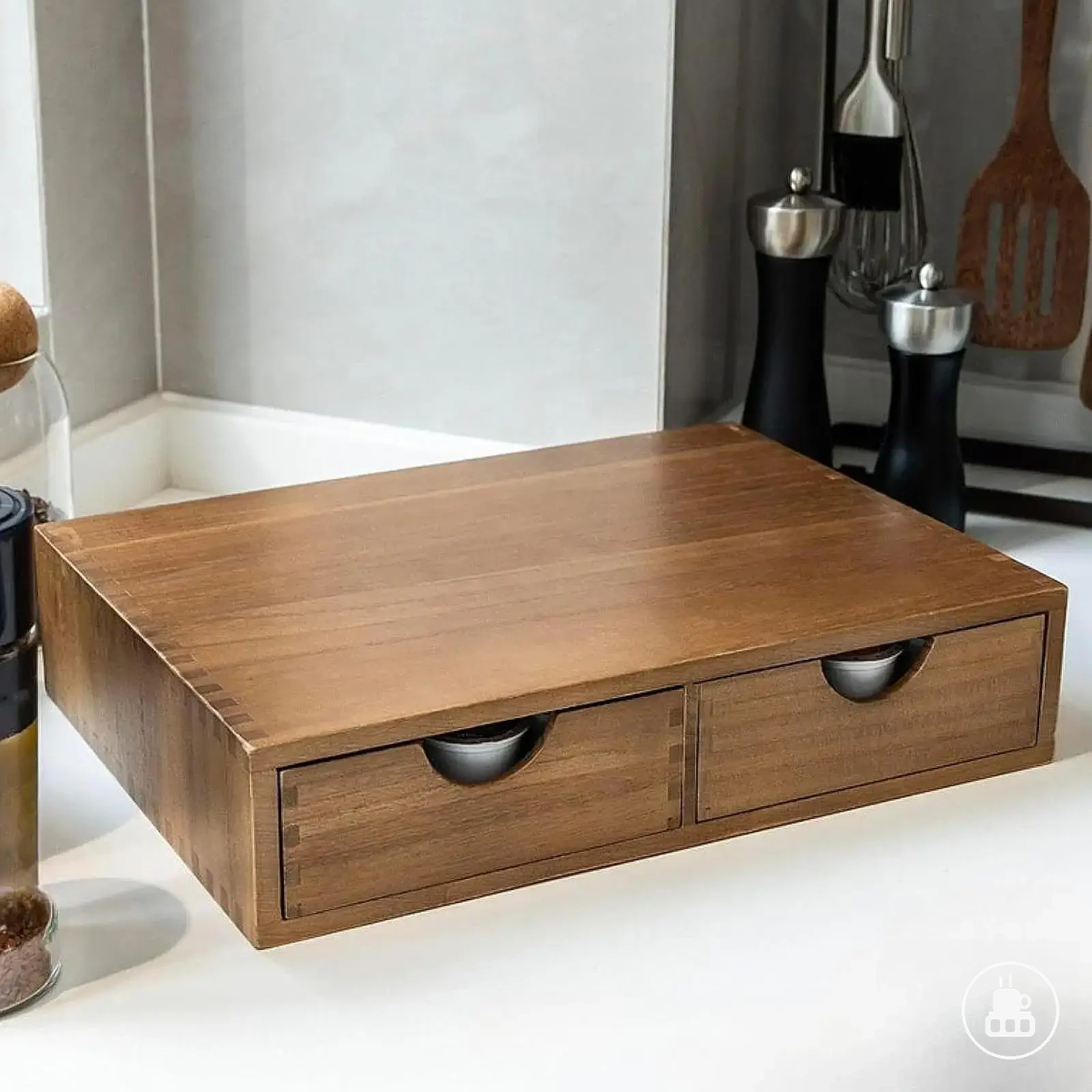
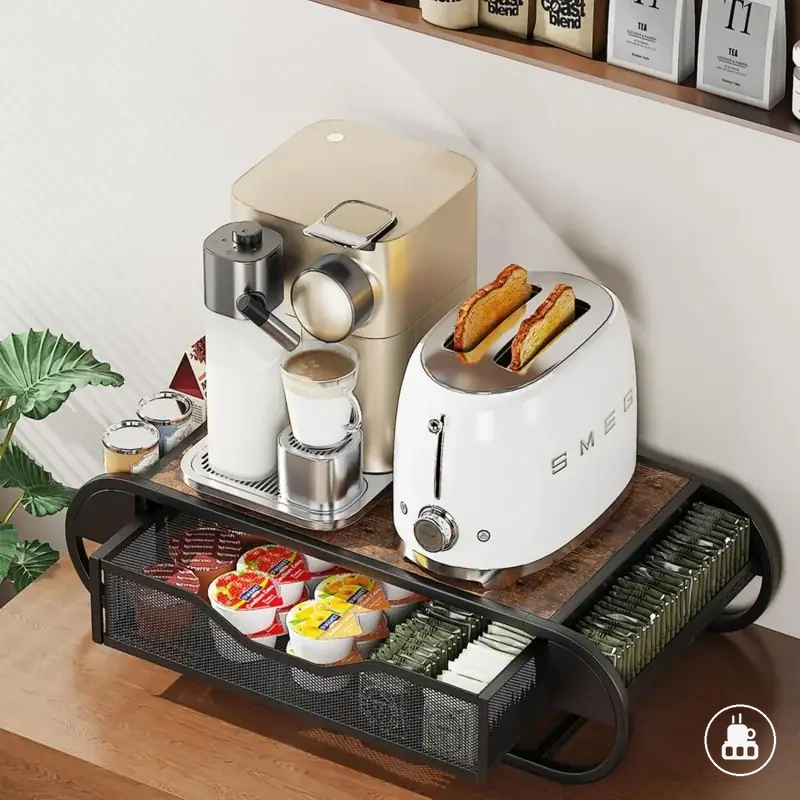
Drawer coffee station organizers are storage systems that use pull-out storage to keep coffee supplies separated inside a concealed drawer. A drawer coffee station organizer typically combines drawer depth with dividers so pods, sachets, sweeteners, stirrers, and other small accessories remain organized while out of sight. This hidden storage approach creates a cleaner appearance, although supplies are not immediately visible until the drawer is opened.
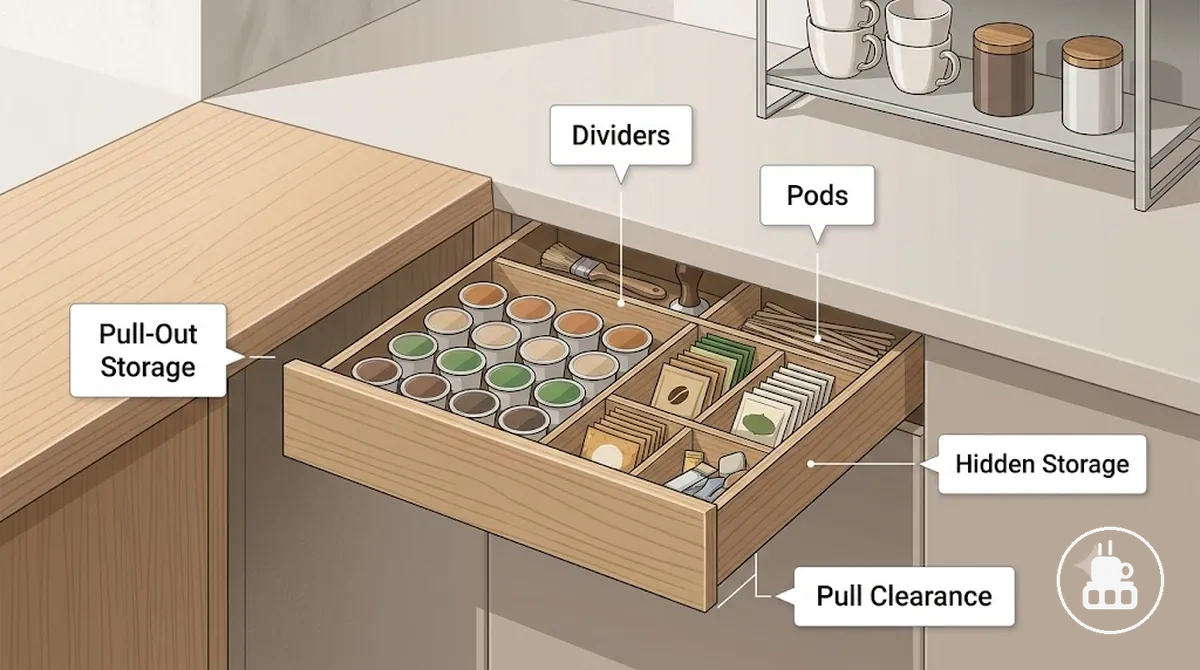
Drawer depth, divider layout, and pull clearance influence everyday access. Different divider arrangements may suit different supplies, while sufficient pull clearance helps provide easier access depending on the drawer position and surrounding counter layout.
- Pods: Dividers can separate pod storage to make retrieval more organized after opening the drawer.
- Sachets and sweeteners: Individual compartments may keep small packets grouped and easier to locate.
- Stirrers: Narrow dividers can prevent long accessories from shifting within the drawer.
- Small accessories: Hidden storage keeps these items out of view, but access depends on opening the pull-out drawer.
Tiered coffee station organizers
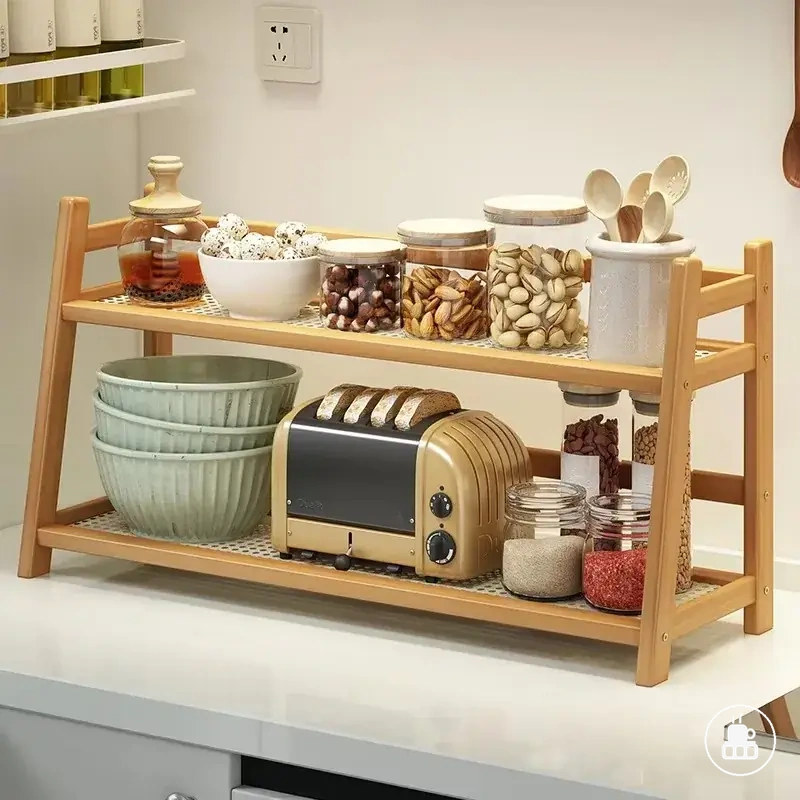
Tiered coffee station organizers are vertical storage systems that stack supplies across multiple tiers instead of relying only on a wider countertop. A tiered coffee station organizer keeps visible supplies arranged on separate levels, making everyday items easier to see while using available height. The benefit of vertical storage depends on shelf clearance, mug size, and nearby machine clearance.
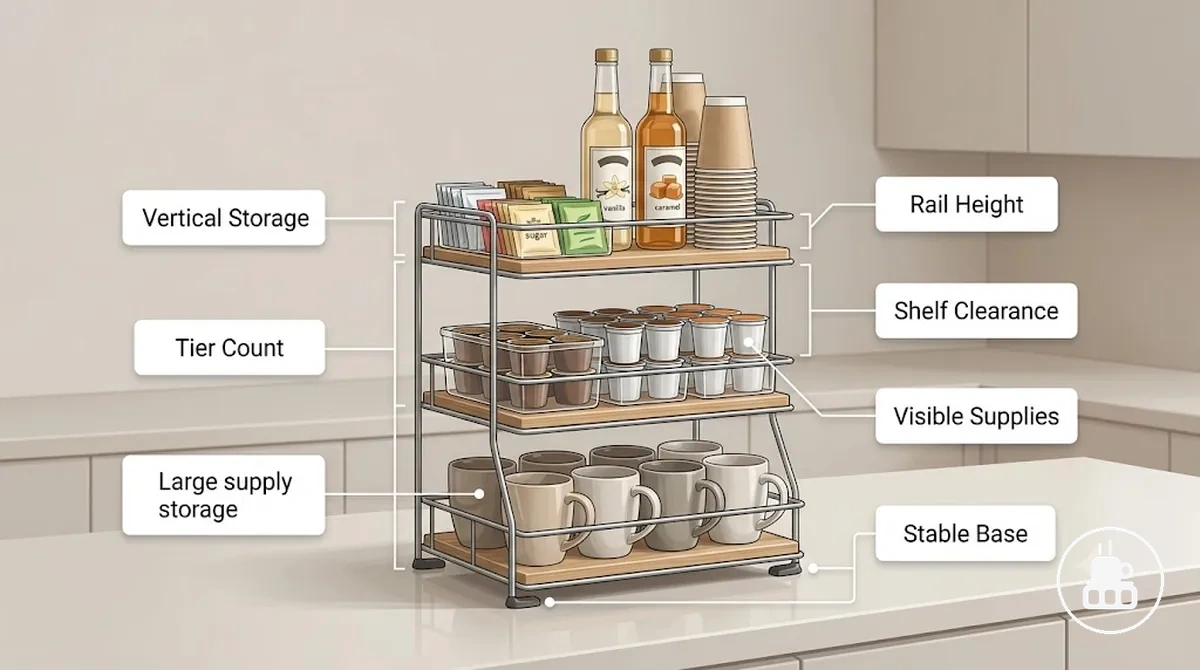
Tier count, shelf clearance, rail height, and load distribution influence visibility, access, and stability. Additional tiers or taller supplies may require more clearance, while balanced placement can help maintain stability depending on the organizer design.
- Tier count: Separate levels can organize pods, cups, and condiment packets for clearer daily access.
- Shelf clearance: Spacing between tiers may determine whether taller mugs, cups, or syrup bottles fit comfortably.
- Rail height: Side rails can help keep visible supplies in place while remaining easy to reach.
- Load distribution: Evenly placing items across the tiers may support a more stable arrangement, depending on the organizer.
Tray coffee station organizers
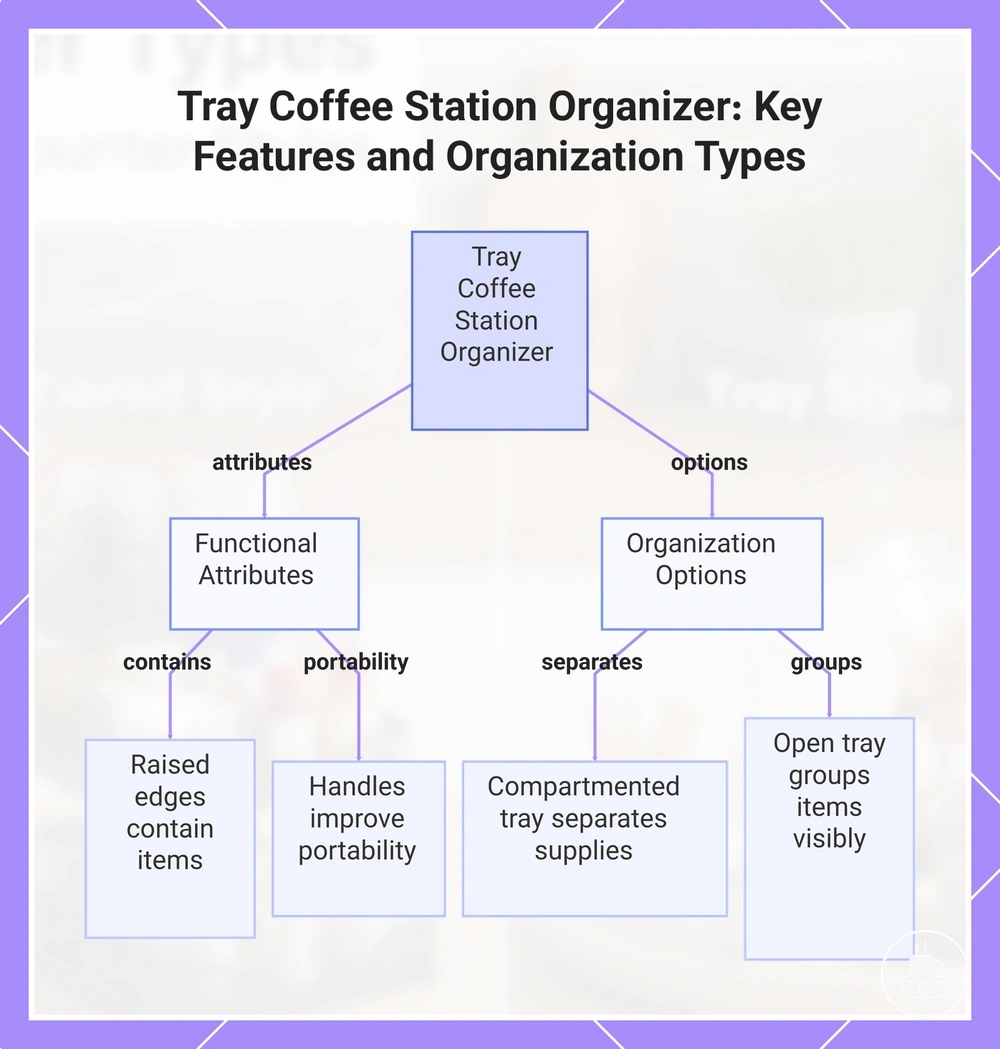
Tray coffee station organizers are open-base styles that group coffee supplies in one visible area instead of enclosing them within compartments. A tray coffee station organizer may include raised edges, handles, or a compartmented tray to keep frequently used items together while remaining easy to access. This open arrangement supports visual grouping while keeping everyday supplies within easy reach.
Portability, containment edges, and compartment presence influence how a tray coffee station organizer functions. Handles may make a coffee station tray easier to move, clean, or reset when needed, while raised edges can help keep items grouped during normal use. A compartmented tray may offer more clutter control than a simple serving tray, but a basic tray is not the same as a compartmented coffee station organizer. For a broader comparison, see coffee station organizer versus tray.
- Raised edges: Can help contain cups, pods, and small accessories during everyday use.
- Handles: May improve portability when the tray is moved for serving, cleaning, or resetting the coffee area.
- Compartments: A compartmented tray can separate supplies, while a simple coffee bar tray keeps them together in one open space.
- Open placement: Visible grouping may support clutter control and make routine organization easier, depending on the tray design.
This chart shows the main design attributes and organization approaches that define a tray coffee station organizer.
Countertop caddy organizers
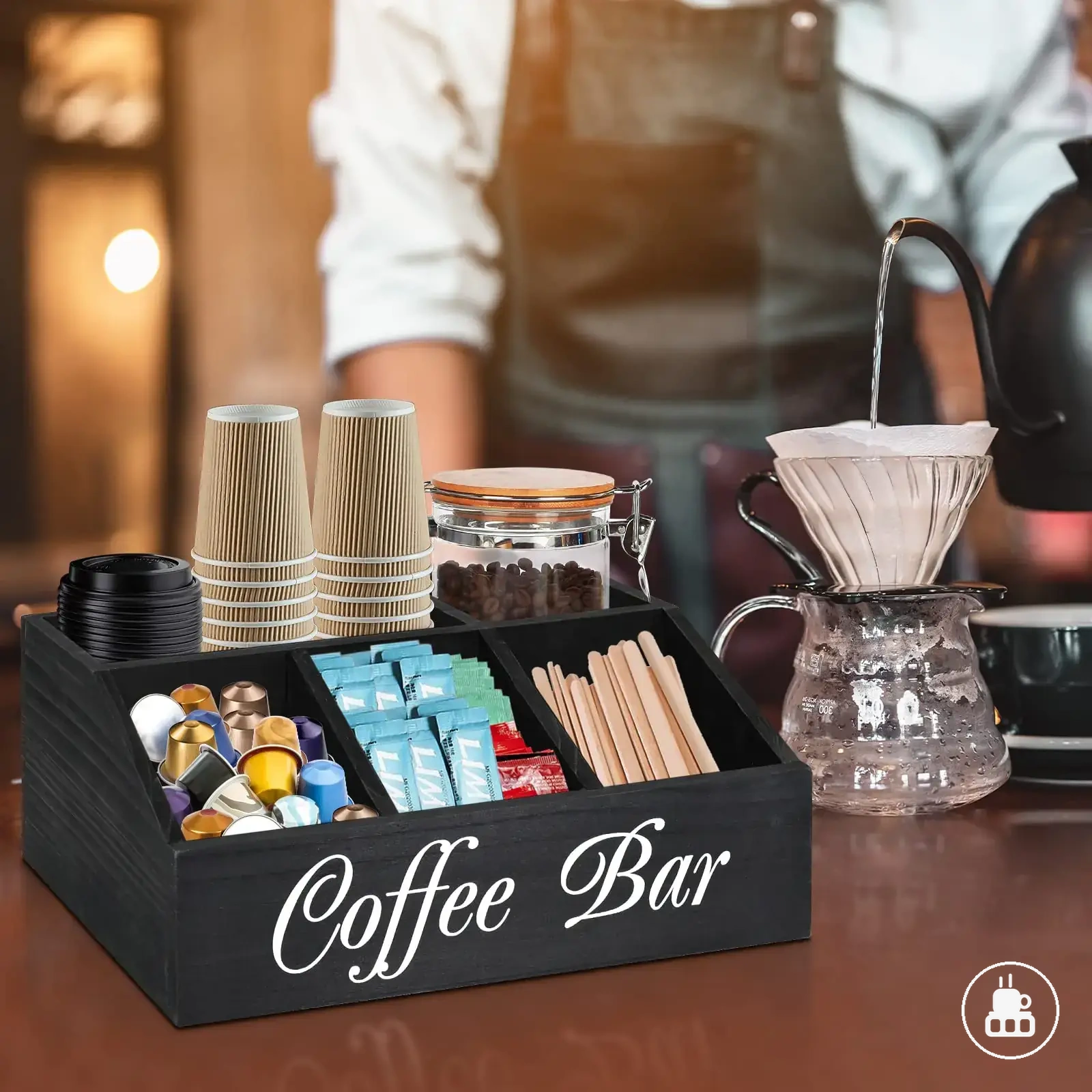
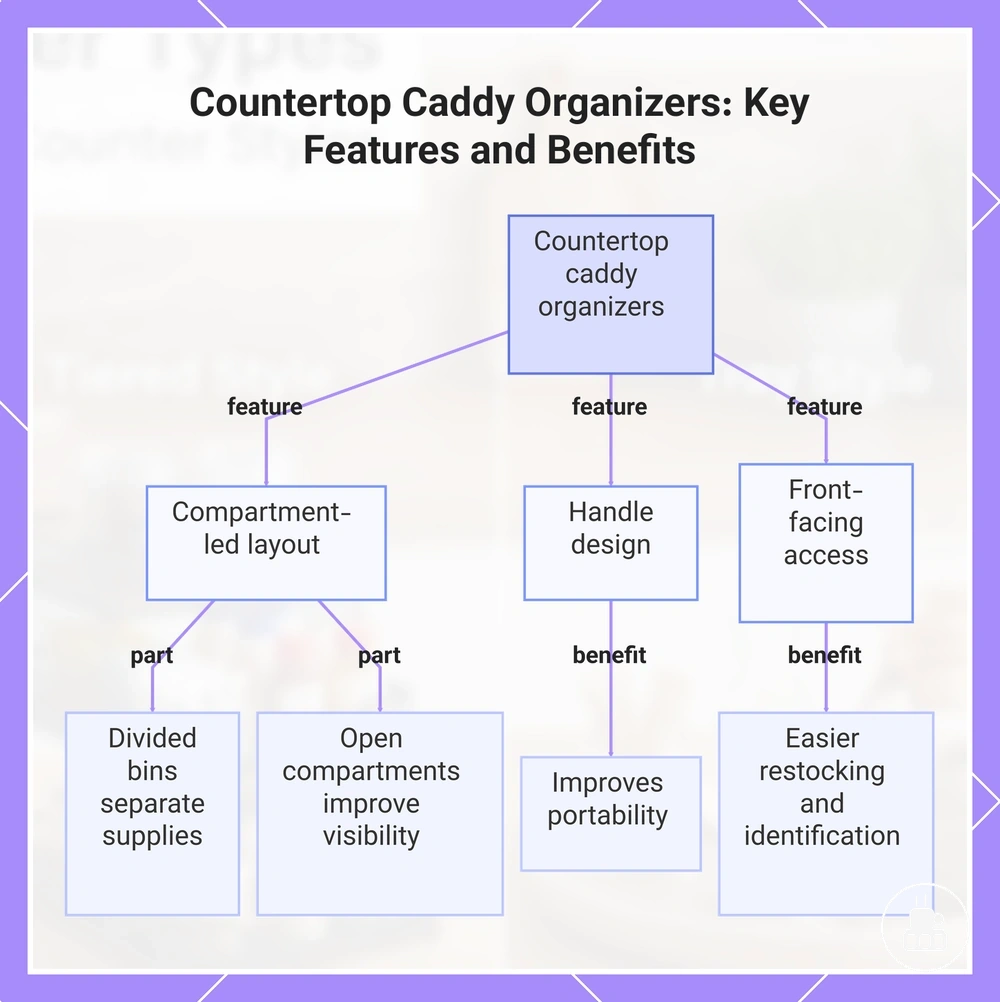
Countertop caddy organizers are portable or semi-portable organizers built around open compartments for everyday coffee supplies. A countertop caddy organizer typically uses divided bins to keep pods, stirrers, packets, and similar items visible and easy to reach from the front. This compartment-led layout supports portable open access while making routine restocking easier.
Compartment count, handle design, and front-facing access influence how a countertop caddy organizer is used. Handles may improve portability when the organizer is moved, while divided bins and open compartments can make supplies easier to identify, replenish, and share depending on the organizer layout and supply mix.
- Open compartments: Keep frequently used supplies visible for quicker everyday access.
- Handles: May improve portability when the caddy is moved or repositioned on the counter.
- Divided bins: Can separate pods, stirrers, packets, and other daily supplies for clearer organization.
- Front-facing access: Makes supplies easier to identify and restock during routine use.
- Shared use: Open visibility may help multiple users find and return items more easily, depending on the organizer layout.
This chart shows the main features of countertop caddy organizers, including compartment layout, handle design, and front-facing access, and how they improve everyday access and organization.
Shelf and rack coffee station organizers
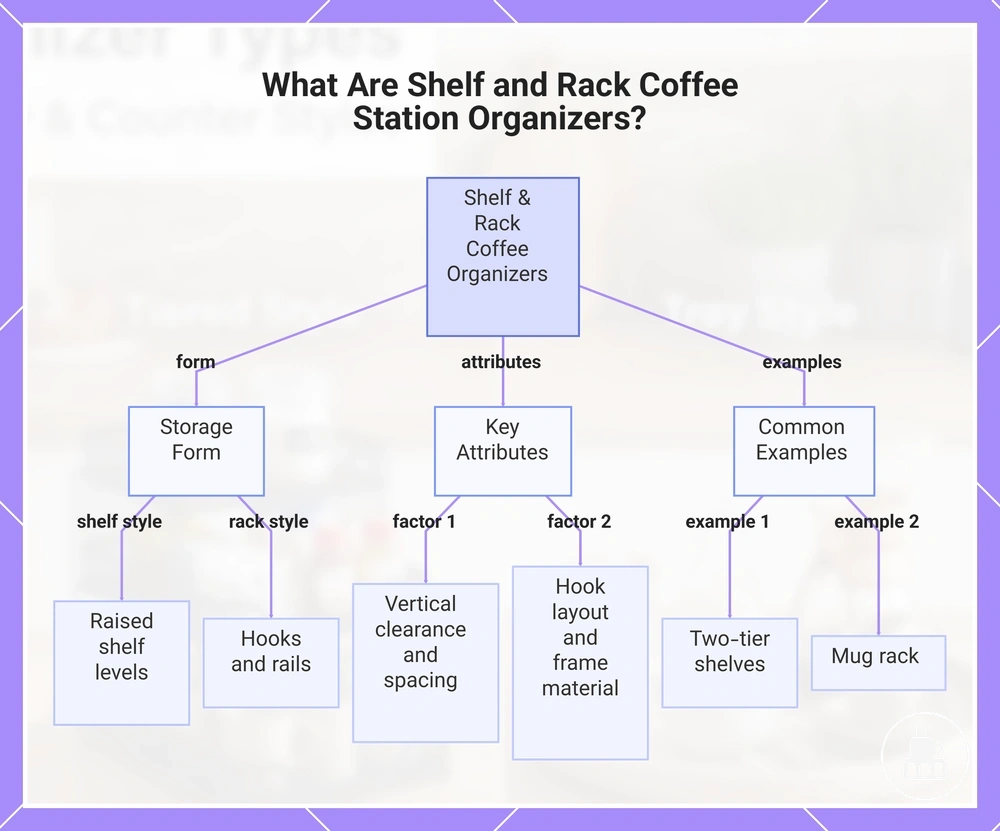
Shelf and rack coffee station organizers are raised or framed storage styles that use shelves, hooks, rails, or vertical zones to separate coffee supplies. A shelf organizer may arrange cups, pods, and accessories across different levels, while a rack organizer can combine hooks and rails to keep frequently used items accessible. Together, these formats organize supplies through raised or framed storage rather than enclosed compartments.
Vertical clearance, shelf spacing, hook placement, and frame material influence how shelf and rack organizers function. Clearance and spacing affect access to taller items, while hook layout and frame design may contribute to stability and everyday access depending on the organizer. This section focuses on storage form rather than installation or decorative use.
- Two-tier shelves: Can separate cups, pods, and accessories across raised storage levels.
- Mug rack: Hooks may keep mugs accessible while preserving shelf space for other coffee supplies.
- Pod rack: Rails or dedicated rack sections can keep pods visible for easier selection.
- Condiment rack: Vertical zones or shelves may group packets, stirrers, and similar accessories for organized access.
This chart shows the storage form, key attributes, and common types of shelf and rack coffee station organizers.
Storage access and visibility by organizer type
Storage access and visibility by organizer type depend on how each organizer presents, groups, or conceals everyday coffee supplies. The balance between hidden supplies, visible supplies, restocking ease, and clutter control influences daily use and the overall appearance of the coffee station. The most suitable access pattern depends on the organizer type, user routine, and available counter space.
Storage access and visibility by organizer type can be compared through access pattern, visibility level, and the practical effect each layout has on everyday use. The table below summarizes these differences without suggesting that one organizer type is universally better than another.
| Organizer type | Access pattern | Visibility level | Best-fit use condition |
|---|---|---|---|
| Drawer organizer | Pull-out access | Hidden supplies | When a cleaner counter appearance is preferred and supplies do not need immediate visual access. |
| Countertop caddy | Front-facing access | Visible supplies | When shared use and restocking ease are priorities. |
| Tray organizer | Open grouped access | Visible grouped supplies | When keeping related items together and occasional portability are important. |
| Tiered organizer | Vertical access | Visible supplies across levels | When frequently used items benefit from vertical visibility and convenient reach. |
| Shelf or rack organizer | Open shelf or hook access | Visible supplies | When raised storage and separated storage zones suit the available layout. |
Each organizer type offers a different balance between storage access and visibility rather than a fixed advantage. Hidden supplies may improve clutter control, while visible supplies can make scanning and restocking easier. The most practical choice depends on how everyday use, counter appearance, and the preferred access pattern fit the intended storage routine.
Compartment and divider patterns by organizer style
Compartment and divider patterns by organizer style describe how compartments, dividers, open wells, drawer zones, and shelf zones influence the way coffee supplies are stored. These patterns affect how pods, cups, lids, stirrers, packets, and small coffee tools fit within an organizer, making compartment layout an important factor in supply fit and storage flexibility.
Compartment and divider patterns by organizer style can be organized by the type of storage layout each organizer uses. The table below compares broad compartment patterns rather than individual products or exact capacities.
| Organizer style | Compartment or divider pattern | Supply fit condition | Effect or risk |
|---|---|---|---|
| Drawer organizer | Drawer zones with fixed or removable dividers | Suitable for pods, packets, stirrers, and small tools | Removable dividers may improve flexibility, while overfilling can reduce organization. |
| Countertop caddy | Fixed compartments | Suitable for separated daily supplies | Fixed compartments keep items grouped but may offer less layout flexibility. |
| Tray organizer | Open wells or shallow divided storage | Suitable for cups, lids, and grouped accessories | Open layouts may improve access but can become less organized if overfilled. |
| Tiered organizer | Shelf zones | Suitable for separating supplies across levels | Storage flexibility depends on shelf spacing and the size of stored items. |
| Shelf or rack organizer | Shelf zones with open storage | Suitable for cups, pods, and accessories | Open storage may improve visibility, although supply grouping depends on the available zones. |
Removable dividers can provide greater flexibility for mixed supplies because compartment sizes may be adjusted to suit different storage needs. Fixed compartments maintain consistent separation for packets and stirrers, while open wells and shelf zones accommodate larger items but may require more deliberate grouping to reduce overfilling risk.
After evaluating compartment layout and divider patterns, the next criterion is storage capacity by organizer style, where compartment arrangement and available storage space can be considered together without relying on exact item counts.
Counter footprint and vertical storage tradeoffs by style
Counter footprint and vertical storage tradeoffs by style depend on how each organizer uses width, depth, height, clearance, and load placement. Flat layouts usually require more horizontal counter footprint, while taller layouts shift storage upward and may need more cabinet or machine clearance. The fit risk changes when the organizer sits near a coffee machine area, wall, cabinet, or outlet.
Counter footprint and vertical storage tradeoffs by style can be compared through base footprint, vertical demand, and the clearance condition each layout creates. The table below keeps the sizing view style-level rather than turning it into an exact measurement checklist.
| Style | Footprint tendency | Vertical demand | Fit risk to check |
|---|---|---|---|
| Drawer | Moderate width and depth | Low height demand | Pull clearance near the counter edge or coffee machine area. |
| Tiered | Smaller base footprint than many flat layouts | Higher vertical storage demand | Cabinet clearance, mug height, and load placement across tiers. |
| Tray | Wider flat footprint | Low height demand | Depth near a wall, outlet, or machine base. |
| Caddy | Compact to moderate counter footprint | Low to medium height demand | Handle clearance, supply height, and access from the front. |
| Shelf | Moderate base footprint | Medium to high vertical demand | Shelf spacing, cabinet clearance, and stable load placement. |
| Rack | Varies by frame shape | Medium vertical demand | Hook clearance, rail position, and nearby wall or outlet access. |
Vertical storage can reduce reliance on wider counter space, but it may create height or clearance limits when cabinets, machines, or tall supplies are nearby. Flat organizers can stay lower and easier to move, but they may occupy more width and depth on the countertop. Load placement also matters because uneven or tall storage can affect access and stability depending on the organizer design.
For a more detailed sizing pass, use fit and dimensions for each organizer type after comparing the style-level tradeoff. The same organizer style can fit differently beside a coffee machine, against a wall, below a cabinet, or near an outlet, so the final fit condition depends on the surrounding layout.
Material and finish patterns across organizer styles
Material and finish patterns across organizer styles describe how wood, bamboo, acrylic, plastic, metal, and mixed-material builds affect the way an organizer looks and functions on the counter. Material can change surface texture, weight, transparency, cleaning needs, durability perception, and counter appearance. These traits make material a practical tradeoff rather than a simple quality ranking.
Material and finish patterns across organizer styles are easier to compare when each material is connected to common style fit and use conditions. The table below organizes broad material patterns without making brand, price, or universal durability claims.
| Material or finish | Common style fit | Practical effect | Condition to qualify |
|---|---|---|---|
| Wood | Tray, shelf, or rack organizers | Creates a natural finish and warmer counter appearance. | Cleaning and moisture tolerance depend on surface finish and care. |
| Bamboo | Drawer, tray, or shelf organizers | Often supports a light natural look with visible surface texture. | Durability perception and cleaning burden depend on construction and finish. |
| Acrylic | Drawer inserts, pod holders, or caddies | Transparency can improve visibility of stored supplies. | Clear surfaces may show smudges or clutter more easily. |
| Plastic | Caddies, divided bins, or drawer organizers | Light weight can support easy repositioning and routine cleaning. | Cleaning ease and durability perception vary by surface and build quality. |
| Metal | Tiered shelves, racks, rails, or framed organizers | Metal frames can support an open structure and a stronger stability perception. | Moisture tolerance and surface wear depend on coating and use conditions. |
| Mixed-material | Tiered, shelf, or rack organizers | Combines frame material with shelf or tray surfaces for a blended appearance. | Cleaning burden depends on how many surfaces and joins the organizer includes. |
Acrylic can support visual access because transparent surfaces make stored items easier to see, while wood and bamboo usually change the counter appearance through a natural finish. Plastic may reduce handling effort when a lighter organizer is useful, and metal may increase stability perception in framed or tiered styles. Cleaning, moisture tolerance, and durability perception still depend on the specific finish, surface exposure, and how the organizer is used.
Best coffee station organizer type by setup need
The best coffee station organizer type depends on stored supplies, counter space, visibility preference, access frequency, and whether the setup is a private setup or shared setup. A suitable style should match the items being stored and the way those items are reached during daily use. This makes the final choice conditional rather than universal.
Best coffee station organizer type by setup need can be matched through the decisive attribute behind each use case. The decision matrix below connects setup need to likely organizer type and the main tradeoff to check before choosing.
| Setup need | Decisive attribute | Likely organizer type | Main tradeoff |
|---|---|---|---|
| Hidden supplies | Visibility preference | Drawer organizer | Cleaner counter appearance, but slower visual scanning after opening. |
| Visible daily access | Access frequency | Countertop caddy or tiered organizer | Easier scanning and restocking, but supplies remain visible. |
| Compact counter use | Counter space and footprint | Tiered organizer or shelf organizer | Uses vertical storage, but clearance and load placement still need checking. |
| Portable grouping | Movement and reset need | Tray organizer | Keeps related supplies grouped, but open storage may need more frequent tidying. |
| Mixed supplies | Compartments and capacity condition | Countertop caddy, drawer organizer, or divided tray | Better separation depends on compartment layout, supply size, and overfilling control. |
Stored supplies should guide the first selection filter because pods, cups, packets, stirrers, and small accessories place different demands on compartments and capacity. Counter space and visibility preference narrow the suitable style further, while access frequency decides whether hidden storage or open access is more practical. Shared use often benefits from visible supplies and restocking ease, while a private setup may allow more concealed storage if quick scanning is less important.
For a fuller criteria sequence, continue with choosing the right organizer type after matching setup need to the likely style and tradeoff. Product examples should only be considered after fit, capacity, material, and access conditions are clear.
The products below are useful examples for comparing available options. Before buying, check that the compatibility criteria, key features, and product details match your needs.