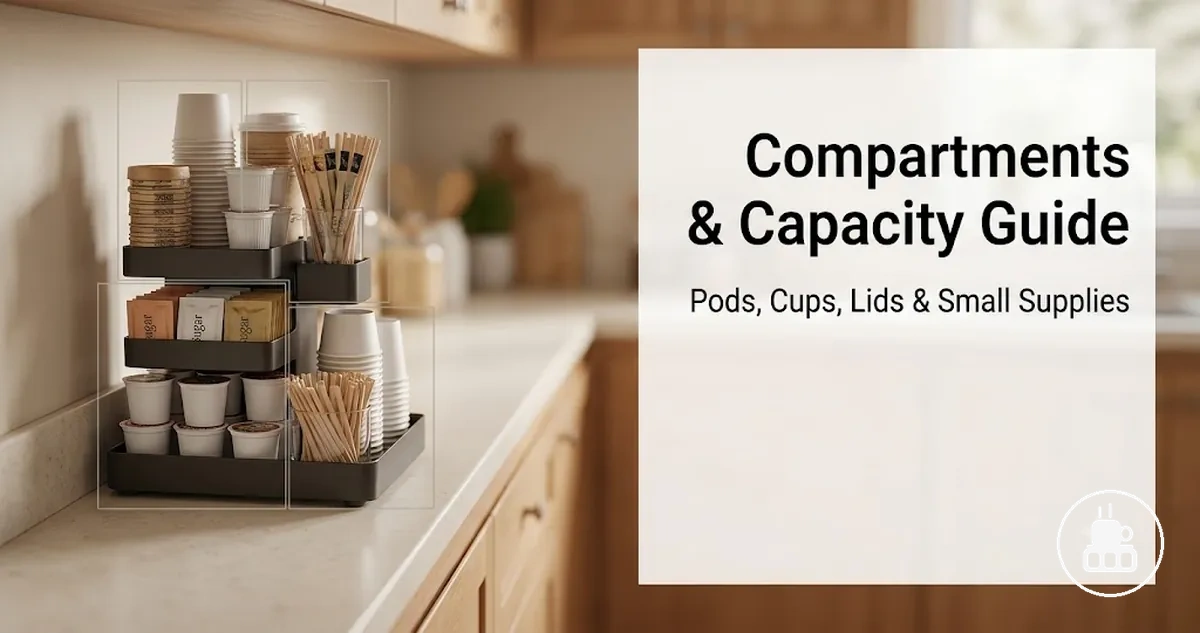
Coffee station organizer compartments and storage capacity
Coffee station organizer compartments and storage capacity refer to how a coffee station organizer structures separated storage and how that structure affects usable capacity in real use. The focus is on how many sections exist and how compartments, drawers, and removable dividers influence how pods, cups, lids, and condiments are stored and accessed. Usable capacity emerges from the balance between internal space, supply size, and refill access rather than the visible compartment layout alone.
The evaluation of a coffee station organizer becomes practical when it is seen in daily use scenarios where access speed and supply separation matter. A coffee station organizer is typically assessed by how its compartments support routine handling of pods, cups, lids, condiments, drawers, and mixed supplies without creating congestion or wasted space. The way people use coffee station organizers often depends on how quickly they need access to these items during daily coffee preparation, especially when multiple users share the same station or when refills must remain efficient.
Problems with capacity usually appear when compartment count is confused with practical storage behavior, leading to overfilled sections or blocked access paths. In many cases, usable capacity decreases when pods, cups, or condiments exceed the layout’s intended separation, even if compartments still appear available. The more reliable approach is to treat compartment design and real access flow as the main indicator of practical storage performance rather than relying on surface-level space assumptions.
Compartment count and usable capacity in coffee station organizers
Compartment count and usable capacity in coffee station organizers is the distinction between the visible number of separated sections and the amount of functional storage those sections actually provide in real use. Compartment count refers to the observable section count created by drawers, tiers, trays, or removable dividers, while usable capacity is shaped by internal volume, divider position, supply shape, and access clearance. These factors together determine how pods, cups, lids, and condiments fit and how efficiently they can be reached, separating labeled structure from real storage behavior.
Compartment count is a visible metric of how many sections a coffee station organizer contains, but usable capacity describes how much practical storage those sections can support under real conditions. Claimed capacity often reflects the layout design, while practical capacity depends on internal volume usage, divider position, and how supply shape affects crowding or access clearance. An organizer with fewer compartments may hold more usable storage if its internal structure reduces wasted space, while a higher compartment count may still offer limited practical capacity when access becomes restricted. The key difference is that claimed capacity describes structure, while practical capacity reflects real storage behavior.
Compartment layouts for separated coffee supplies
Compartment layouts for coffee station organizers define how internal sections are structured to separate coffee supplies such as pods, cups, lids, and condiments. These layouts determine how items are grouped, divided, and positioned within the organizer, shaping how space is used and accessed.
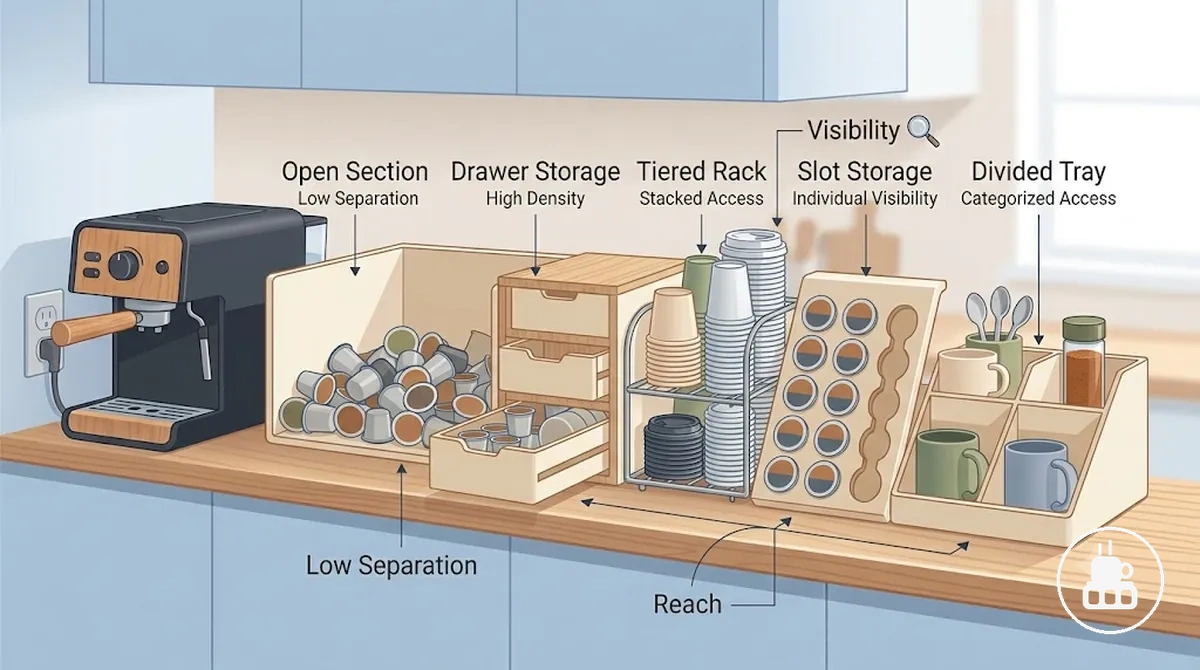
Compartment layouts for separated coffee supplies determine how visibility, reach, and stacking behavior change across different storage designs. These layouts influence whether items remain open and visible or partially hidden behind structural divisions, and they also affect how quickly users can reach pods, cups, lids, and condiments during daily use.
Different compartment layouts change usable behavior even when compartment counts appear similar, because separation style affects access and stacking efficiency. An open section may prioritize visibility, while a drawer-based layout may prioritize hidden storage with controlled access. These differences shape how supplies are organized and how efficiently they can be reached, leading into a structured comparison of layout behavior.
Compartment layouts vary in how they manage separation, visibility, and access, which directly affects storage behavior across similar organizer sizes. Open sections expose supplies for quick reach, drawers limit visibility but improve containment, tiered racks improve vertical stacking, slots guide upright storage, and divided trays separate smaller items like packets or lids. These differences are summarized below, including how each layout influences access and capacity behavior.
| Layout form | Separation style | Access pattern | Capacity effect |
|---|---|---|---|
| Open sections | Exposed separation | Direct visibility and reach | Faster access, lower containment |
| Drawers | Hidden compartmentalization | Pull-to-access | Controlled storage, reduced visibility |
| Tiered racks | Vertical separation | Layered reach | Improved stacking, moderate access depth |
| Slots | Linear separation | Front-facing access | Organized upright storage |
| Divided trays | Segmented separation | Segmented reach | Efficient small-item grouping |
These organizer types and compartments help interpret how layout structure affects separation and usability beyond simple compartment counts.
Open caddies, drawers, tiered racks, and divided trays
Open caddies, drawers, tiered racks, and divided trays describe four layout forms used in coffee station organizers to separate coffee supplies through different access direction, visibility, and stacking behavior. Each form changes how items are reached, how vertical clearance is used, and how supplies are visually exposed or hidden during use.
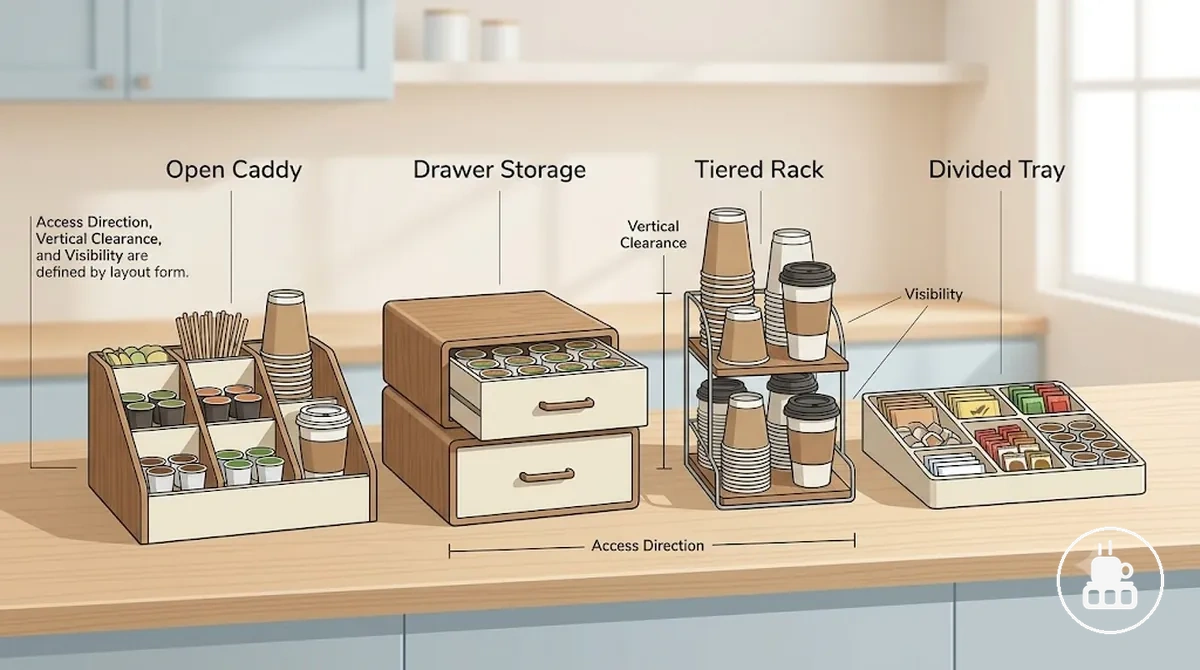
These layout forms differ mainly in how they control access direction and supply visibility within the same storage footprint. An open caddy keeps items exposed for direct reach, while a drawer hides supplies and requires pull-out access with guided clearance. Tiered racks use vertical stacking behavior to separate items across levels, and divided trays segment smaller supplies with limited depth and structured placement.
- Open caddy: Uses top or side access direction, requires low vertical clearance, supports light stacking behavior, and keeps supplies fully visible for immediate retrieval.
- Drawer: Uses pull-out access direction, requires guided clearance for movement, supports controlled stacking behavior, and hides supplies to reduce visibility while slowing immediate retrieval.
- Tiered rack: Uses upward vertical access, requires higher vertical clearance, improves layered stacking behavior, and partially exposes supplies depending on shelf level.
- Divided tray: Uses segmented top access, requires low vertical clearance, limits stacking behavior, and organizes small supplies with mixed visibility depending on compartment depth.
Removable dividers and adjustable compartments
Removable dividers and adjustable compartments refer to internal organizer structures that allow section sizes to be changed by inserting, shifting, or removing divider pieces. They control how coffee supplies are separated by altering slot spacing and internal boundaries within the same unit. This adjustability can support different supply sizes, but only when the structure maintains enough stability during reconfiguration.
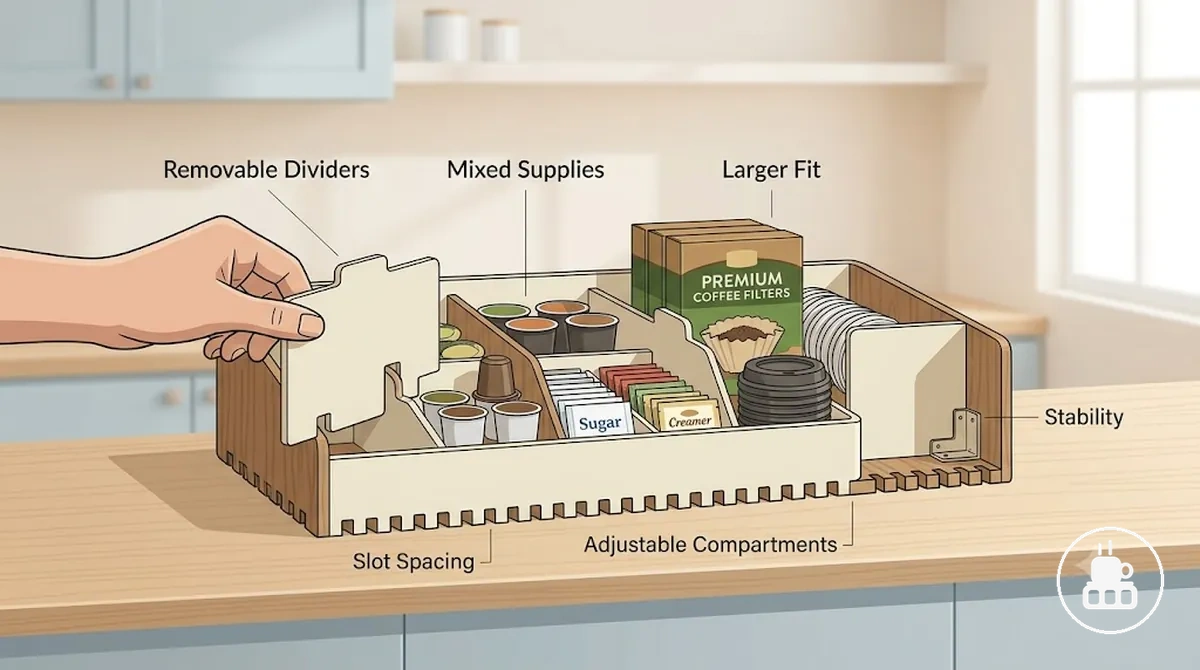
When coffee supplies vary in size or mix between pods, cups, and packets, removable dividers may improve adaptability by reshaping compartments to match the load. In contrast, fixed divisions may provide more consistent stability when items remain uniform, reducing internal shifting during use.
- Removable dividers: Increase reconfiguration flexibility when slot spacing supports stable placement, but may reduce structure if over-adjusted.
- Adjustable compartments: Support mixed supplies when compartment size can be reshaped, but capacity may vary depending on divider positioning and reconfiguration range for larger-item fit.
- Fixed divisions: Maintain stable separation for uniform items, but limit larger-item fit when spacing cannot be changed.
- Slot spacing: Determines how finely compartments can be adjusted and affects how securely dividers remain in place.
- Stability: Influences whether adjustable layouts hold mixed supplies securely or shift under repeated access.
Capacity ranges for pods, cups, lids, and condiments
Capacity ranges for pods, cups, lids, and condiments in coffee station organizers depend on compartment depth, stack height, and refill frequency patterns rather than fixed limits. Each supply type changes how storage amount behaves inside the same organizer structure. As a result, capacity must be understood by supply type rather than a single uniform range.
A pod-focused setup usually concentrates capacity in deeper compartments where pods can be stored in tighter layers, making compartment depth the main limiting factor. Mixed-supply setups that include cups, lids, stirrers, sweetener packets, and condiments rely more on stack height and segmented spacing, which can reduce storage consistency while improving separation. This creates a clear contrast between high-density pod storage and more variable mixed-use storage, where access risk may increase as more supply types are combined.
Capacity planning becomes more reliable when pod, cup, lid, and condiment storage are evaluated by their individual space requirements and refill frequency needs, since combining them without separation can reduce practical limits. For deeper structure on how different supply types interact in shared layouts, see pods cups and condiments storage, where capacity behavior is broken down by supply arrangement.
| Supply type | Capacity variable | Practical limitation | What to check |
|---|---|---|---|
| Pods | Compartment depth | Access restriction when overfilled | Depth vs refill frequency |
| Cups | Stack height | Instability when stacked too high | Vertical clearance |
| Lids | Stack height and alignment | Misalignment during frequent access | Separation spacing |
| Stirrers | Linear slot capacity | Overcrowding reduces retrieval speed | Slot width consistency |
| Sweetener packets | Surface grouping area | Mixing with other small items | Segmentation clarity |
| Condiments | Container depth and grouping | Access risk when mixed with pods | Section separation |
Pod counts and drawer capacity claims
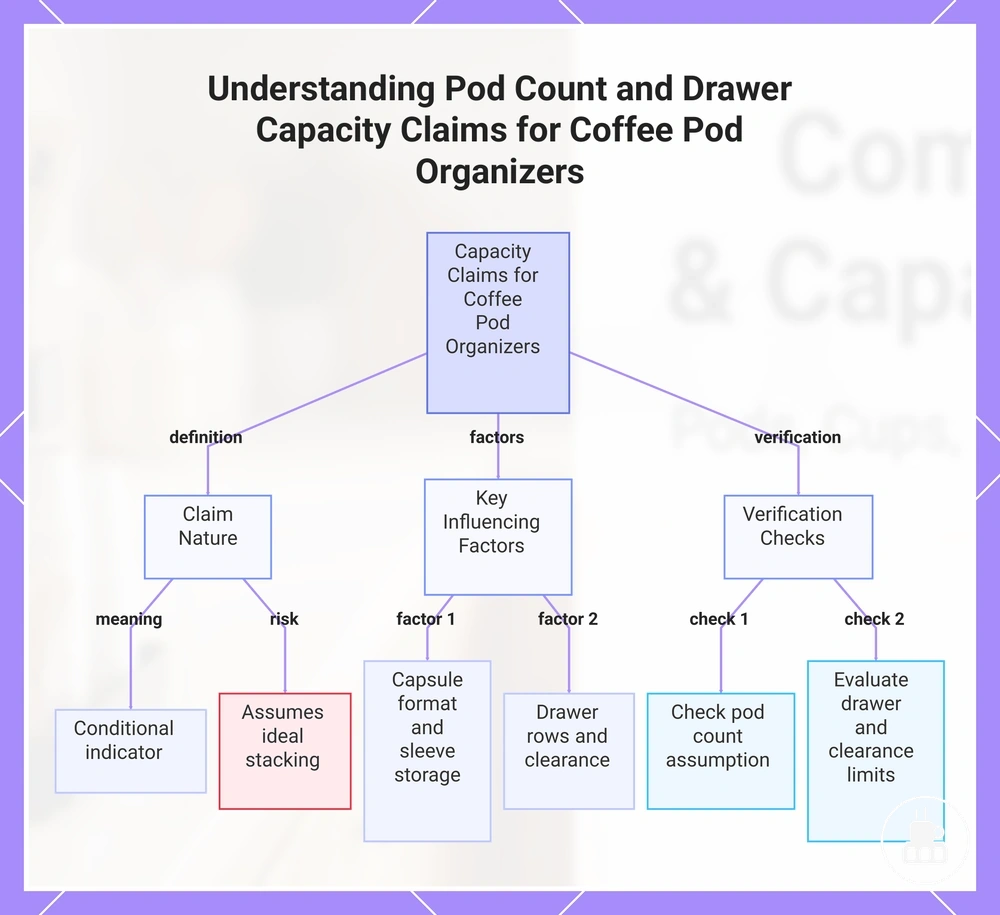
Pod count and drawer capacity claims refer to stated storage amounts that connect coffee pod organizers to capsule format, drawer rows, sleeve storage, and available clearance. These claims must be evaluated carefully because claimed capacity often assumes ideal stacking conditions that may not match real drawer depth or internal segmentation. As a result, pod count claims should be treated as conditional indicators rather than fixed storage guarantees.
When assessing these claims, variation in capsule format, drawer rows, and clearance can significantly change the realistic stored quantity. A higher claimed pod count may not translate into actual capacity if drawer depth is shallow or sleeve storage is split inefficiently, increasing mismatch risk between stated and usable capacity. Therefore, verification should focus on how pods, capsule formats, and drawer structure interact rather than relying on a single numerical claim.
- Pod count: Check whether the claim assumes single-layer or stacked capsule format.
- Drawer capacity: Evaluate how drawer rows distribute pods across usable space.
- Capsule format: Compare pod or K-cup shape differences that affect fit.
- Sleeve storage: Assess whether pods are stored individually or in packaging form.
- Clearance: Verify vertical and horizontal space limits that influence realistic stored quantity.
This chart shows the nature of pod count and drawer capacity claims, the key factors affecting real capacity, and the verification checks to assess realistic storage.
Cup, lid, stirrer, and packet storage capacity
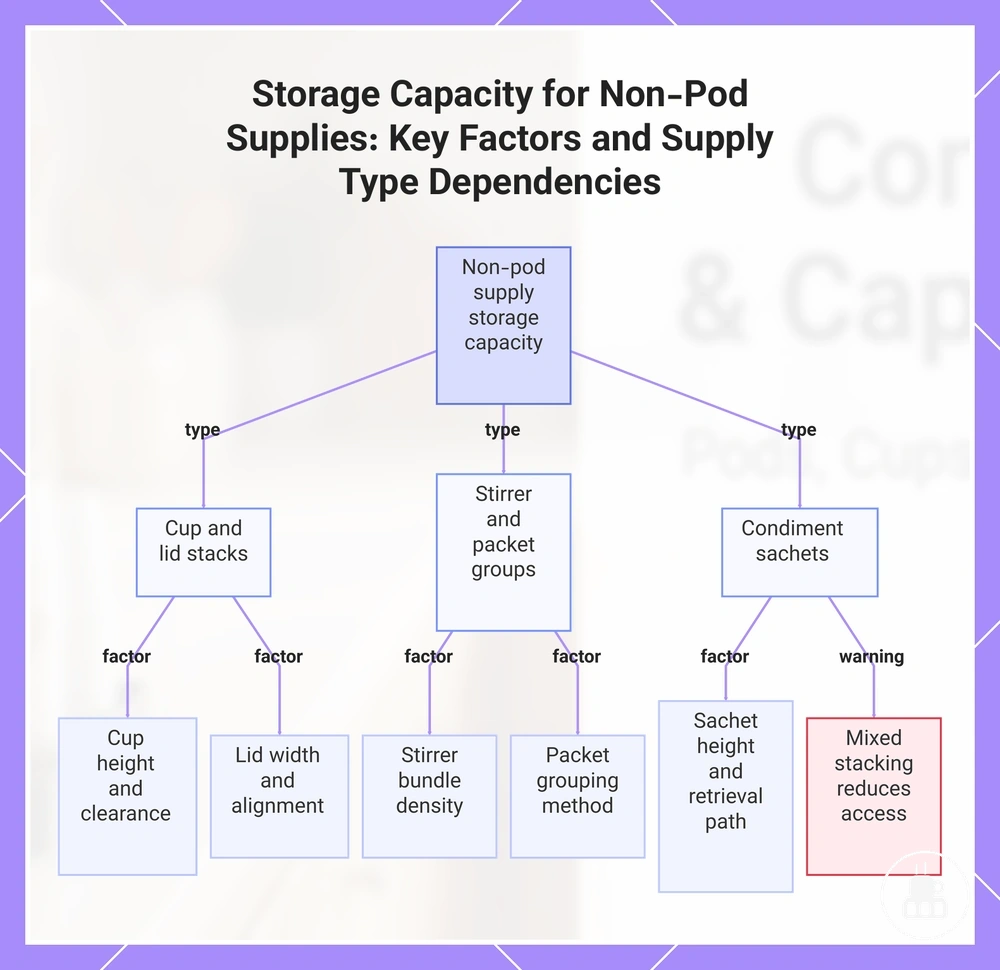
Cup, lid, stirrer, and packet storage capacity depends on how non-pod supplies vary in height, width, and stackability inside a coffee station organizer. Mixed supplies change capacity behavior because cup stacks, lid stacks, stirrer bundles, and packet groups each require different clearance and retrieval paths, making simple storage calculations less reliable. As a result, storage efficiency depends on how these supply types are arranged rather than a fixed capacity expectation.
Capacity planning for non-pod supplies must consider how shape differences affect crush risk, retrieval path, and turnover speed inside the organizer. When cup stacks are too tall or lid stacks too wide, access can become restricted even if space remains available. Stirrer bundles and condiment sachets may also reduce storage efficiency when they are not separated clearly, increasing clutter and slowing retrieval during use.
- Cup stack: Depends on height and vertical clearance; taller stacks can increase crush risk and reduce retrieval efficiency when depth is limited.
- Lid stack: Depends on width and alignment; wider stacks may reduce access efficiency and disrupt orderly retrieval paths in shared compartments.
- Stirrer bundle: Depends on separation and bundle density; tighter bundles improve compactness but may reduce quick retrieval efficiency.
- Packet group: Depends on grouping method and visibility; loose grouping can increase clutter risk and reduce storage efficiency for sweetener or similar packets.
- Condiment sachet: Depends on height and retrieval path; mixed stacking can reduce visibility and slow access when combined with other small supplies.
This chart shows the key factors affecting storage capacity for non-pod supplies in a coffee station organizer, including cup and lid stacks, stirrer and packet groups, and condiment sachets.
Large-capacity organizers and storage trade-offs
Large-capacity organizer selection depends on whether storage demand outweighs added counter footprint and access complexity. A large-capacity organizer increases storage availability through extra compartments, tiers, drawers, width, and depth, but these same features can also change how easily items are reached during daily use. The decision therefore depends on balancing storage demand against space limits and workflow access needs.
In shared setups or high-use environments, a large-capacity organizer can reduce refill interval frequency by supporting more reserve storage for pods, cups, lids, stirrers, and packets. However, extra compartments, tiers, and drawers may increase access burden, especially when items are placed deeper or across multiple levels. Wider or deeper designs can also increase counter footprint, which may reduce available working space when mixed supplies require frequent handling and visibility.
Choosing a large-capacity organizer becomes more practical when storage demand, shared use, or supply variety consistently exceeds what compact layouts can handle. It becomes less suitable when counter depth is limited or when access speed and visibility are more important than reserve storage. The selection depends on whether storage gain justifies the added access and space trade-offs in daily use.
Capacity trade-offs overview:
Large-capacity organizers shift value between storage expansion and usability costs. The comparison below outlines how key structural features influence storage gain versus trade-offs.
| Feature | Storage gain | Trade-off |
|---|---|---|
| Extra compartments | Improves separation of shared supplies | Can increase access steps during retrieval |
| Tiers | Expands reserve storage vertically | Reduces visibility and quick access |
| Drawers | Increases contained storage capacity | Adds access burden for frequent use items |
| Width expansion | Provides more surface area for mixed supplies | Increases counter footprint usage |
| Depth expansion | Supports higher refill interval efficiency | Can reduce reachability of rear items |
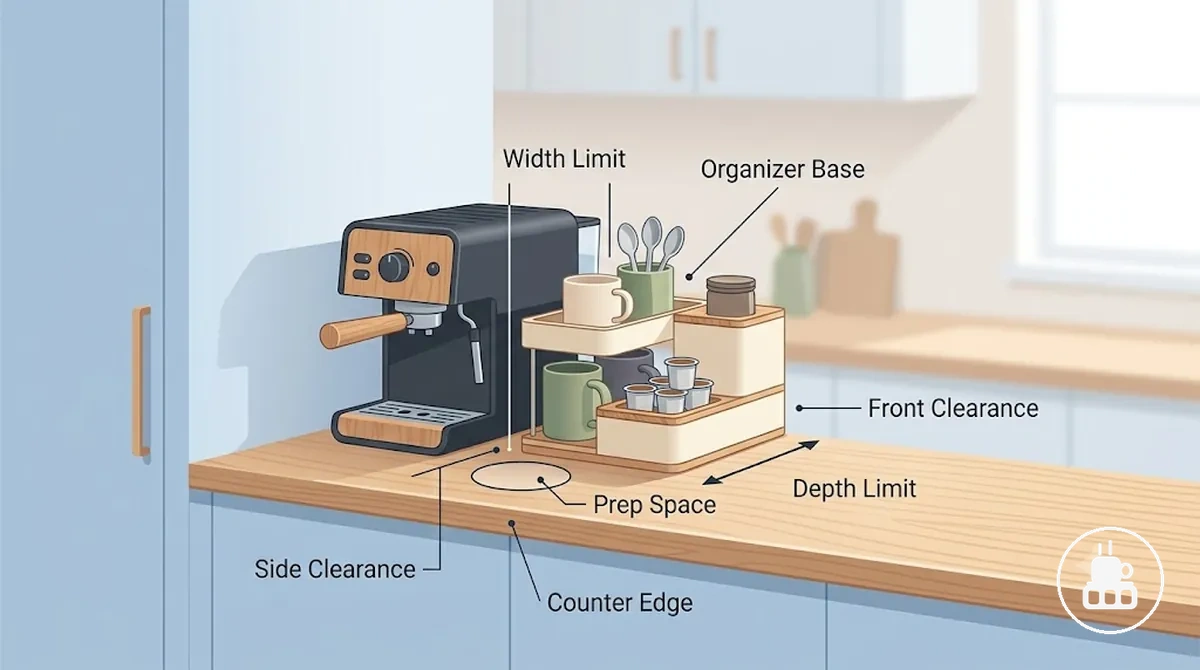
Extra compartments, tiers, and counter footprint
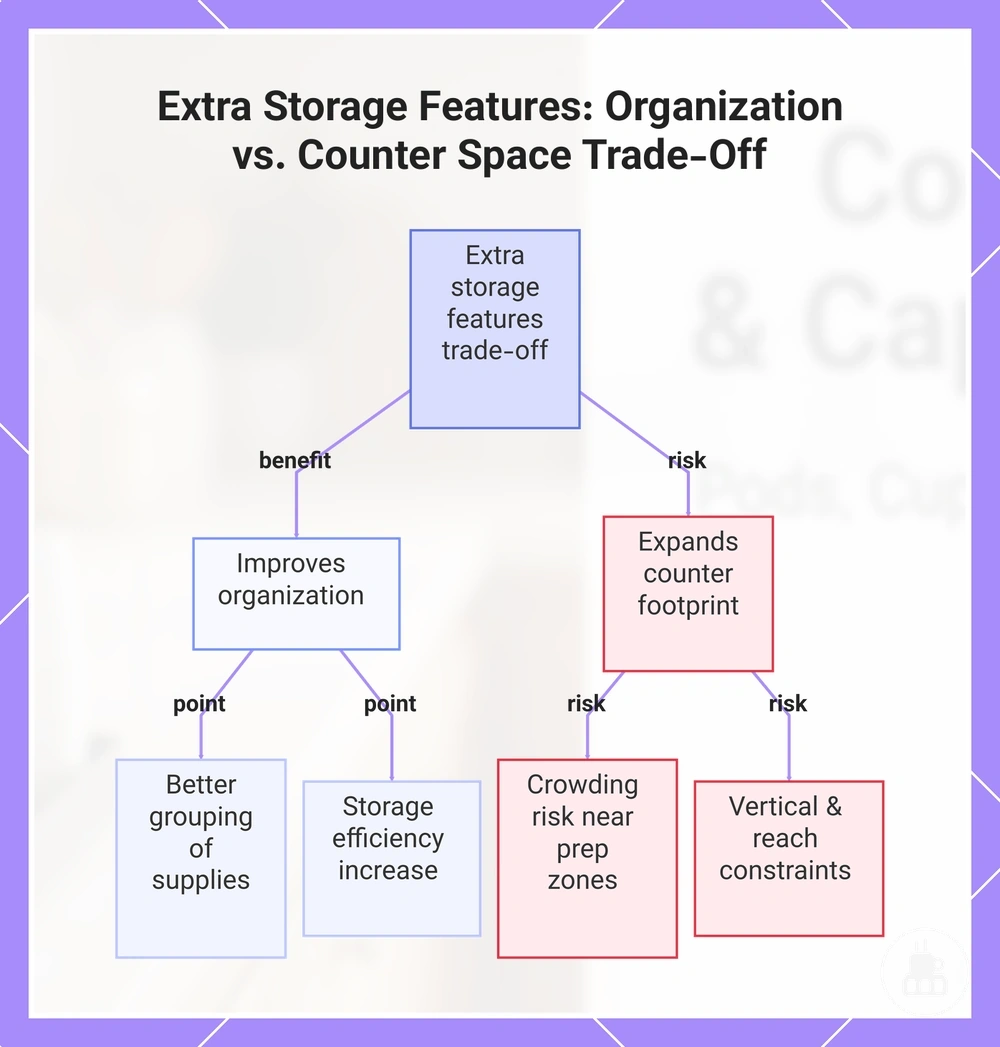
Extra compartments, tiers, and counter footprint refers to how additional storage divisions such as compartments, tiers, drawers, or side bins increase internal organization while also expanding occupied counter space and affecting usability in a coffee station organizer. :contentReference[oaicite:0]{index=0} These structural additions can improve separation of supplies but may also introduce crowding risk when counter depth, machine proximity, or reach angle becomes constrained in tighter layouts.
When extra compartments or layered tiers are introduced, storage efficiency may improve through better grouping of cups, lids, stirrers, and packets, but physical placement becomes more sensitive to available space. Increased vertical clearance requirements from tiers and forward reach adjustments from deeper drawers can affect how naturally items are accessed during routine use, especially when multiple supply types are stored together in compact work areas.
Footprint and capacity trade-off signals:
- Extra compartments: Increase internal storage divisions but can expand counter footprint and create crowding risk when placed near active prep zones.
- Tiers: Improve vertical storage layering but require additional vertical clearance and may affect reach angle near machines or walls.
- Drawer: Adds hidden storage capacity but needs pull space and can interfere with nearby equipment in narrow counter layouts.
- Side bin: Extends lateral storage for mixed supplies but increases counter width usage and may reduce available machine proximity space.
This chart shows how additional storage divisions like compartments, tiers, drawers, and side bins improve internal organization while also expanding counter footprint and creating space constraints.
Overfilled compartments and access loss
Overfilled compartments are a functional capacity problem in which storage exceeds accessible structure, causing access loss rather than usable capacity in a coffee station organizer. When stacked pods, compressed packets, blocked lids, crowded drawers, or hidden stirrers accumulate, visibility and reach are reduced and refill friction increases. This condition defines overfill as usable-capacity loss rather than increased storage.
When compartments become overfilled, items shift into blocked access positions and retrieval paths become constrained, increasing refill friction and clutter return after repeated use. Overfilled compartments can also appear as a layout issue, but the main effect is reduced usability across mixed storage types rather than true capacity gain.
Overfilled compartments and access loss can be diagnosed by checking visible storage conditions and how they affect usable capacity across daily use, including overfilled compartment problems in related layouts where space becomes restricted. :contentReference[oaicite:0]{index=0}
- Stacked pods: reduce retrieval speed and lower usable capacity by blocking direct access layers.
- Compressed packets: reduce visibility and increase access delay due to tight packing pressure.
- Blocked lids: restrict quick opening access and disrupt normal retrieval flow.
- Crowded drawers: limit internal movement and increase access friction during use.
- Hidden stirrers: reduce visibility and slow retrieval due to buried placement.
- Refill friction and clutter return: create recurring overfill cycles that reduce sustained usable capacity.
Matching capacity to daily coffee station demand
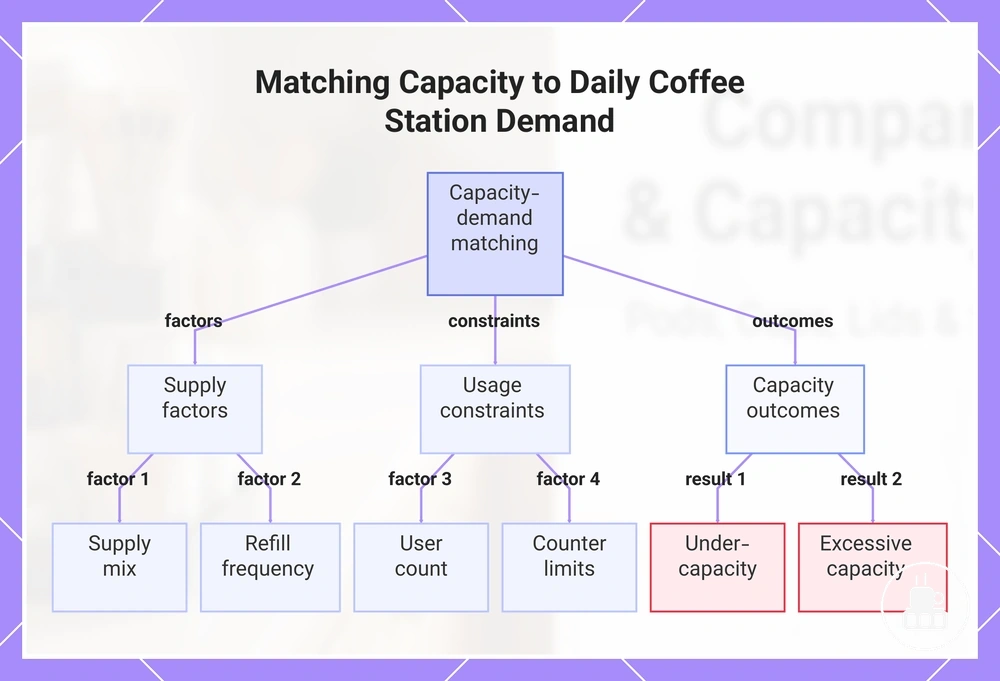
Matching capacity to daily coffee station demand depends on how supply mix, refill frequency, user count, and counter limits shape practical storage needs. It is used as a selection method to align usable volume with real daily usage patterns rather than theoretical storage size. The goal is to interpret demand as a capacity filter for organizing coffee supplies.
In daily use environments, capacity requirements shift based on how pods, cups, lids, packets, and condiments are consumed and restocked. Higher supply turnover or shared use increases the importance of balancing storage structure with access speed and available space.
- Supply mix: Combination of pods, cups, lids, packets, and condiments in daily use
- Refill frequency: Rate at which supplies are restocked during routine operation
- User count: Number of people using the coffee station
- Counter limits: Available space and placement constraints on the station
- Backup quantity: Extra stock stored for continuous availability
Capacity evaluation improves when demand signals are translated into structured selection criteria. Comparing usable volume against counter limits helps identify whether a setup may support daily turnover or create inefficiency under real conditions. A fit checklist for storage capacity helps structure this evaluation by linking physical constraints with supply behavior.
Capacity outcomes can generally be understood through three conditions. Under-capacity may lead to frequent refill interruptions due to insufficient space for supply mix. Right-sized capacity aligns usable volume with daily coffee station demand and maintains stable turnover. Excessive capacity may introduce overbuying risk when counter limits are exceeded or unused storage space accumulates.
In practical scenarios, smaller stations often prioritize compact organization for low user count environments, while shared stations require more structured allocation of space to manage higher refill frequency and mixed supply usage. The relationship between demand and usable volume becomes more critical as usage intensity increases across multiple users.
Here are product examples that may make comparison easier. Before buying, always review the compatibility criteria, essential features, and product details.
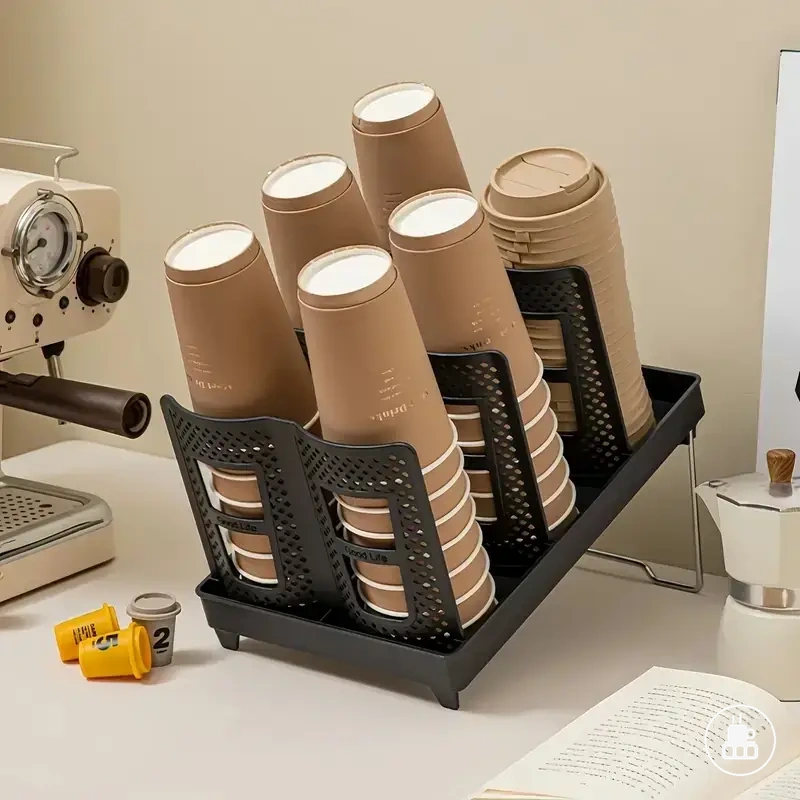
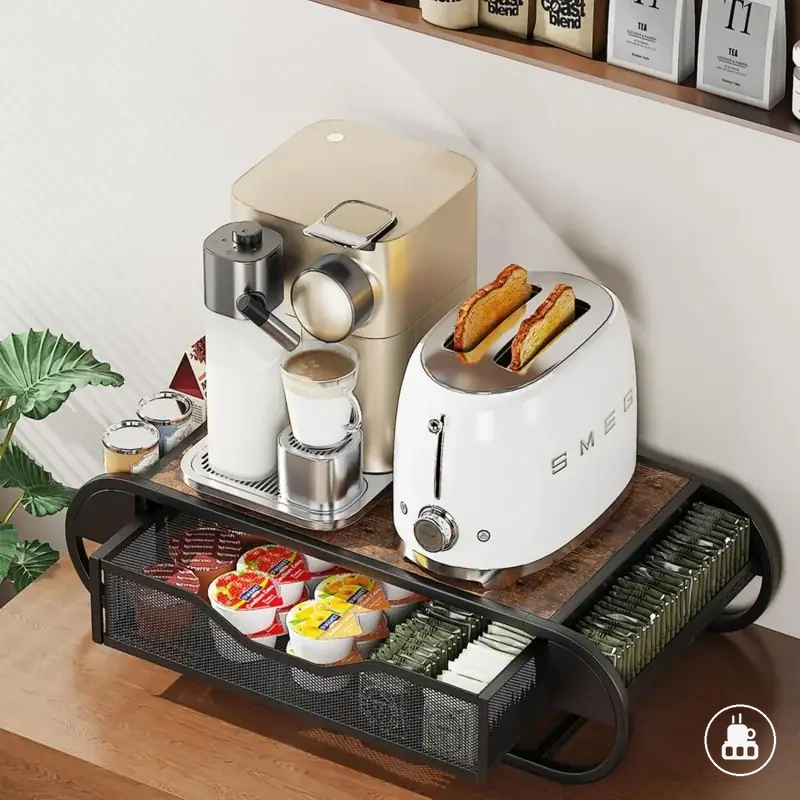
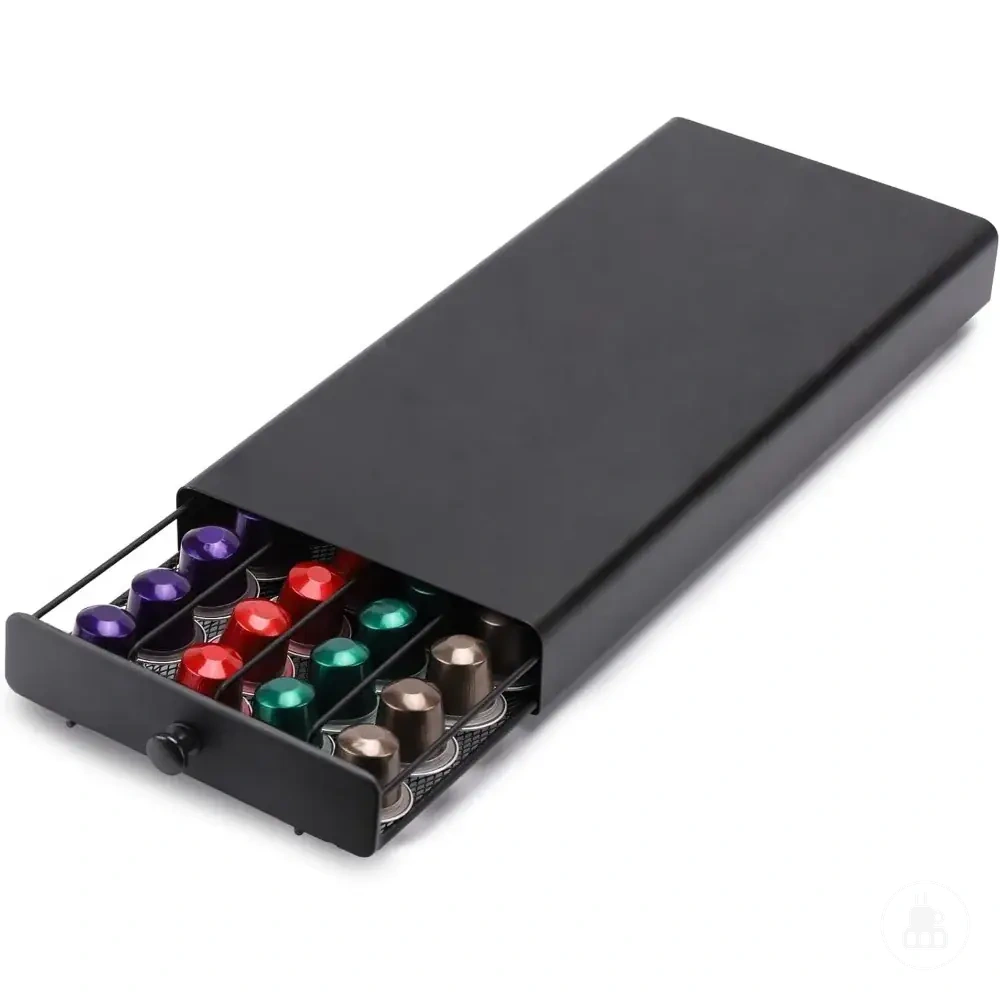
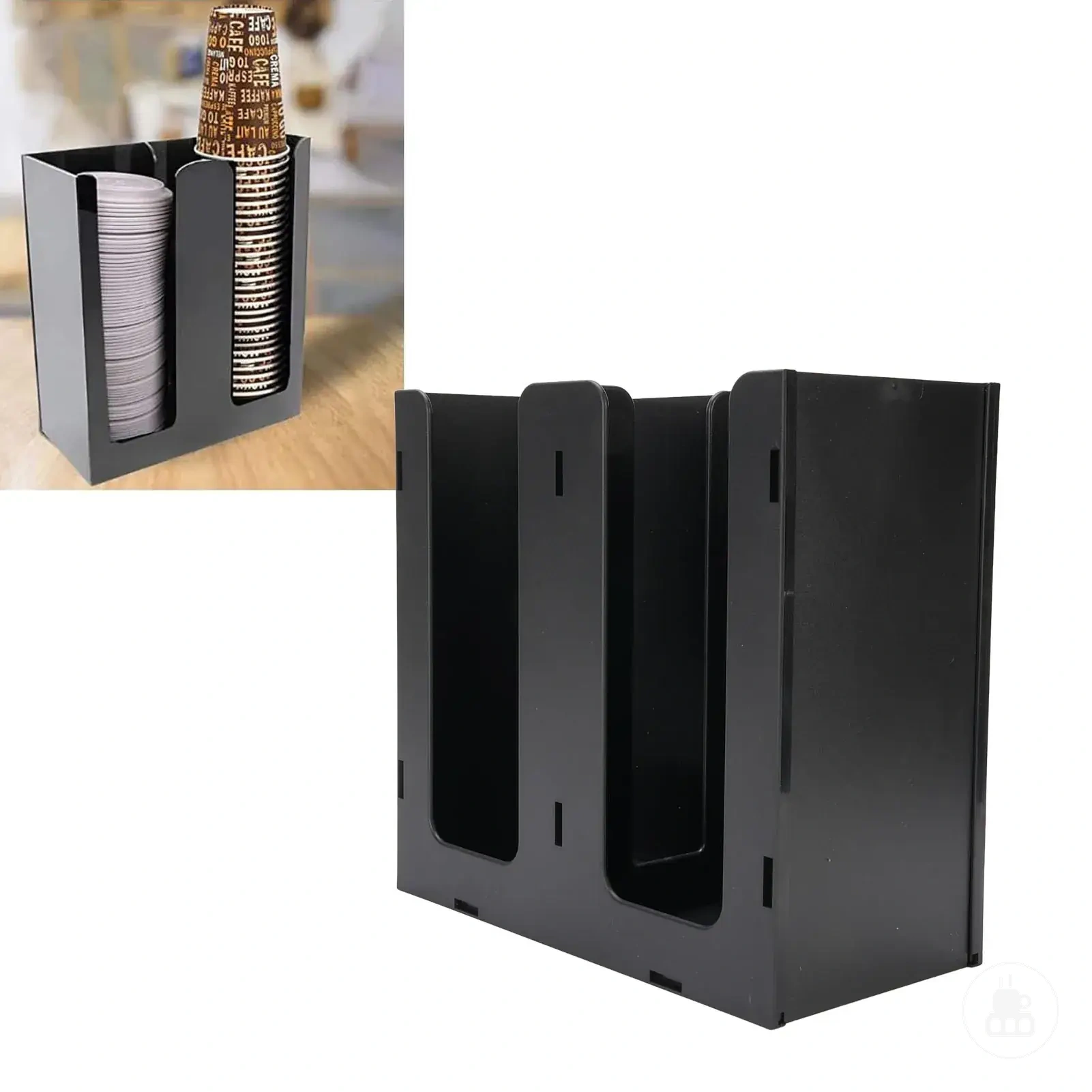
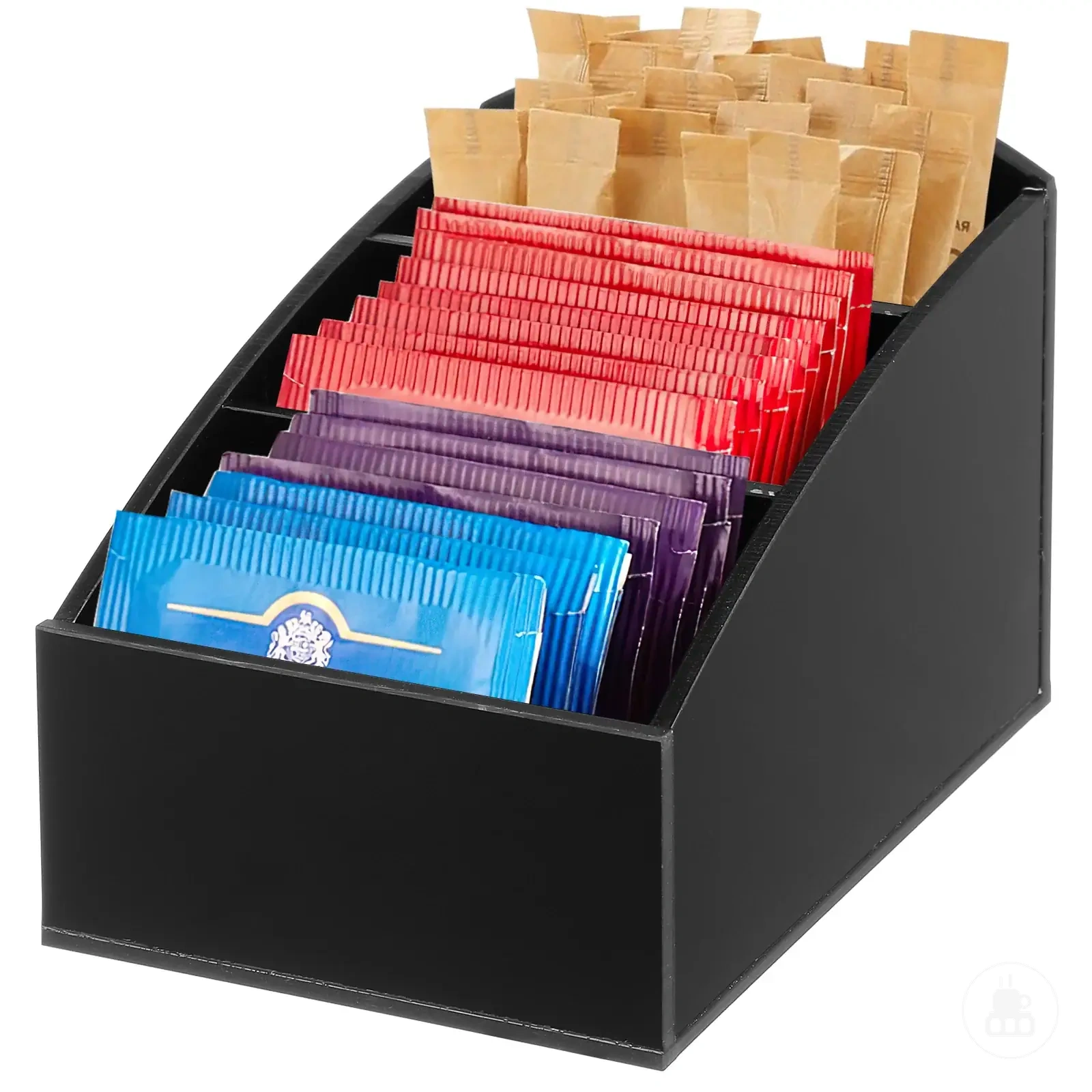
This chart shows the key demand factors and physical constraints that influence capacity matching, along with the resulting capacity outcomes of under-capacity and excessive capacity.
Visibility, reach, and refill access inside compartments
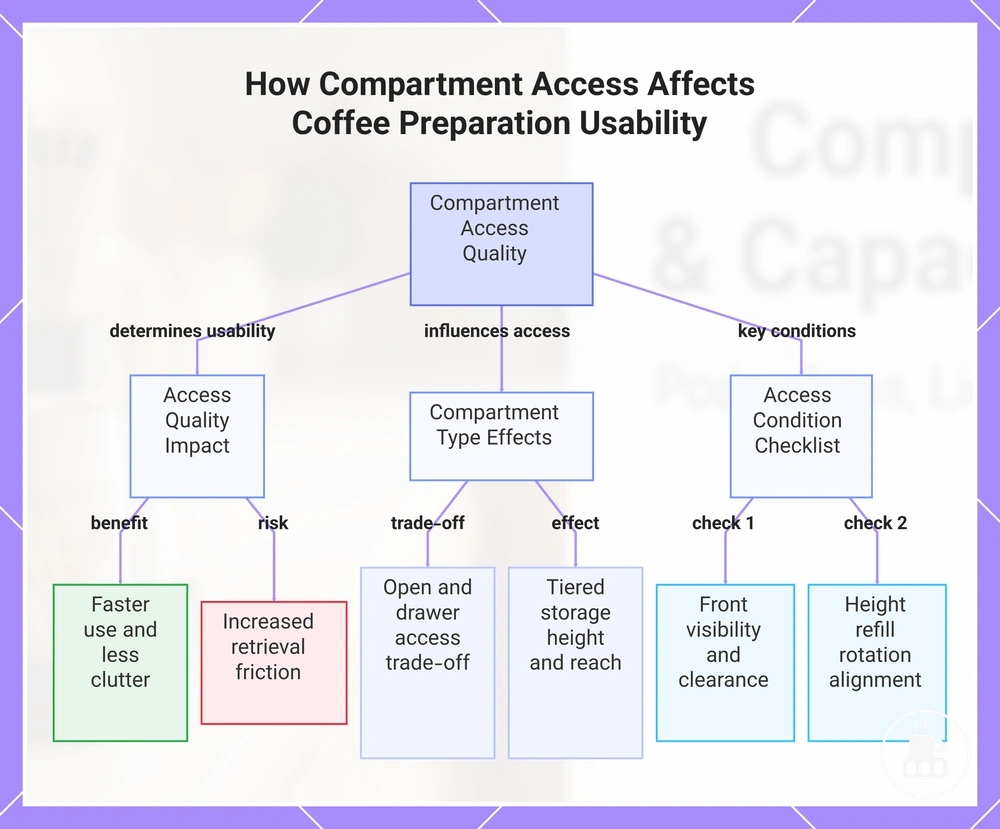
Visibility, reach, and refill access determine whether stored capacity remains usable during daily coffee preparation. When access quality is strong, front visibility and hand reach help maintain faster use and lower clutter risk. When access is restricted, even adequate compartment space may create friction during routine retrieval and restocking.
Different compartment types influence access quality during daily coffee preparation based on how items are positioned and retrieved. Front visibility in open compartments typically supports faster identification and reduces retrieval delay, while drawers depend on drawer pull clearance that can increase friction when space is tight. Tiered storage changes tier height and hand reach requirements, which can improve organization but may slow access depending on placement. Refill openings and supply rotation also influence how smoothly items move through regular use, especially when multiple users interact with the same setup.
Blocked or reduced access lowers the practical usefulness of stored capacity because visibility, reach, and refill access are directly tied to usability. This effect becomes more noticeable when supply rotation does not match daily coffee preparation patterns or when compartment design limits natural hand reach. A setup workflow for stored supplies can help align compartment behavior with access needs when adjustments are required. In most cases, better access conditions help maintain consistent usability rather than increasing total storage alone.
Access condition checklist:
- Front visibility allows quick identification of stored supplies
- Drawer pull clearance supports smooth access without obstruction
- Tier height matches natural hand reach during daily use
- Refill openings allow efficient restocking during rotation
- Supply rotation remains aligned with daily coffee preparation needs
This chart shows how visibility, reach, and refill access determine whether stored capacity remains usable, including compartment type effects and a checklist of access conditions.