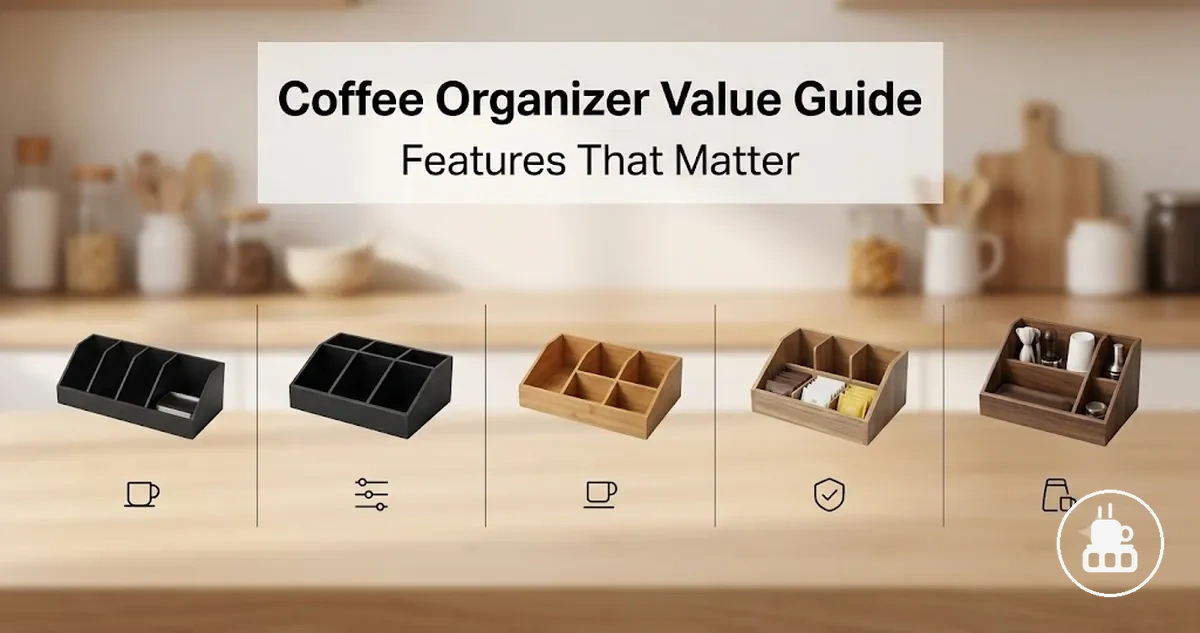
Coffee Station Organizer Price and Value Guide
A coffee station organizer price and value guide refers to the way cost is evaluated against how well a coffee station organizer supports daily counter use, storage efficiency, and long-term usability across different setups of coffee station organizers. Value is not defined by price alone but by how the organizer performs in real conditions such as supply volume, counter space, cleaning effort, and overall daily fit.
Price variation in coffee station organizers is typically influenced by material choice, storage capacity, compartment design, finish quality, and structural durability. Options often vary across budget, mid-range, and premium tiers, with many designs clustering around balanced functionality where cost and practical usability are aligned rather than focused only on either minimal or high-end features.
From a decision perspective, value can be understood through an Entity-Attribute-Value logic where the organizer (entity) connects to attributes such as material, compartments, and footprint, while value outcomes depend on how these attributes match the user’s counter setup, daily supply load, and cleaning tolerance. This means two organizers with similar prices can perform differently if their storage layout or maintenance needs differ in practice.
Price and value should therefore be interpreted as a contextual relationship rather than a fixed rating, where the same organizer may be considered high or low value depending on how well its features align with actual usage conditions and space constraints.
Coffee Station Organizer Price Ranges and What Changes Between Them
Coffee station organizer price ranges reflect differences in material, footprint, compartment design, finish quality, and build construction rather than price alone, meaning value changes based on how these attributes support daily use and storage needs.
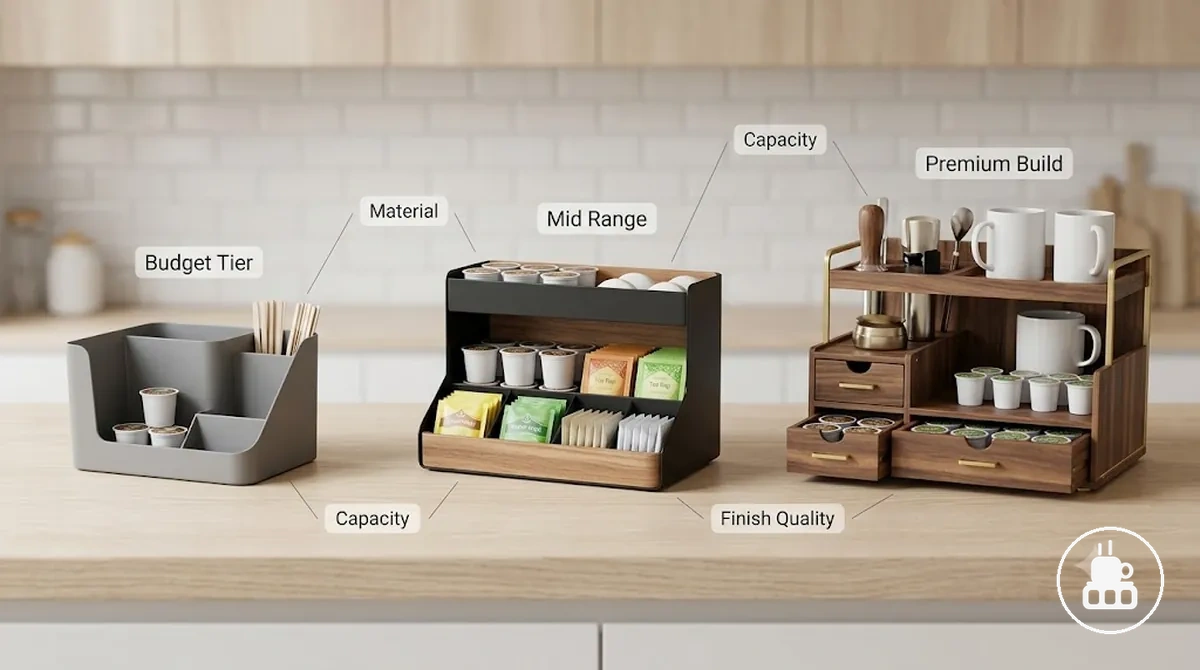
Across common market groupings, organizers are typically understood in budget, mid-range, and higher-end categories, where each level adjusts structural strength, storage flexibility, and surface finish instead of only changing appearance. Budget options focus on basic storage needs, while higher tiers introduce more durable materials and more structured compartment layouts.
Price differences are also influenced by organizer styles that affect price, since drawer-based, tiered, tray-style, or modular layouts can require different levels of construction complexity and material usage. These structural choices often have a stronger impact on value than visual design alone.
A simpler organizer can still be sufficient when daily supply needs are limited, such as using only a few pods, cups, and condiments, where compact layouts and basic compartments provide enough structure without additional features.
The table below summarizes how price ranges generally relate to key structural differences without representing fixed pricing or product listings.
| Price Range | Material & Build | Capacity & Compartments | Typical Use Context |
|---|---|---|---|
| Budget | Lightweight plastic or basic wood | Simple or limited compartments | Light daily use with minimal supplies |
| Mid-range | Reinforced wood, bamboo, or acrylic blends | Balanced compartment layout with moderate capacity | Regular home or shared kitchen setups |
| Higher-end | Heavier materials with refined finishes | Structured multi-zone storage with higher capacity | Frequent use or more complex coffee station setups |
Coffee Station Organizer Material Value Trade-Offs
Coffee station organizer material value trade-offs refer to how bamboo, wood, acrylic, plastic, and metal influence durability, cleaning effort, visual fit, and overall perceived value depending on how the organizer is used in a daily coffee setup.
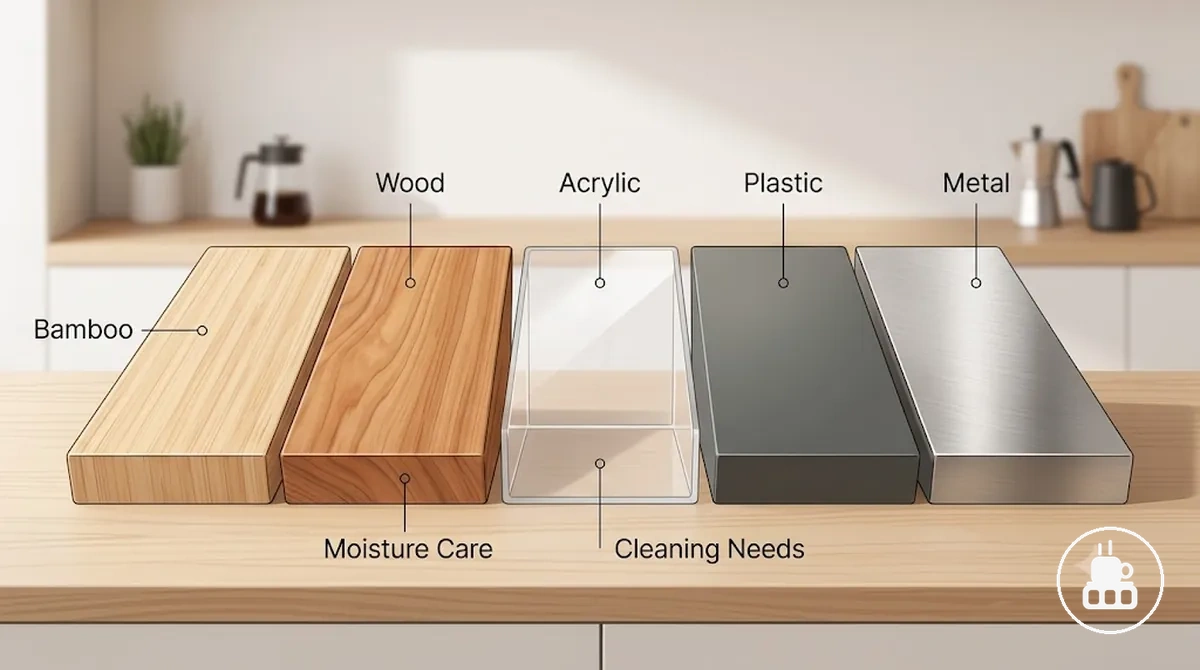
Material choice changes value because each surface type behaves differently under moisture exposure, handling frequency, and cleaning routines, which directly affects how long the organizer stays functional and visually consistent in a coffee station environment.
Bamboo and wood often support a warmer visual fit and stable structure but may require more care in humid or spill-prone conditions, while acrylic and plastic tend to offer easier cleaning and lighter handling with varying levels of scratch resistance. Metal options usually provide higher structural strength and stability, though they can introduce different surface temperature and corrosion considerations depending on finish and environment.
| Material | Surface Behavior | Durability Expectation | Cleaning Effort | Visual Fit | Use-Case Outcome |
|---|---|---|---|---|---|
| Bamboo | Natural porous surface | Moderate with care needed | Low to moderate | Warm and natural | Works well in dry, styled setups |
| Wood | Solid grain surface | Moderate depending on finish | Moderate | Classic and premium feel | Suitable for structured home stations |
| Acrylic | Smooth and transparent | Moderate with scratch sensitivity | Low | Modern and minimal | Good for easy-clean environments |
| Plastic | Light synthetic surface | Variable depending on density | Very low | Functional and simple | Practical for basic daily use |
| Metal | Hard sealed surface | High structural stability | Low to moderate | Industrial and durable look | Suitable for heavy-use stations |
Bamboo and Wood Organizer Value
Bamboo and wood organizer value refers to how finish quality, moisture exposure, and daily cleaning habits influence the practicality and visual consistency of bamboo or wood coffee station organizers in everyday use.
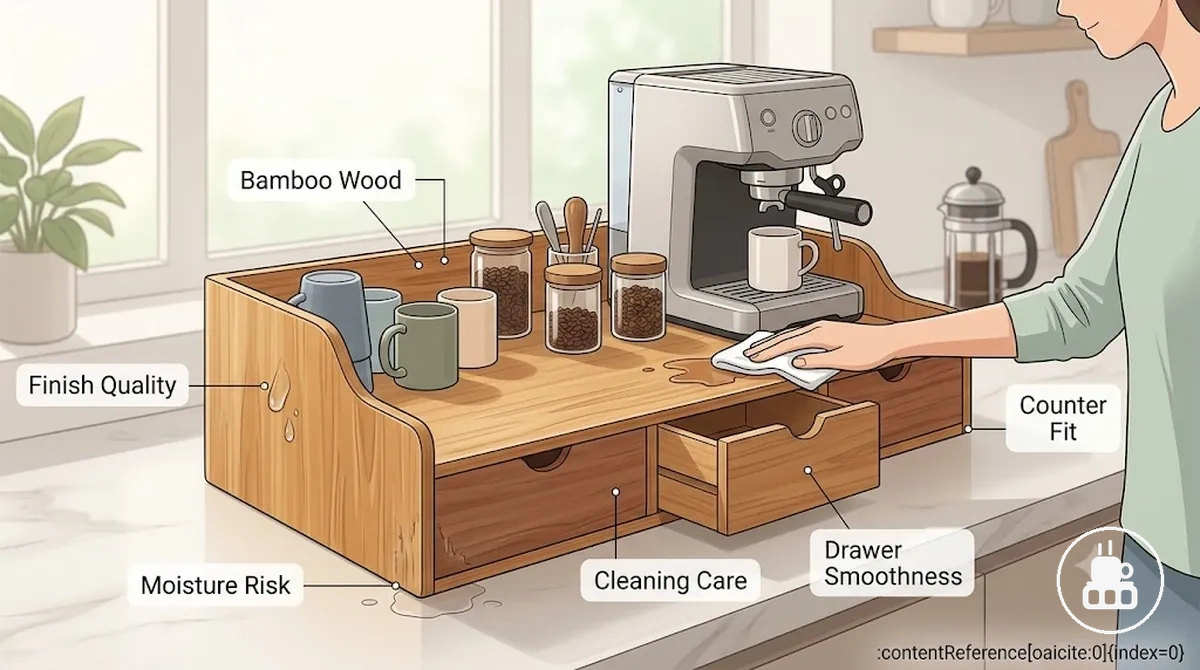
Value in bamboo and wood organizers depends largely on how well the surface is sealed and maintained, since coatings and finishes can affect stain resistance, moisture response, and long-term surface appearance in a kitchen environment.
In many setups, smoother finishes can support easier cleaning and more consistent drawer movement, while less protected surfaces may show marks or absorb moisture more quickly depending on usage intensity and spill exposure. These differences directly influence how stable the organizer feels over time rather than its initial appearance alone.
For example, a bamboo organizer placed on a dry coffee counter with light daily use can maintain its appearance with minimal maintenance, while the same material in a high-spill or high-humidity setup may require more frequent care to preserve its surface condition and usability.
Acrylic and Plastic Organizer Value
Acrylic and plastic organizer value refers to how visibility, thickness, modular design, and surface resistance influence the practicality and cost-benefit of clear or opaque storage organizers used in a coffee station setup.
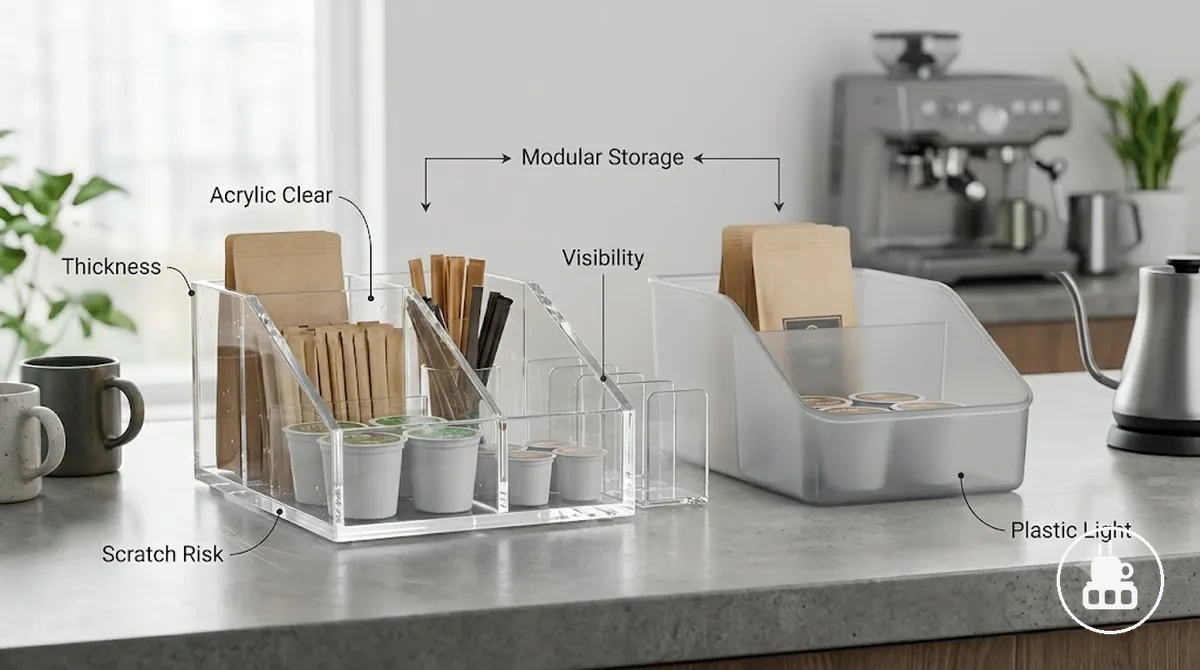
Acrylic and plastic organizers depend on different structural properties, where acrylic often provides higher clarity and a more rigid feel, while plastic variations typically prioritize lighter construction and broader functional use. Both can support daily coffee station storage, but their value shifts based on thickness, load handling, and how frequently items are accessed or rearranged.
Visibility is a key factor in acrylic units, as clear compartments can make pods, cups, or packets easier to track, which may reduce restocking delays in active setups. Plastic organizers may be less transparent but often offer flexible compartment designs that support varied storage needs such as lids, stirrers, or mixed supplies.
In some home-counter setups, combining visibility with modular separation can improve workflow efficiency, especially when quick identification of supplies matters more than decorative finish or material uniformity. These outcomes vary depending on usage intensity and how often the organizer is reorganized or cleaned.
Metal Organizer Value
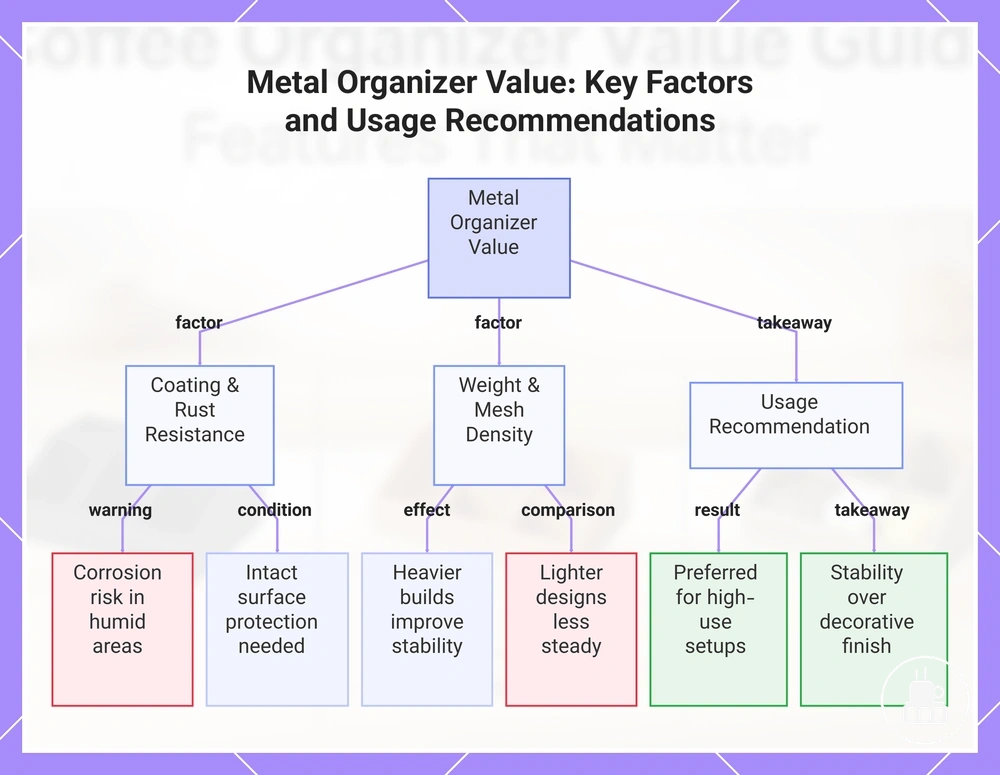
Metal organizer value refers to how coating quality, mesh density, weight, and rust resistance influence the practical durability and everyday usability of metal coffee station organizers.
Metal organizers depend on structural build and surface protection, where frame strength and coating quality can support stable handling and repeated use, while performance may still vary based on moisture exposure and overall finish condition.
Rust resistance is closely tied to coating integrity, since exposed or worn surfaces may gradually show corrosion in humid or spill-prone environments. Heavier builds can improve stability on busy counters, while lighter designs may feel less steady depending on base structure and load distribution.
- Durability cue: coated metal frames can support repeated shared use when surface protection remains intact
- Moisture caution: prolonged exposure to water or steam may increase wear risk in unsealed or damaged coatings
- Stability factor: weight and mesh density influence balance during frequent handling on active counters
In high-use coffee station setups, metal organizers may be preferred when consistent stability and repeated handling matter more than decorative finish, especially where frequent access and shared usage require dependable structural support.
This chart illustrates how coating quality, weight, and mesh density affect metal organizer durability and stability, and when they are recommended for high-use setups.
Storage Features That Can Justify a Higher Price
Storage features justify a higher price when they improve access to supplies, reduce counter clutter, and match everyday coffee routines through a clear capacity-to-use balance. In this context, value is determined by whether each added feature meaningfully supports storage efficiency rather than simply increasing structural complexity.
Drawers, dividers, removable compartments, tiered layouts, cup and lid zones, pod storage, and condiment sections each function as storage attributes within an Entity-Attribute-Value structure, where the organizer is evaluated by how well these attributes reduce search time and maintain order during daily use. Their impact depends on how closely they align with actual supply variety and frequency of access.
Evaluation of whether a storage feature adds real value depends on supply needs, counter space, and routine usage patterns, and it should be considered alongside capacity features worth comparing when judging overall usefulness. Features that exceed daily requirements may not improve function, while well-matched features can reduce clutter and improve access efficiency.
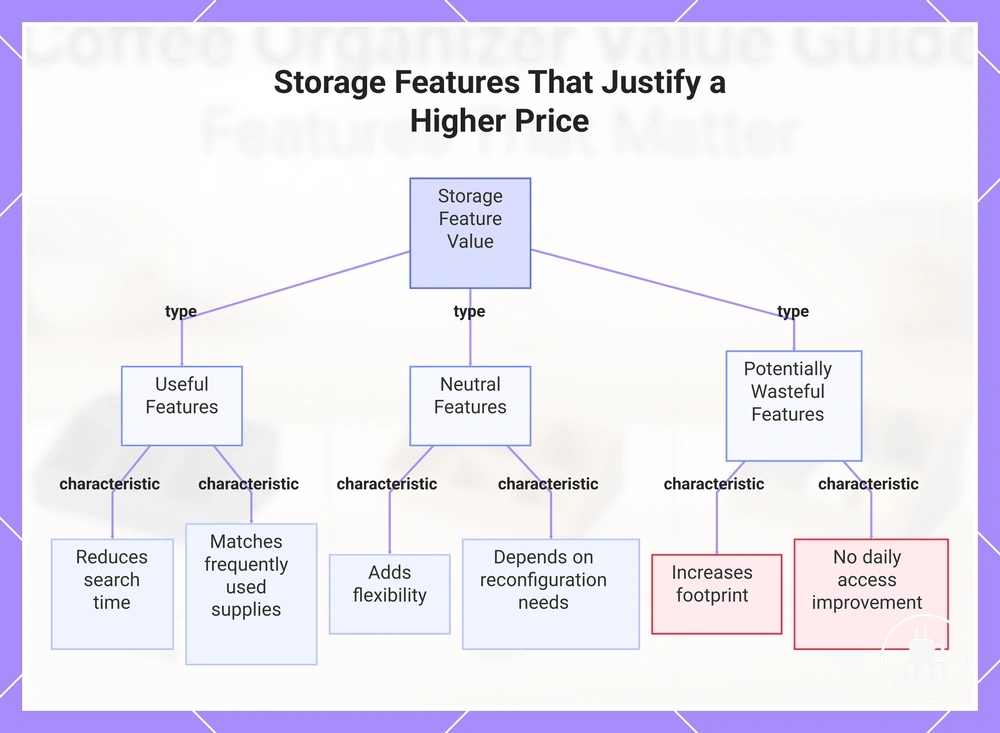
This classification helps separate storage features into practical categories:
- Useful features: drawers, dividers, and pod zones that match frequently used supplies and reduce search time
- Neutral features: tiering or removable parts that add flexibility but depend on actual reconfiguration needs
- Potentially wasteful features: oversized compartments or unused sections that increase footprint without improving daily access
This framework helps identify when a storage feature contributes to practical value versus when it mainly increases structure without improving everyday usability.
This chart classifies storage features into useful, neutral, and potentially wasteful categories based on their impact on daily access and clutter reduction.
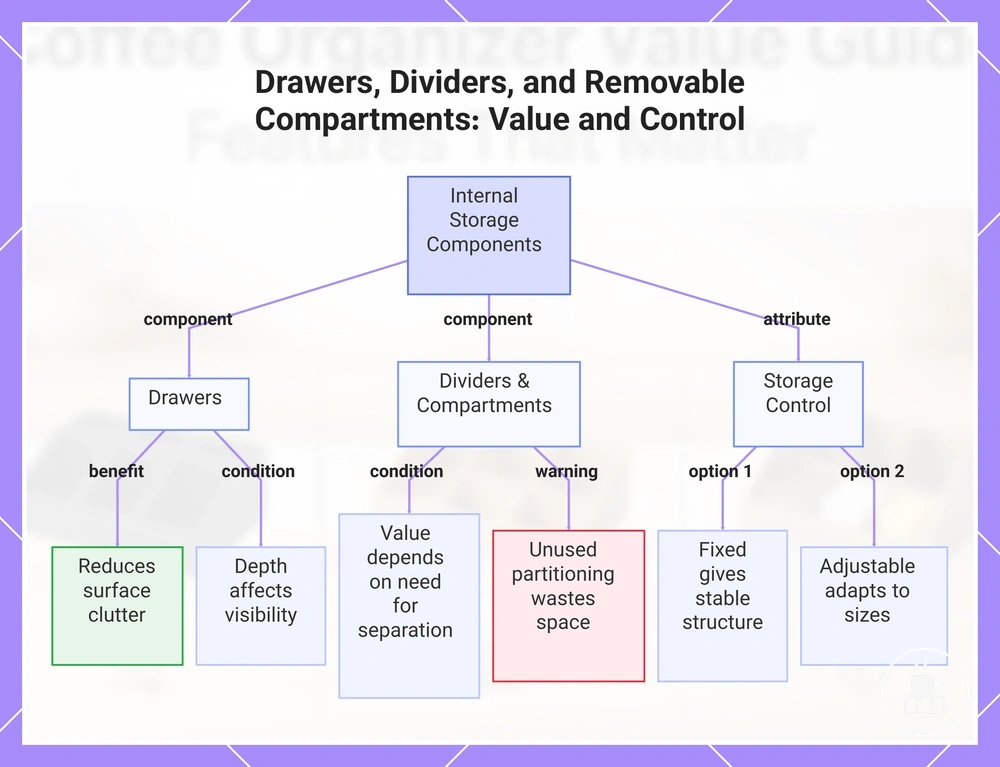
Drawers, Dividers, and Removable Compartments
Drawers, dividers, and removable compartments refer to internal storage components that structure coffee station supplies by separating items based on access, visibility, and grouping needs.
These components add value only when they improve how quickly items can be reached, how clearly they are separated, and how easily the storage space can be cleaned based on what is actually stored.
Drawers provide pull-out access that can reduce surface clutter, but their usefulness depends on depth and whether items remain visible during daily use. Dividers help keep small supplies separated, while removable compartments allow layout changes when the stored items shift over time.
Fixed vs adjustable storage control:
- Fixed storage: consistent structure that keeps items stable but limits reconfiguration when supply types change
- Adjustable storage: flexible layout using removable or repositionable parts that can adapt to different item sizes and quantities
A shallow drawer can solve clutter by grouping frequently used packets in one accessible place, while a deep drawer may hide small items too far back, making them less visible and slower to retrieve during routine use.
The value of dividers and removable compartments depends on whether the stored items genuinely need separation or frequent rearrangement, since unused partitioning can reduce usable space without improving daily efficiency.
This chart shows how drawers, dividers, and removable compartments add value based on access, visibility, and storage control, and contrasts fixed vs adjustable configurations.
Large Capacity Without Wasted Counter Space
Large capacity in a coffee station organizer depends on how much usable storage it provides relative to its counter footprint, not on size alone. Value increases when capacity supports real supply needs without reducing access efficiency or creating unused internal space.
High-capacity designs can improve storage balance when they distribute cups, pods, lids, and condiments across vertical or segmented zones. However, capacity only remains useful when items stay reachable and do not compete for limited access paths within the same layout.
The following checklist helps evaluate whether capacity is being used efficiently rather than wasted:
- Footprint: space used on the counter compared to usable storage gain
- Height: whether vertical space improves storage without blocking access
- Compartment count: alignment between storage divisions and actual supply variety
- Restocking frequency: whether capacity reduces or adds unnecessary refilling effort
- Supply variety: compatibility with cups, pods, lids, and condiments without overlap
- Access path: ease of reaching items without shifting other stored components
Capacity evaluation should prioritise usable storage outcomes over measurement size, since larger structures only add value when they reduce clutter while maintaining efficient daily access across the coffee station layout.
:contentReference[oaicite:0]{index=0}
Cleaning Burden and Durability Over Time
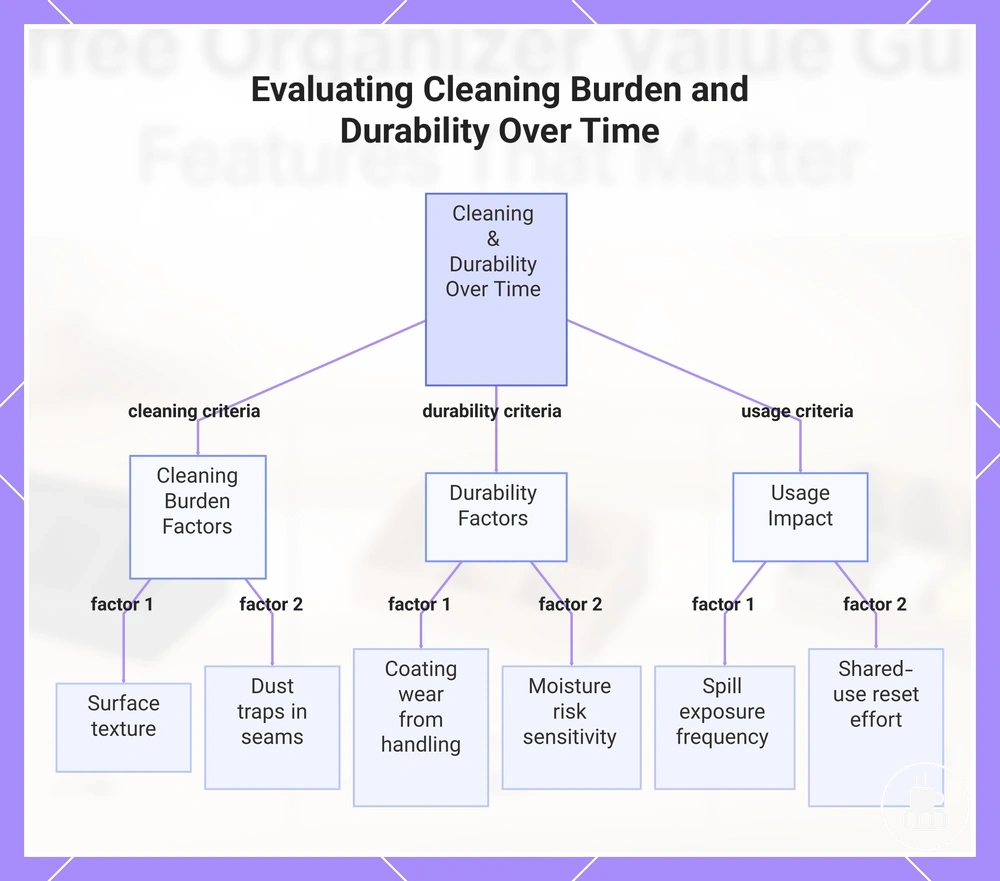
Cleaning Burden and Durability Over Time refers to evaluating long-term value by connecting how much maintenance a coffee station organizer requires with how well its structure and surfaces withstand repeated daily use, affecting the practical cost of ownership over time.
The following checklist helps evaluate how cleaning effort and durability accumulate through repeated use:
- Removable parts: whether components can be separated for easier cleaning or create extra maintenance steps
- Surface texture: how smooth or complex surfaces influence wiping and residue buildup
- Spill exposure: how often liquid contact increases cleaning frequency needs
- Dust traps: whether design gaps collect debris during daily use
- Coating wear: how protective layers hold up under repeated handling
- Moisture risk: sensitivity to humidity or wet cleaning conditions over time
- Shared-use handling: how multiple users affect cleanliness consistency and reset effort
Some designs may appear valuable at purchase due to structured compartments or enclosed layouts, but they can become less practical if they are difficult to wipe, dry, or reset during routine use. This assessment aligns with maintenance and cleaning burden when evaluating long-term upkeep impact.
Features such as deep recesses or tightly segmented zones may increase organisation initially but can also add recurring cleaning effort depending on how the station is used.
:contentReference[oaicite:0]{index=0}
This chart categorizes the key evaluation criteria for cleaning burden and durability over time, helping assess long-term practicality of coffee station organizers.
Budget vs Higher-Priced Coffee Station Organizer Decisions
Budget organizer and higher-priced organizer decisions depend on use frequency, supply quantity, durability expectations, and cleaning tolerance because these factors determine how much practical value a price difference actually adds in daily coffee station setups.
The comparison between budget and higher-priced organizers focuses on how storage fit, maintenance effort, and feature depth change under different usage conditions rather than price alone. The same price level can perform differently depending on whether the setup is minimal, shared, or frequently restocked.
| Decision Factor | Budget Organizer | Higher-Priced Organizer |
|---|---|---|
| Frequency of use | Suitable for light or occasional use | Better aligned with frequent daily access |
| Supply quantity | Works for limited items and simple setups | Supports larger or more varied supply sets |
| Shared vs personal use | Often sufficient for individual use | More stable for shared or multi-user setups |
| Durability expectations | Basic structural support under normal handling | Typically designed for more repeated handling stress |
| Cleaning tolerance | Simple surfaces with fewer components to maintain | May include more structure that requires regular upkeep |
| Feature value | Focus on essential storage only | May include modular or segmented design features |
Decision clarity improves when the choice is aligned with real use conditions rather than price level alone, and this is further explained in how to choose a coffee station organizer which helps connect setup needs with practical selection criteria.
In practice, a higher-priced organizer can be reasonable when frequent use, multiple users, or larger supply variety requires more structured storage, while a budget option may remain sufficient when the setup is minimal, less frequently accessed, and easier to maintain without additional features.
When an Affordable Organizer Is Enough
An affordable organizer is enough when it fits the counter space, stores the daily coffee supplies, and does not create extra cleaning effort or access friction in regular use.
This condition depends on simple usage needs where storage demand, counter size, and handling frequency stay limited and predictable. In these cases, lower-cost organizers can meet functional requirements without reducing day-to-day usability.
An affordable organizer is typically sufficient when:
- Simple supply set: only basic items such as pods, cups, or condiments need to be stored
- Light usage: the coffee station is not accessed heavily throughout the day
- Compact layout: limited counter space requires a small footprint solution
- Basic structure: no advanced compartment system or modular adjustment is required
- Simple materials: standard finishes are acceptable for the environment
- Easy cleaning: surfaces can be wiped quickly without disassembly
An affordable option may become less effective when it is too small for actual supply needs, unstable under regular handling, or difficult to clean due to tight compartments or poor surface access, which can increase daily friction despite the lower initial cost. :contentReference[oaicite:0]{index=0}
When a Higher Price Creates Better Value
A higher price creates better value when the added features reduce daily friction, improve durability, or better support heavier use in a coffee station setup.
This condition depends on whether the upgrade solves real usage needs rather than adding unused structural complexity. Value increases only when features align with actual demand such as frequent access, shared use, or larger supply variety.
A higher-priced organizer is typically justified when:
- Sturdier materials: support repeated handling and reduce instability over time
- Smoother drawers or access systems: improve speed and reduce effort during frequent use
- Removable dividers: allow flexible layout adjustment based on changing supplies
- Larger usable capacity: better fits higher volume or more varied items
- Better surface finish: helps maintain appearance under regular wear conditions
- Easier cleaning design: reduces buildup and simplifies routine maintenance
Higher price does not automatically indicate better value when these features are not needed in the setup. In such cases, added structure may remain unused and provide limited practical benefit.
In shared coffee areas or high-use counters, higher-priced organizers can create better value because durability and faster reset cycles reduce daily interruptions when multiple users rely on the same station.
:contentReference[oaicite:0]{index=0}
Coffee Station Organizer Value Checks Before Buying
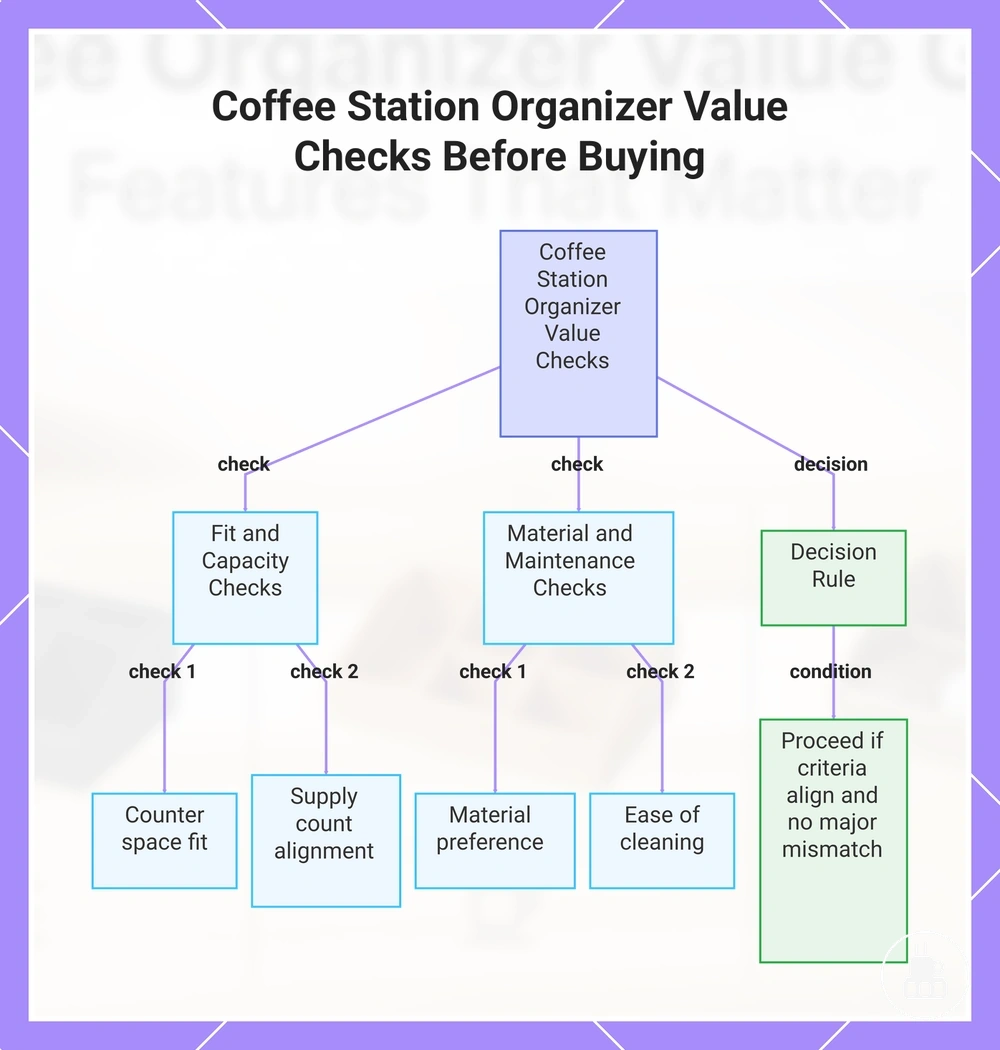
Coffee Station Organizer value checks before buying depend on confirming whether price is justified by fit, material quality, capacity, cleanability, and expected use, since these factors determine whether the organizer matches real daily requirements.
A final value check works as a quick decision filter before any partner-offer click by organising key criteria into a structured review of real usage conditions.
- Counter space: verifies whether the organizer fits without disrupting workflow
- Supply count: confirms capacity alignment with daily items
- Drawer need: checks whether separation features are actually required
- Material preference: evaluates suitability for expected usage conditions
- Cleanability: assesses how easily the structure can be maintained
- Durability signals: checks whether build strength matches usage intensity
- Upgrade reasons: verifies whether added features solve real problems
These value checks follow an EAV logic where the organizer (entity) is evaluated through attributes such as capacity, material, structure, and cleaning effort, while the predicates focus on whether these attributes verify fit, reduce friction, or remain unnecessary for the intended setup conditions.
The safest decision rule is to proceed only when most criteria align with actual usage needs and no major mismatch appears in fit, capacity, or cleaning effort, since value remains conditional when these checks are incomplete. :contentReference[oaicite:0]{index=0}
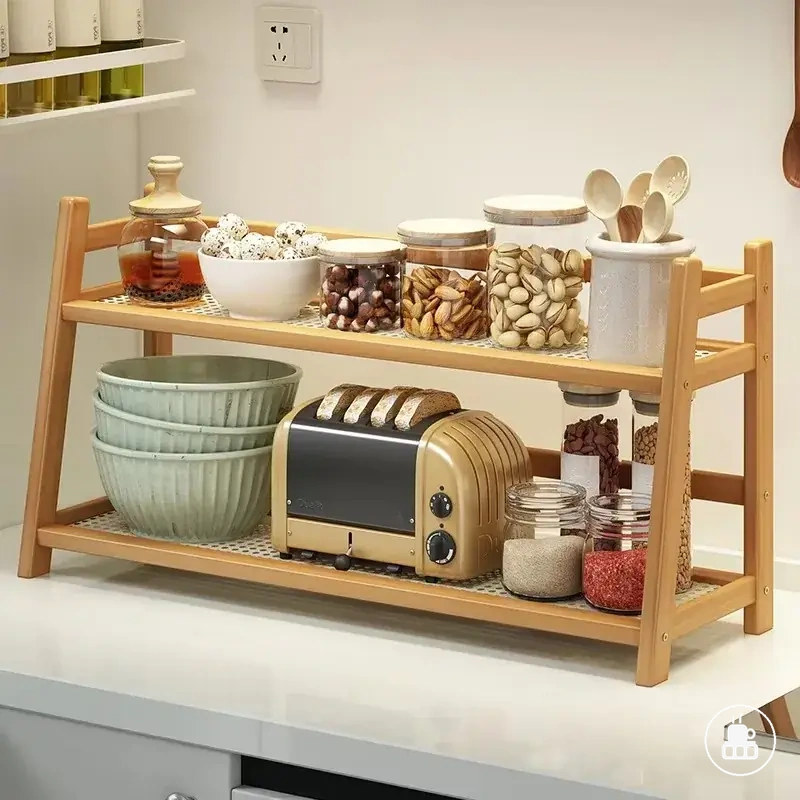
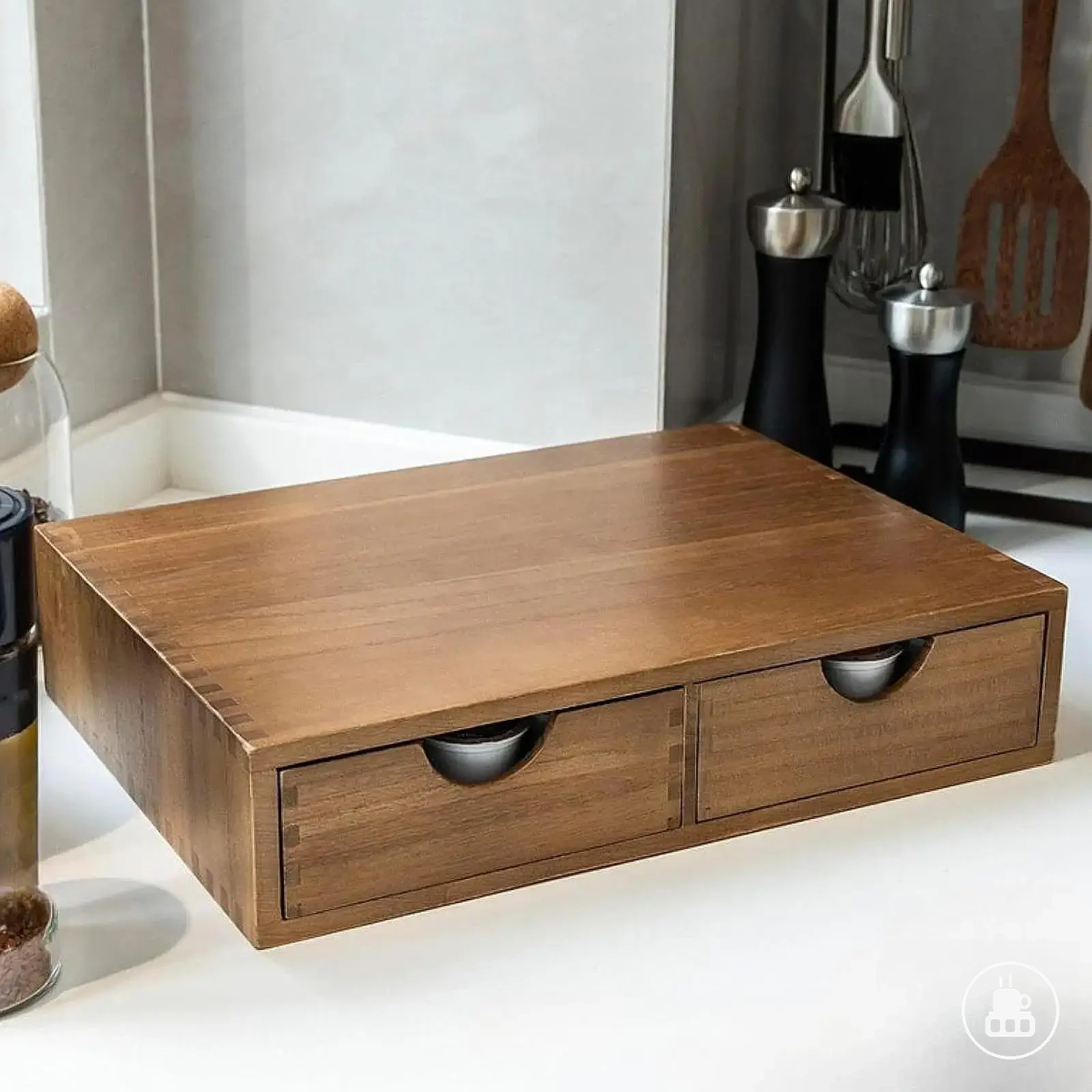
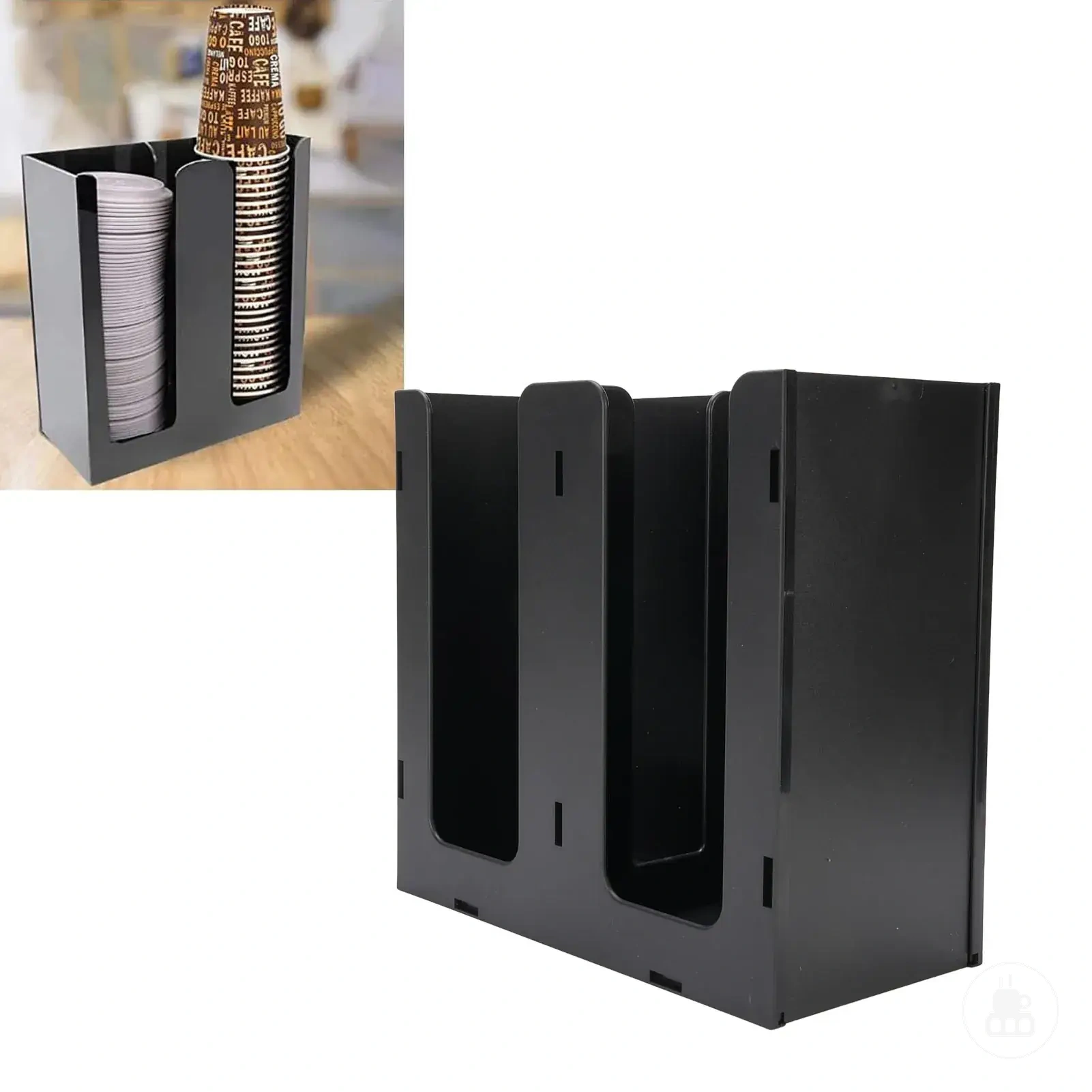
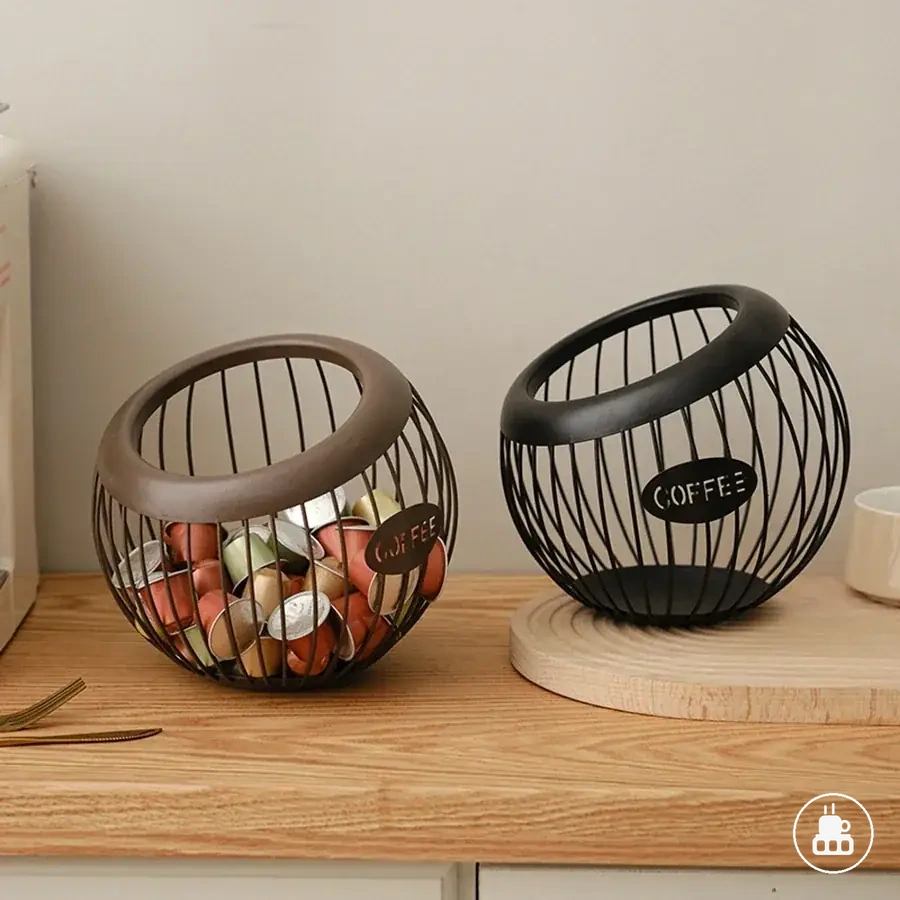
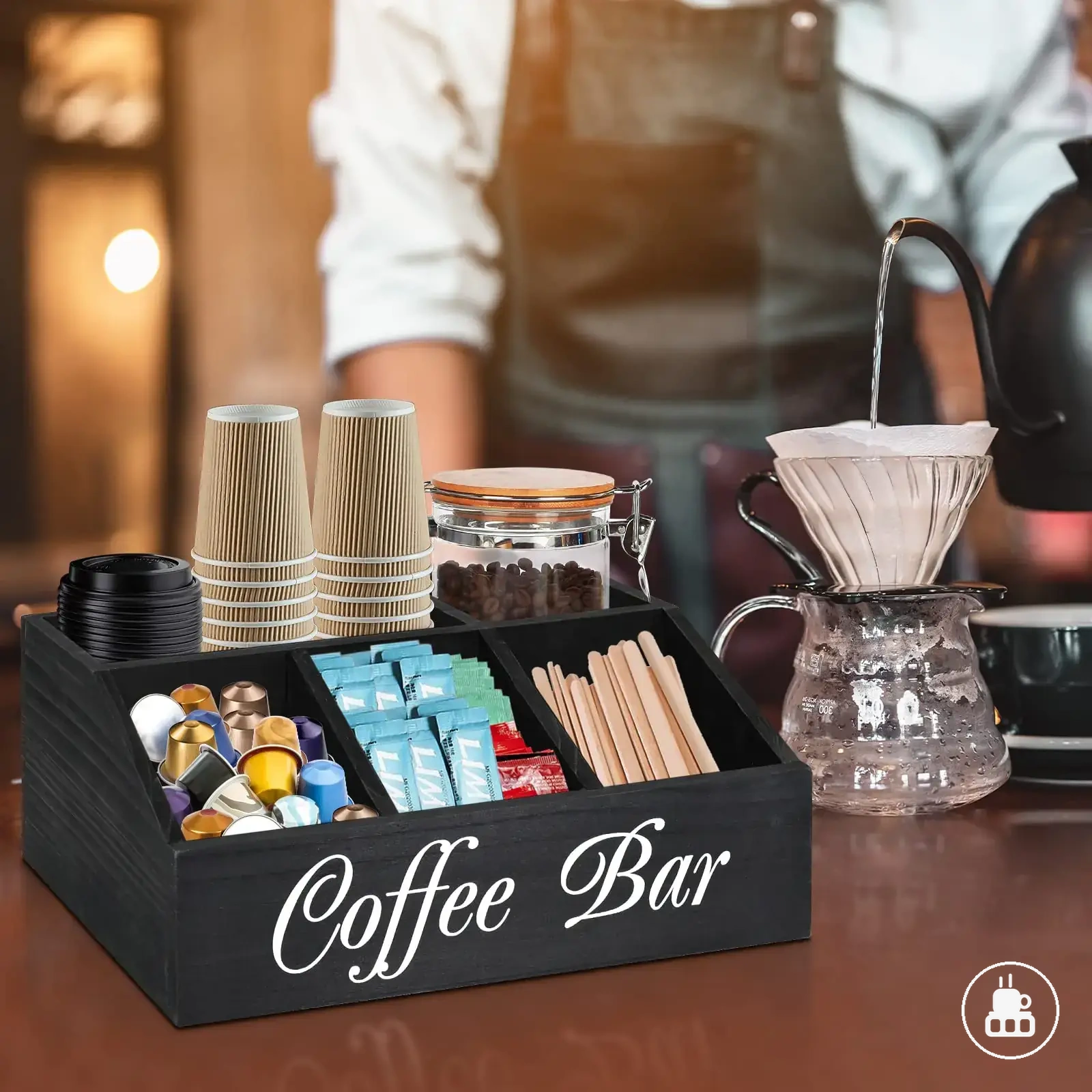
Here are product examples that may make comparison easier. Before buying, always review the compatibility criteria, essential features, and product details.
This chart shows the key value checks and decision rule for evaluating a coffee station organizer purchase.