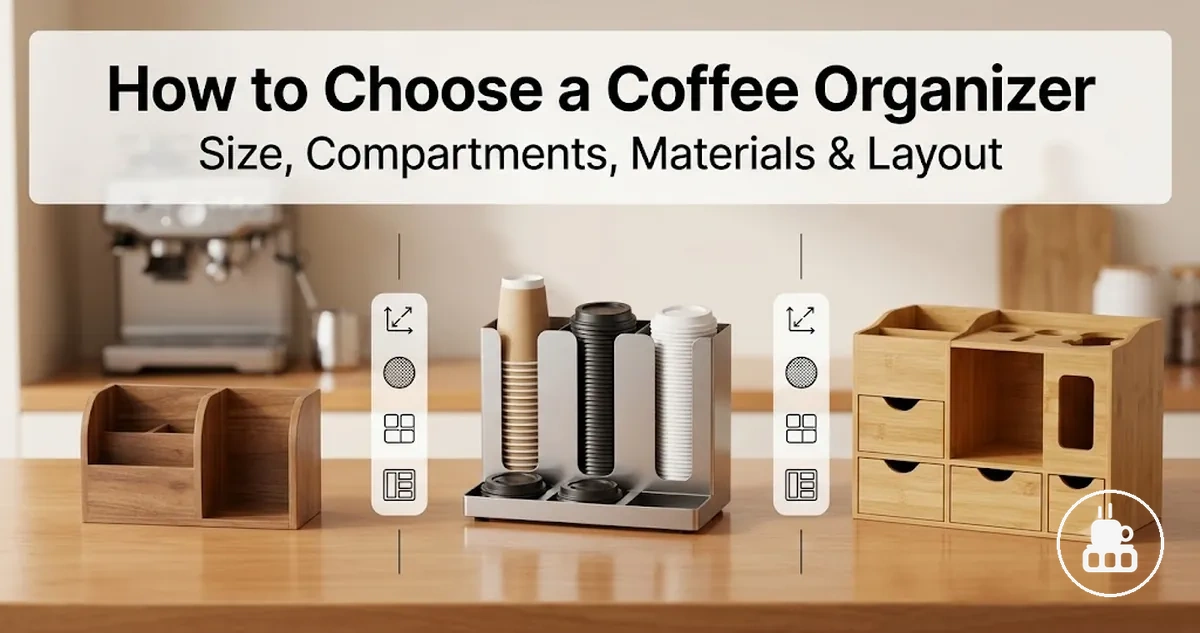
Coffee Station Organizer Selection Guide
A coffee station organizer is chosen based on how well it matches counter space, daily supplies, access habits, storage needs, material behavior, and overall value in daily use. The right selection depends on how these factors align with real use rather than visual appearance or decorative preference. Fit and storage capacity shape how comfortably items sit on the counter, while access and material affect how easily supplies are used and maintained. Value comes from how well the organizer reduces friction in daily coffee routines, so selection should prioritize function over appearance.
Different use situations change what counts as a suitable coffee station organizer. A home counter with light use may prioritize compact storage and easy access, while shared counters often require clearer compartments for cups, lids, and other supplies that are refilled more frequently. Pod-heavy setups typically need structured storage that keeps items visible and separated, whereas tight or compact spaces depend more on footprint efficiency and vertical use. These differences show that selection depends on the relationship between counter layout, supplies, and access frequency before any specific style or format is considered.
Coffee station needs that shape the right choice
Coffee station needs define the usage context that directly controls coffee station organizer selection, including how supplies are stored, how much counter space is available, and how quickly items must be accessed. These needs guide organizer choice by prioritizing storage behavior, access frequency, and counter location before any structural feature comparison. The controlling variable is how daily coffee setup demand translates into storage pressure and reach efficiency on the counter.
Coffee station needs differ based on whether the setup serves a single user, a household, or shared users, and each situation changes how storage and access should be structured. A single-user setup often supports simpler storage and lighter supply rotation, while household use increases the need for balanced storage across shared supplies. Shared users typically require clearer separation of items and faster access to reduce friction during repeated use. A coffee station organizers setup becomes effective only when these needs are aligned with supply behavior rather than visual arrangement, which is why selection must follow usage context first.
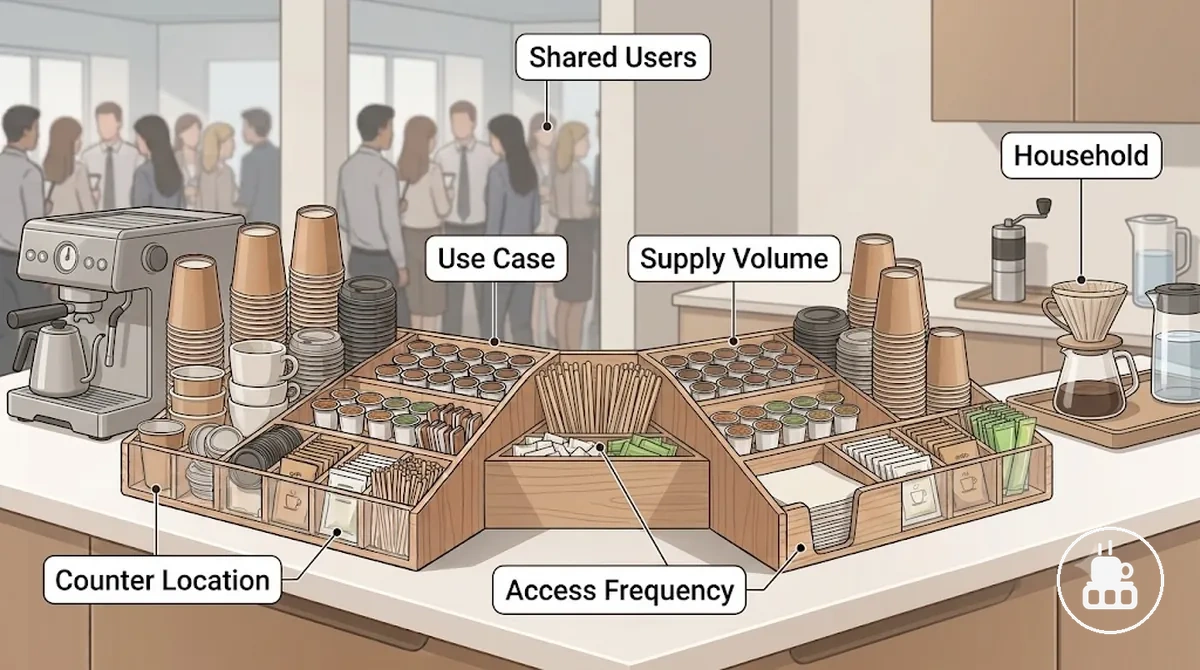
The image below illustrates how coffee station needs vary by supply volume, counter location, and access frequency, helping clarify how these factors influence organizer choice.
Key coffee station needs that influence organizer selection include:
- Use case: Defines whether the coffee station serves one person, a household, or shared users, affecting storage structure and access flow.
- Supply volume: Determines how much space is required for pods, cups, lids, and refill items without creating counter congestion.
- Counter location: Shapes how close the organizer must be to daily reach zones and how efficiently items can be accessed.
- Access frequency: Influences whether open visibility or compartmentalized storage is more suitable for repeated use.
- Storage behavior: Defines how supplies are grouped or separated based on daily coffee setup patterns.
Home counter use versus shared supply demand
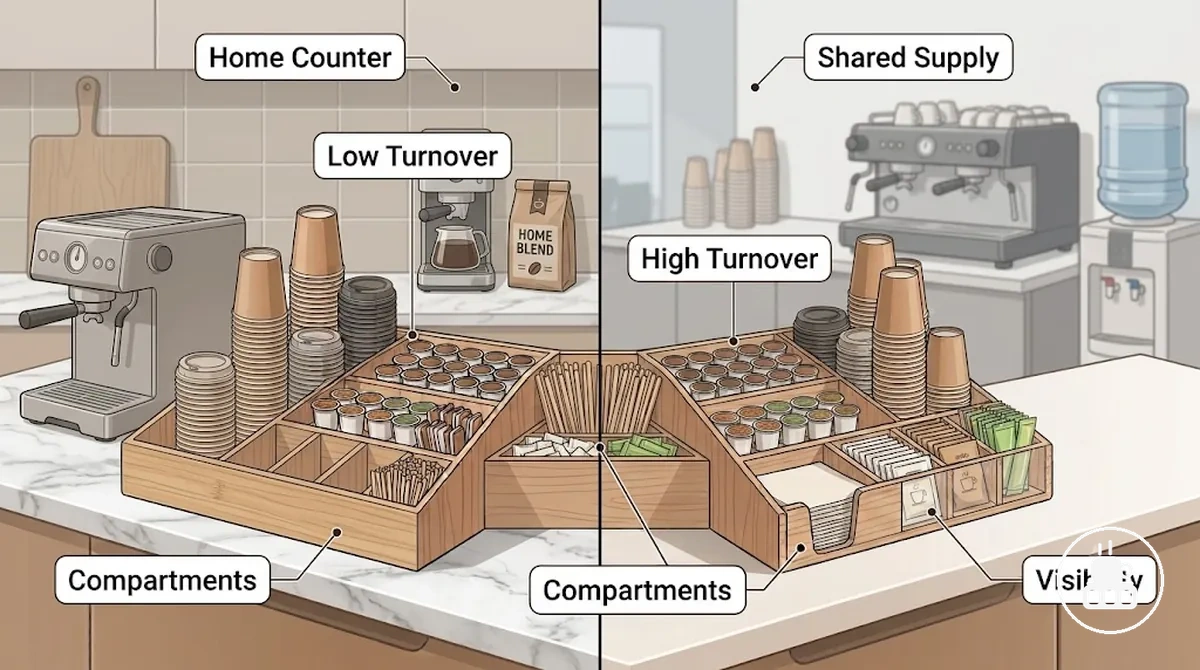
Home counter use versus shared supply demand defines how coffee station organizers should be selected based on use intensity, turnover rate, and how supplies move across the counter. Home counter setups typically involve lower refill frequency, fewer cups and lids in circulation, and more stable storage patterns. Shared supply demand creates higher turnover and faster movement of items, which increases pressure on visibility, compartments, and access flow. The selection threshold depends on how strongly daily use drives storage stress and organization clarity.
Home counter use focuses on compact storage with manageable supply levels, while shared supply demand requires faster access and clearer compartment separation due to repeated use by multiple users. Higher turnover in shared contexts increases the need for structured visibility so cups and lids remain easy to locate. Durability becomes more relevant under shared demand, while home counter setups can often prioritize simpler storage behavior as long as access remains efficient.
| Factor | Home counter use | Shared supply demand |
|---|---|---|
| Refill frequency | Lower and stable over time | Higher due to multiple users |
| Supply volume | Smaller daily quantities of cups and lids | Larger rotating stock of cups and lids |
| Visibility | Helpful but not critical for access | Important for fast identification |
| Durability | Moderate use conditions | Higher stress from frequent handling |
Daily supplies that must stay visible and accessible
Daily supplies that must stay visible and accessible are the coffee station items used every day and therefore require front, easy-reach placement in the organizer. Pods, cups, lids, stirrers, sweeteners, and napkins should stay in visible storage because they are repeatedly handled during each coffee preparation cycle. The selection focus is keeping frequently used supplies within a clear reach zone to reduce access friction.
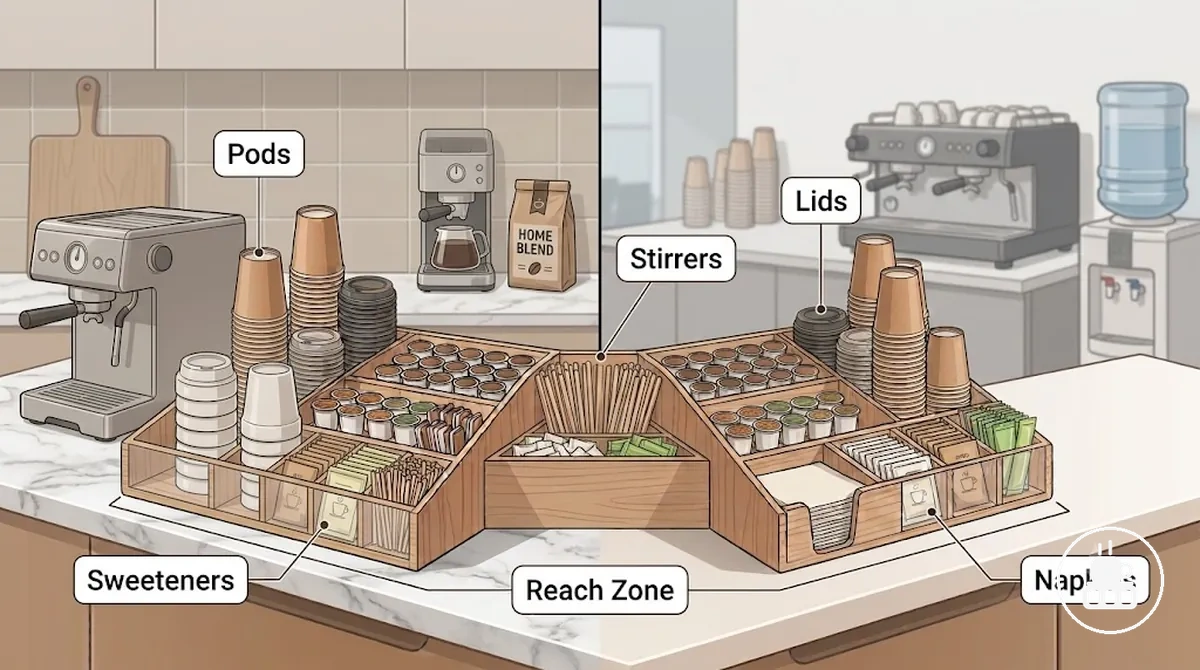
These daily supplies can be structured using an EAV approach to clarify how each item should be stored based on access need and visibility requirements:
- Pods: Require visible storage → quick selection → front-access compartment improves refill awareness.
- Cups: Require direct reach access → stable stacking zone → reduces delay during daily use.
- Lids: Require organized separation → controlled compartment storage → prevents mixing and improves speed.
- Stirrers: Require small visible sections → easy reach placement → reduces search time.
- Sweeteners: Require grouped packet storage → clear visibility → supports fast preparation flow.
- Napkins: Require front-access placement → spill response readiness → reduces friction during cleanup.
Counter fit and placement conditions
Counter fit depends on footprint, clearance, and placement conditions that determine whether an organizer can function properly in the intended space. Width, depth, and height define the physical footprint, while machine spacing and outlet access affect usability during daily operation. Clearance around cabinets and nearby appliances also shapes whether the reach path remains comfortable or becomes restricted. Fit decisions should rely on measured counter fit rather than visual estimation to avoid placement errors.
Common placement issues occur when an organizer fits the surface but fails to support daily movement and access needs. A compact footprint can still create problems if drawer pullout space is blocked or if machine spacing is too tight for safe handling. Outlet access may also be limited when the placement zone does not align with cable direction or rear clearance. These issues show why counter fit must be evaluated as a combination of space and functional access rather than size alone.
To simplify evaluation, the fit-check table below organizes key placement conditions such as footprint, clearance, and access factors into practical selection checks.
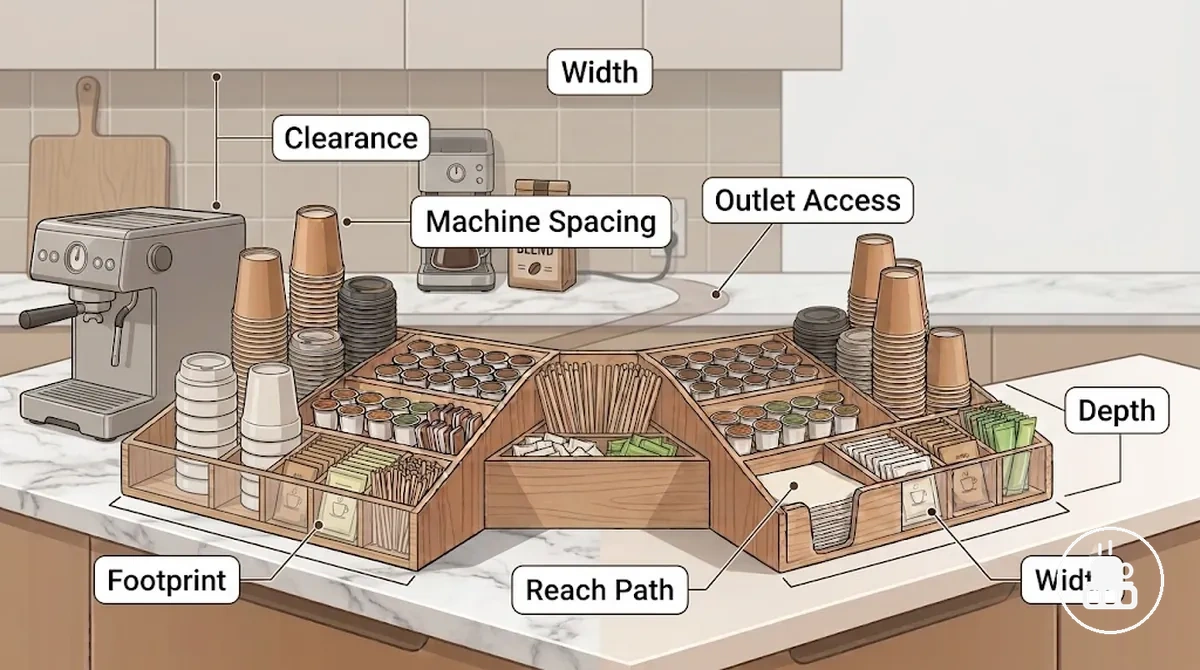
In tighter layouts, compact or vertical organizers may still work, but only when clearance, outlet access, and reach path remain unobstructed. Even small designs can fail if machine spacing is insufficient or cabinet clearance restricts movement. Before final selection, it is important to check dimensions and fit based on real counter measurements and placement conditions.
| Placement factor | What to check | Risk if ignored | Selection effect |
|---|---|---|---|
| Width | Available counter span | Reduces usable workspace | Limits organizer size options |
| Depth | Front-to-back counter space | Causes overhang or blockage | Affects stability and placement |
| Height | Cabinet clearance above counter | Restricts placement or access | Limits vertical designs |
| Drawer pullout | Front clearance for movement | Prevents full drawer opening | Reduces usability |
| Outlet access | Power source proximity | Blocks or strains cables | Limits appliance positioning |
| Machine spacing | Distance between appliances | Creates interference or crowding | Defines layout flexibility |
Footprint, height clearance, and machine-area spacing
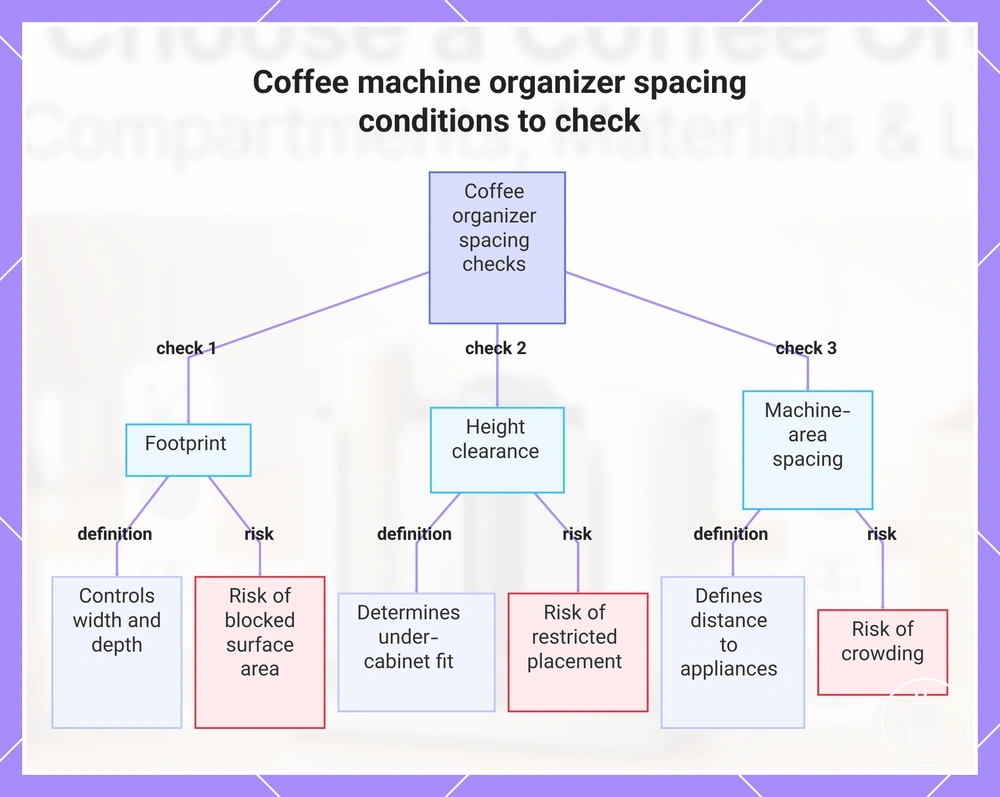
Footprint, height clearance, and machine-area spacing define how the organizer fits and functions around the coffee machine setup. Footprint controls the width and depth occupied on the counter, while height clearance determines whether the setup fits under cabinets or shelving. Machine-area spacing affects how comfortably the organizer sits alongside appliances and supports mug reach and outlet access during daily use. These spacing conditions must be checked together before selecting an organizer.
Fit issues often appear when one spacing factor is ignored even if the rest seem acceptable. Limited footprint can restrict placement near the counter edge, while reduced height clearance can block upper cabinet use. Tight machine-area spacing may also interfere with drawer pullout, mug reach, or outlet positioning. These conditions make it important to evaluate how all spacing elements interact rather than treating them separately.
The checklist below summarizes the key spacing checks needed for safe and functional placement around the coffee station.
- Footprint (width and depth): defines counter coverage → risk of blocked surface area → affects placement flexibility.
- Height clearance: defines vertical space under cabinets → risk of restricted placement → affects usable vertical storage.
- Machine-area spacing: defines distance between organizer and appliances → risk of crowding → affects workflow efficiency.
- Drawer pullout: defines front clearance → risk of blocked movement → affects usability and access.
- Mug reach: defines reach distance to cups → risk of awkward handling → affects daily speed of use.
- Outlet access: defines power connection space → risk of cable strain → affects placement flexibility.
This chart shows the three main spacing factors for a coffee machine organizer and the risks of ignoring each one.
Small-counter layouts and vertical storage trade-offs
Small-counter layouts rely on vertical storage when footprint savings are needed, but this choice depends on how much reachability and stability the space can still support. In tight counters, tiered shelf systems, stacked trays, and narrow drawers help reduce surface use, yet they also increase dependency on cabinet clearance and accessible reach paths. Vertical storage works best when items remain easy to access without forcing awkward movement. The key trade-off is between saving footprint and maintaining practical usability in daily use.
The contrast below shows when vertical storage supports small-counter layouts and when it may introduce friction due to reach or stability limits.
| Helps when | Can fail when |
|---|---|
| Tiered shelf improves footprint savings while keeping items within easy reach | Cabinet clearance is limited, reducing upper-tier accessibility |
| Narrow drawer improves compact storage in tight counter layouts | Drawer pullout space restricts smooth access and creates friction |
| Stacked tray separates items without expanding counter footprint | Stability is reduced when stacking height becomes unbalanced |
| Corner placement uses unused space in small-counter layouts | Reachability becomes difficult in tight machine or mug zones |
Storage capacity and supply compatibility
Storage capacity depends on how well it matches the actual supplies it needs to hold, including pods, cups, lids, stirrers, sweeteners, napkins, tea bags, and packets, along with how often these items are refilled. Supply compatibility defines whether the compartment count and usable size support daily use patterns without creating overflow or wasted space. Capacity is only meaningful when it aligns with supply structure and refill frequency, since mismatch leads to either underuse or constant overfilling. Large storage capacity is not automatically better if it does not match real supply needs.
Problems usually appear when storage capacity is chosen without checking how supplies behave in real use. Overbuying can create large compartments that remain partially empty or inefficiently divided, while underfitting leads to tight packing that reduces access and increases clutter during refill cycles. The goal is to match storage volume, compartment count, and usable size with actual supply demands rather than visual size. The table below shows how different supplies align with compatibility conditions and selection outcomes.
| Supply | Attribute or size issue | Compatible storage condition | Selection effect |
|---|---|---|---|
| Pods | Requires consistent compartment count and structured grouping | Defined compartments with balanced usable size | Prevents clutter and improves selection speed |
| Cups | Stack height affects space usage | Vertical or open storage with stable support | Maintains accessibility without crowding |
| Lids | Light items prone to mixing | Separated small compartments | Improves order and reduces confusion |
| Stirrers | Thin profile requiring narrow allocation | Narrow or grouped slots | Prevents scattering and loss |
| Sweeteners | Packet variability affects space needs | Small visible compartments | Supports fast access during use |
| Napkins | Flat stacking volume requirement | Medium flat compartment space | Maintains reachability and order |
| Packets | Mixed small-item storage behavior | Flexible compartment zoning | Reduces overfilling and misplacement |
In practice, matching storage capacity and supply compatibility is more effective when evaluating usable compartment behavior rather than advertised volume, especially under capacity and compartments considerations.
Pods, cups, lids, stirrers, and condiments
Pods, cups, lids, stirrers, and condiments are common coffee supplies with different storage needs based on size, access need, and compartment behavior. Pods and cups often require more structured compartments due to stacking and refill patterns. Lids and stirrers need smaller sections for quick access and visibility. Condiments and sweeteners usually depend on stable, contained storage to reduce spills and support easy reach during use.
These coffee supplies differ in how they interact with compartment space and handling flow. Pods may need grouped capsule storage, cups often rely on stack-friendly space, lids benefit from separated sections to avoid mixing, and stirrers work best in narrow visible slots. Condiments and sweeteners typically require controlled access areas where spill risk is reduced and refill handling stays simple. The table below summarises these differences using EAV structure.
| Supply | Storage attribute | Best organizer condition | Risk if mismatched |
|---|---|---|---|
| Pods | Capsule size and refill frequency | Structured compartment with grouped storage | Cluttered layout and inefficient refill handling |
| Cups | Stack height and access need | Open or tiered compartment with stable support | Instability or reduced reach efficiency |
| Lids | Lightweight and mix-prone | Separated small compartments | Mixing and slower retrieval |
| Stirrers | Narrow profile and visibility need | Narrow slot or grouped section | Scattering or loss of items |
| Condiments | Spill risk and packet handling | Contained easy-access compartment | Mess and reduced access control |
Compact storage versus large-capacity storage
Compact storage and large-capacity storage solve different counter size and supply compatibility needs. Compact storage focuses on reducing footprint and supporting smaller setups with lower refill frequency and limited supply volume. Large-capacity storage supports shared use environments where cups, lids, and other supplies require higher storage volume and more structured compartment planning. The right choice depends on counter size, supply count, and refill frequency rather than size alone.
| Choose compact when | Choose large-capacity when | Watch for | |
|---|---|---|---|
| Counter size | Space is limited and a small footprint is required | More counter area allows broader storage layout | Overfilled compartments in compact units or wasted space in large units |
| Refill frequency | Frequent refills are acceptable due to lower storage volume | Lower refill frequency is needed for shared or heavy use | Increased refill burden in compact setups or unused capacity in large setups |
| Supply mix | Fewer items such as pods or limited cups are used | Multiple supplies like cups, lids, and condiments are shared | Poor fit when supply variety exceeds compartment planning |
| Visual impact | Helps reduce visual clutter in small layouts | Helps organize higher supply variety in shared use | Clutter if compact storage is overfilled or if large units are underutilized |
Organizer format and access style
Organizer format and access style depends on how storage structures influence visibility, reach, refill ease, and counter control. Drawers, open compartments, tiered shelves, trays, caddies, and dividers each change how supplies are accessed and how quickly they can be seen or retrieved during daily use. The decision is based on access behavior rather than format labels, especially when balancing visibility with controlled storage on the counter.
Different organizer formats may appear similar in structure, but they create different access patterns that affect how efficiently supplies are handled. Drawers reduce visibility but improve containment and dust control through pullout space. Open compartments increase visibility and quick reach but can create clutter when overfilled. Tiered shelves improve vertical visibility but depend on clearance, while trays, caddies, and dividers adjust how grouped or separated supplies are managed. These differences are clearer when evaluated through access behavior, as shown in the comparison below. You can compare organizer types to see broader format groupings.
| Format | Access strength | Trade-off | Best use case |
|---|---|---|---|
| Drawers | Controlled pullout access with reduced visibility | Slower visual identification of supplies | Dust control and hidden storage setups |
| Open compartments | High visibility and fast reach access | Higher visual clutter risk when overfilled | Frequent use and quick refill access |
| Tiered shelves | Layered visibility and improved vertical reach | Requires more clearance and vertical space | Small footprint counters with vertical organisation |
| Trays | Simple access with easy repositioning | Limited separation between items | Flexible and lightweight counter setups |
| Caddies | Grouped portable access to mixed supplies | Reduced fixed organization stability | Shared use or mobile coffee stations |
| Dividers | Structured separation with controlled zones | Less flexibility for irregular item shapes | Mixed supply organization with consistent layout |
Drawers, open compartments, and tiered shelves
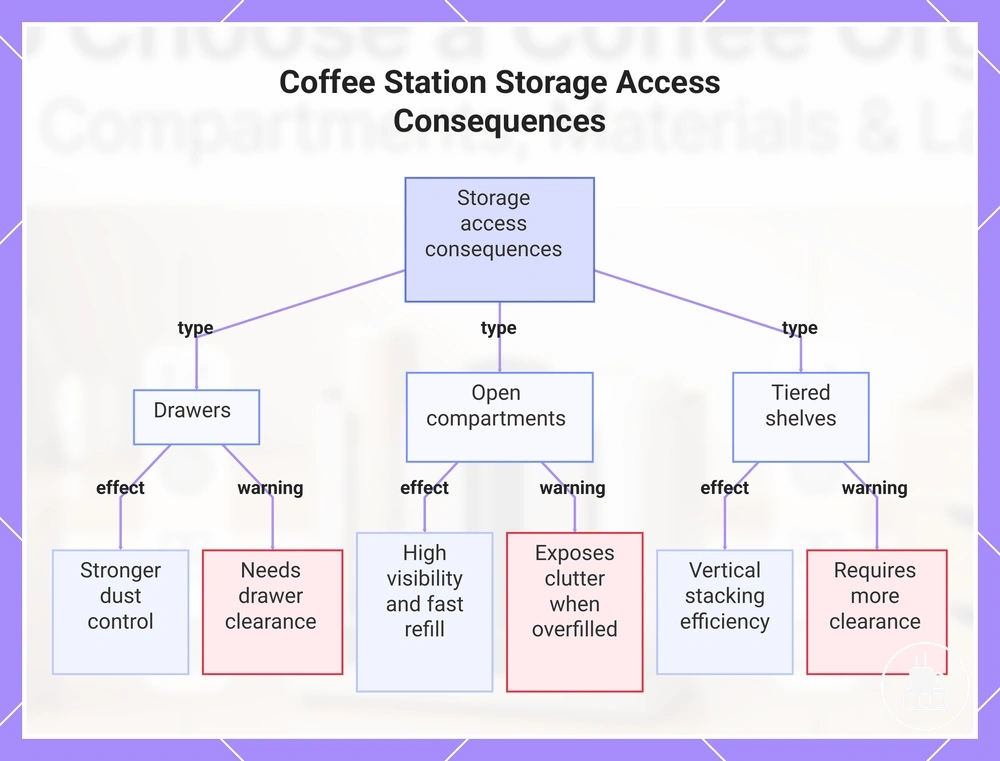
Drawers, open compartments, and tiered shelves differ in how they control visibility, dust control, refill ease, drawer clearance, and vertical reach during daily coffee station use. Drawers prioritize hidden storage with pullout access, open compartments prioritize direct visibility and quick reach, and tiered shelves prioritize vertical stacking and layered access. These differences affect how efficiently supplies are handled depending on counter constraints and use patterns, so the focus stays on access consequences below.
- Drawers: Provide controlled pullout storage with stronger dust control, but may reduce visibility and depend on sufficient drawer clearance for smooth access.
- Open compartments: Offer high visibility and fast refill ease, but can expose clutter more easily when overfilled and depend on consistent organization.
- Tiered shelves: Improve vertical reach and layered storage efficiency, but require more counter or cabinet clearance and may limit access in tight spaces.
:contentReference[oaicite:0]{index=0}
This chart compares how drawers, open compartments, and tiered shelves affect visibility, dust control, refill ease, clearance, and vertical reach during daily coffee station use.
Fixed sections versus removable dividers
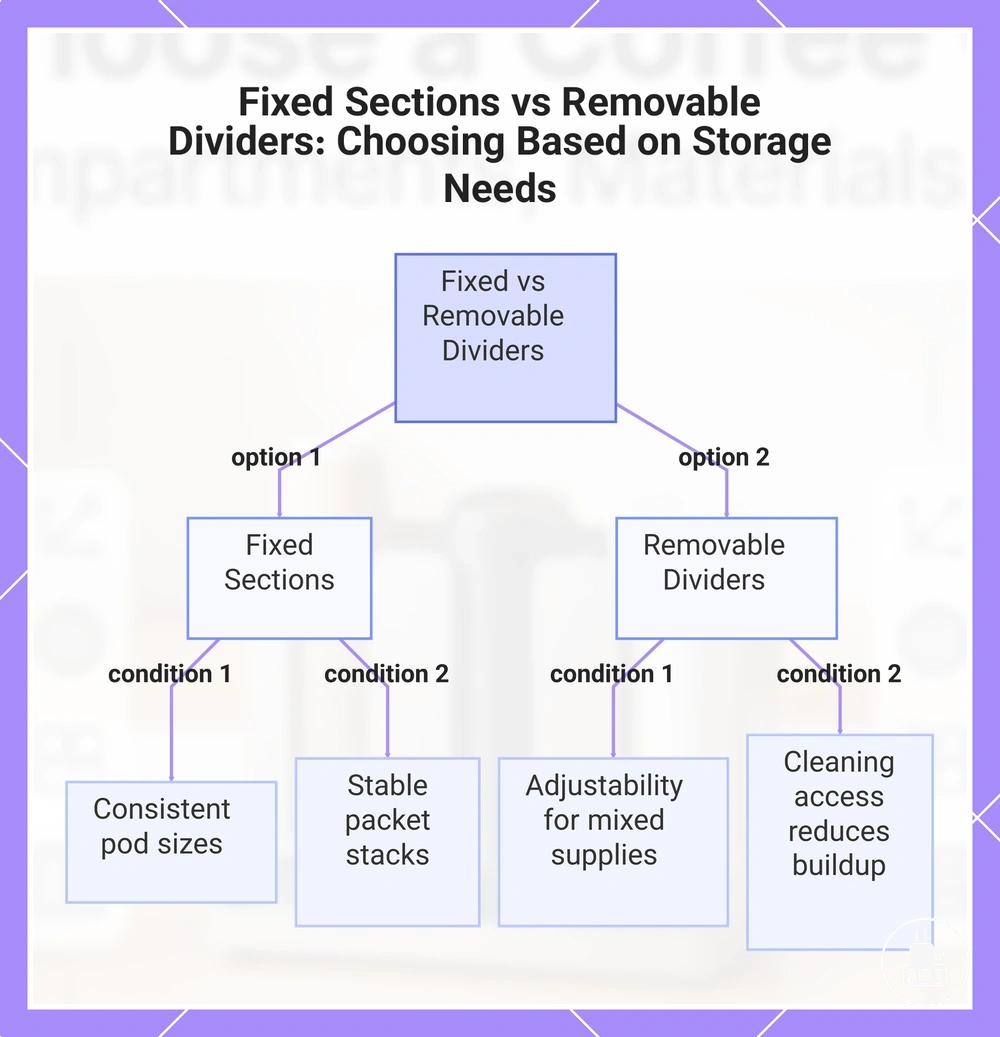
Fixed sections and removable dividers differ in how reliably they manage supply fit based on adjustability, compartment fit, and cleaning access. Fixed sections provide stable rows that usually suit consistent pod sizes and simple packet stacks, while removable dividers allow adjustability for mixed supplies and changing layouts. Reliability depends on whether storage needs are stable or require frequent reconfiguration. The fit-flexibility rule is that stability favors fixed sections, while variability favors removable dividers.
Compartment flexibility affects supply fit in specific, practical conditions:
- Fixed sections: Choose when pod sizes are consistent and stable rows improve compartment fit for predictable storage.
- Removable dividers: Choose when mixed supplies require adjustability and changing compartment fit over time.
- Removable dividers: Choose when cleaning access is important and movable sections help reduce buildup in tight spaces.
- Fixed sections: Choose when packet stacks and simple supplies need stable organization without frequent changes.
This chart compares fixed sections and removable dividers, showing the conditions under which each option provides better supply fit.
Material and build quality trade-offs
Material affects cleaning, visibility, stability, and durability in different ways depending on how the organizer is used. Wood, acrylic, metal, and plastic each behave differently in daily handling, especially under moisture exposure, weight load, and frequent cleaning. These differences influence stability on the counter and how consistently the build quality holds up over time. Material choice works best when it matches daily usage needs rather than surface appearance alone.
Choosing material based only on appearance can lead to mismatches in cleaning effort, visibility, and structural stability. A visually suitable surface may require more maintenance or may show wear faster depending on usage intensity. Material selection should therefore consider cleaning behaviour, durability expectations, and shared-counter conditions. The comparison below shows how each material performs under practical use factors rather than decorative preference.
| Material | Useful attribute | Trade-off | Best-fit condition |
|---|---|---|---|
| Wood | Solid structure with stable feel | Requires more careful cleaning and moisture control | Works when dry storage and moderate cleaning are expected |
| Acrylic | High visibility and clear layout | Scratch visibility may increase with frequent use | Works when visibility and quick access are priorities |
| Metal | Strong stability and higher load handling | Heavier build may require more careful surface placement | Works when durability and shared-counter stability are needed |
| Plastic | Lightweight and easy cleaning | May flex under heavier loads depending on design | Works when lightweight handling and simple cleaning are priorities |
Wood, acrylic, metal, and plastic decision factors
Wood, acrylic, metal, and plastic decision factors depend on finish, visibility, moisture behavior, weight, and cleaning needs in daily coffee station use. Each material responds differently to spills, handling frequency, and how clearly supplies need to be seen on the counter. Wood typically introduces a warmer finish with more sensitive moisture behavior, acrylic supports clear visibility but may show scratches, metal increases weight and stability, and plastic offers lightweight handling with variable flex under load. The comparison below focuses on how these factors affect practical selection rather than visual preference.
This breakdown helps evaluate wood, acrylic, metal, and plastic across home use, shared use, frequent spills, and visible supply storage needs so selection matches real conditions rather than appearance.
| Material | Helps with | Watch for | Suitable condition |
|---|---|---|---|
| Wood | Warm finish and stable visual integration | Moisture behavior and more careful cleaning needs | Dry environments with moderate daily use |
| Acrylic | High visibility for stored supplies | Scratch visibility with frequent handling | Visible storage setups with light-to-moderate use |
| Metal | Higher weight support and structural stability | Heavier handling and surface contact marks | Shared-use counters needing stronger stability |
| Plastic | Lightweight handling and easy cleaning | Flex under heavier loads depending on build quality | Flexible setups with frequent repositioning |
Durability, visibility, stability, and cleaning burden
Durability, visibility, stability, and cleaning burden are reflected through observable build signals that show how a coffee station organizer performs over time. Weak quality often appears as cleaning friction, wobble, reduced visibility of supplies, or inconsistent movement in daily use. These signals are usually connected to seams, drawer glide, divider fit, base stability, surface finish, and refill visibility. The inspection focus is to identify these issues early before evaluating price or appearance.
Quality problems can usually be detected through simple handling checks rather than assumptions about material or design. Poor seams may increase residue buildup and cleaning burden, while uneven drawer glide can reduce durability and smooth access. Loose divider fit may affect compartment stability and cause internal shifting, and weak base stability can create wobble during use. The checklist below focuses on visible and tactile indicators that help assess overall build quality.
- Seams: uneven joins or gaps may trap residue, increasing cleaning burden and reducing surface finish consistency.
- Drawer glide: stiff or uneven movement can reduce durability perception and limit smooth access during use.
- Divider fit: loose or misaligned sections may reduce compartment stability and disrupt organized storage.
- Base stability: wobble or uneven contact with the surface can affect stability and safe placement.
- Surface finish: rough or inconsistent texture may increase cleaning effort and reduce wipeability.
- Refill visibility: blocked or unclear compartments can reduce visibility and lead to inefficient restocking.
Value signals before choosing a coffee station organizer
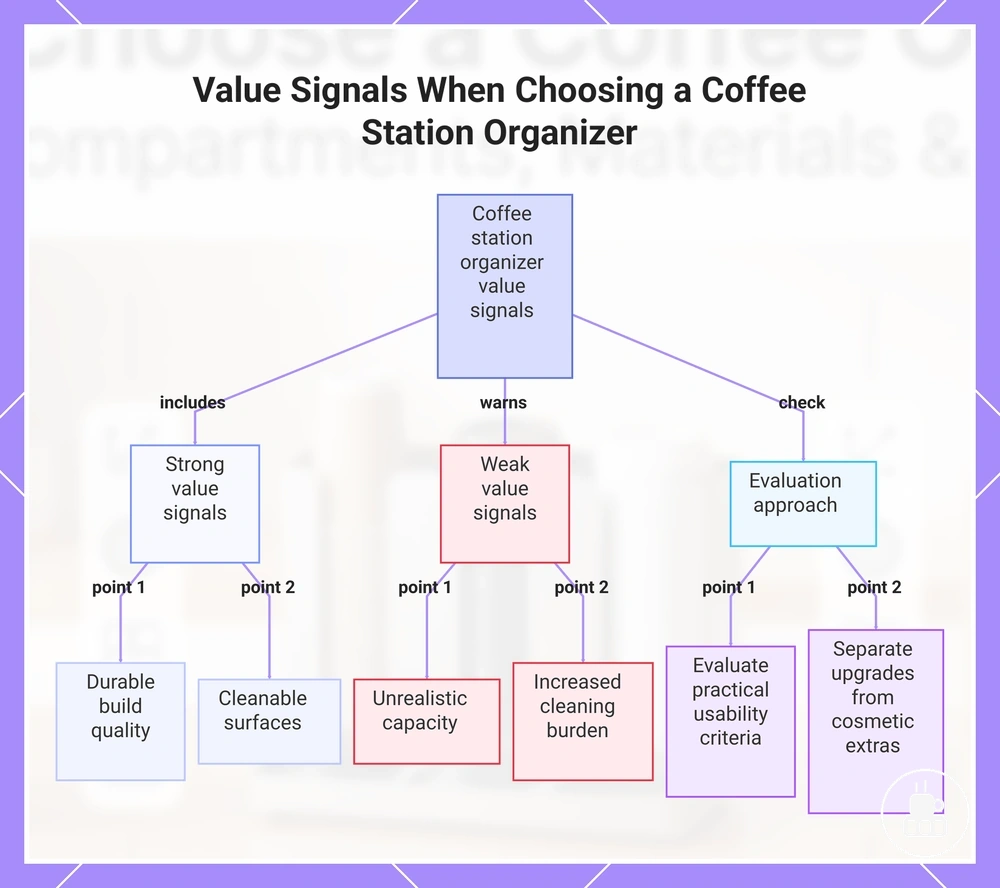
Value signals depend on fit, capacity, material, and access quality rather than price alone when selecting a coffee station organizer. Price only becomes meaningful when it aligns with how well the organizer matches counter space, daily supply load, and access efficiency. Durable build, cleanable surfaces, and stable placement often indicate stronger buying value when they support daily use. This section frames value through practical usability instead of price-first judgment.
Worthwhile upgrades usually appear in durable build quality, useful compartments, cleanable surfaces, and stable placement that improves daily workflow. These value signals often reduce clutter and improve access quality without adding unnecessary handling friction during refilling or cleaning. A strong indicator of feature value is consistent performance under repeated daily use conditions. In many cases, upgrades are justified when they improve function rather than appearance alone.
Weak value signals often appear when design choices reduce access quality, create unrealistic capacity, or increase cleaning burden without improving usability. Poor alignment between compartments and real supply needs can increase clutter instead of reducing it, weakening long-term buying value. Value evaluation should also consider coffee station organizer price and value as a criteria-based comparison of function versus cost expectations.
Comparing options works best by focusing on how each organizer balances fit, capacity, material, and access quality without ranking one option as universally better. The goal is to separate useful upgrades from cosmetic extras based on real counter conditions and daily usage patterns. Strong value signals consistently reduce clutter while maintaining stable placement and usable structure.
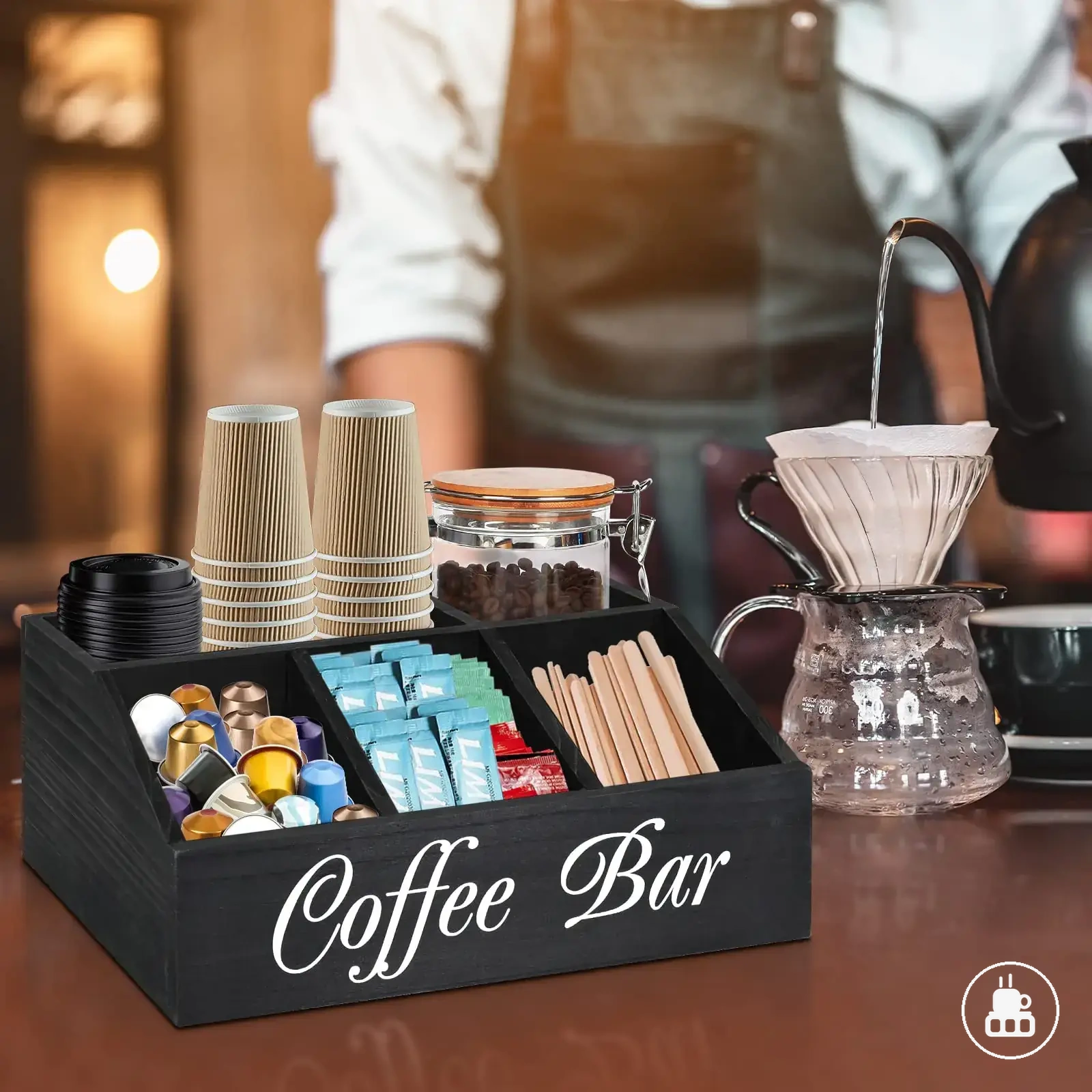
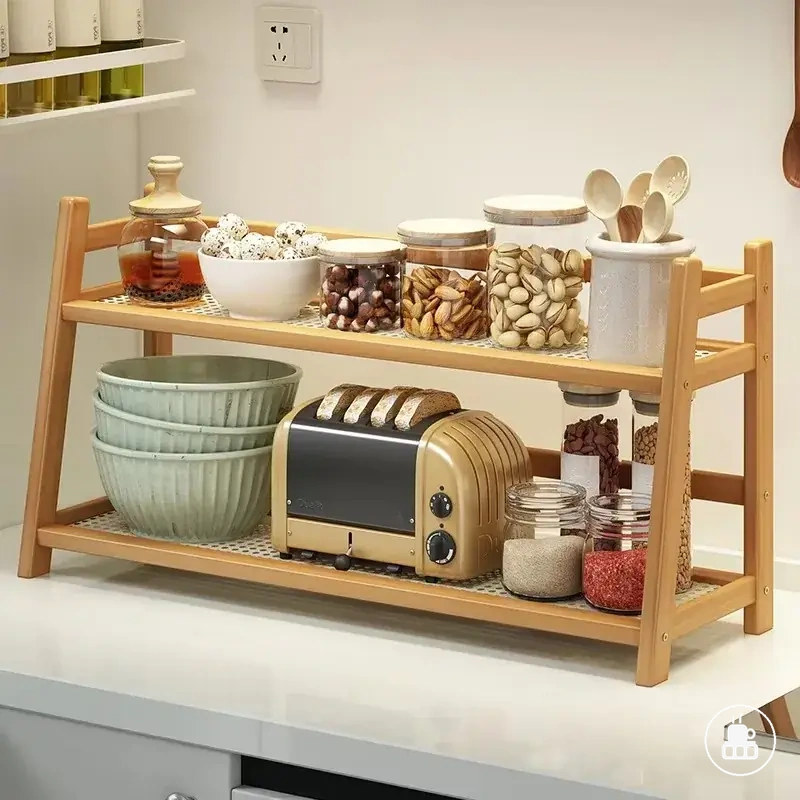
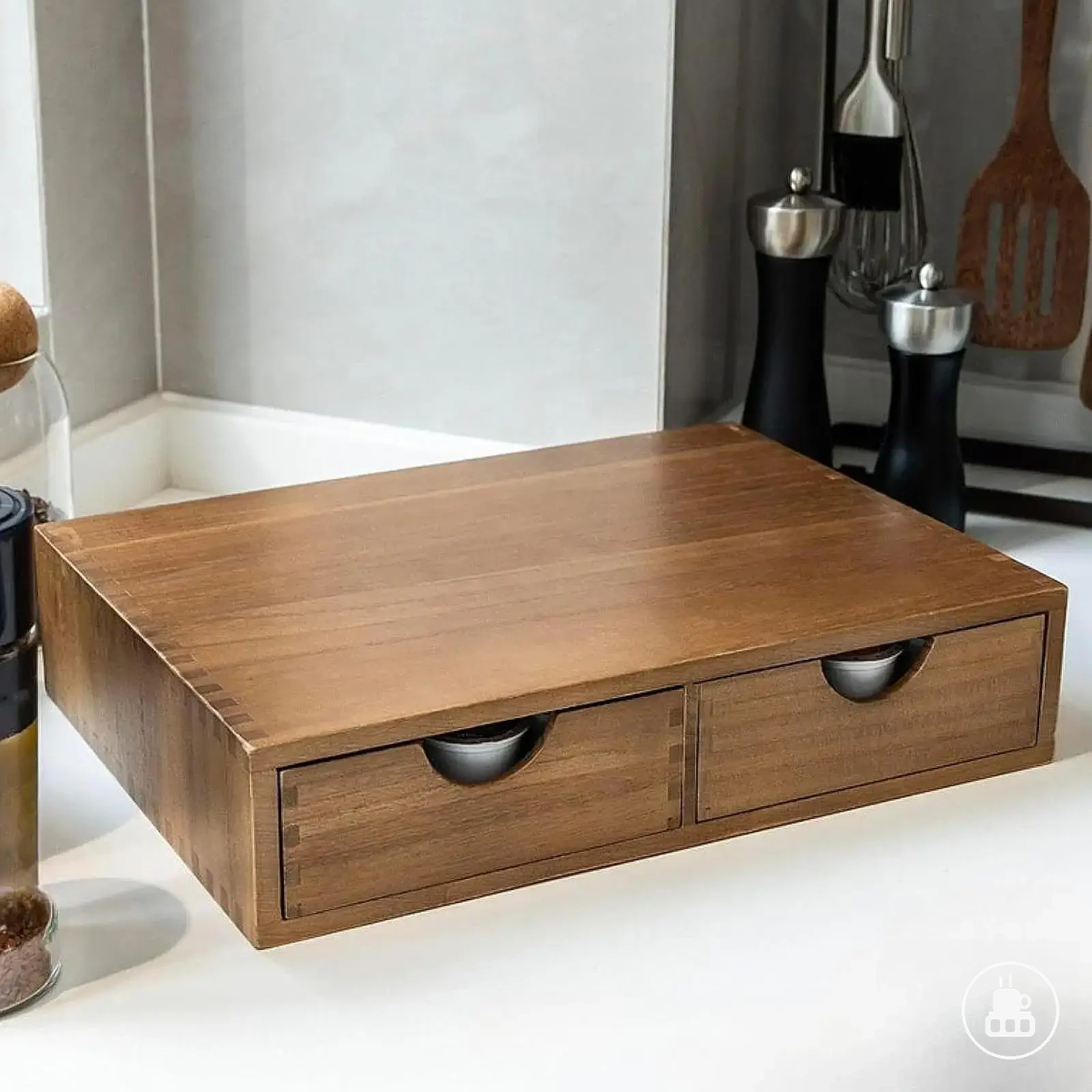
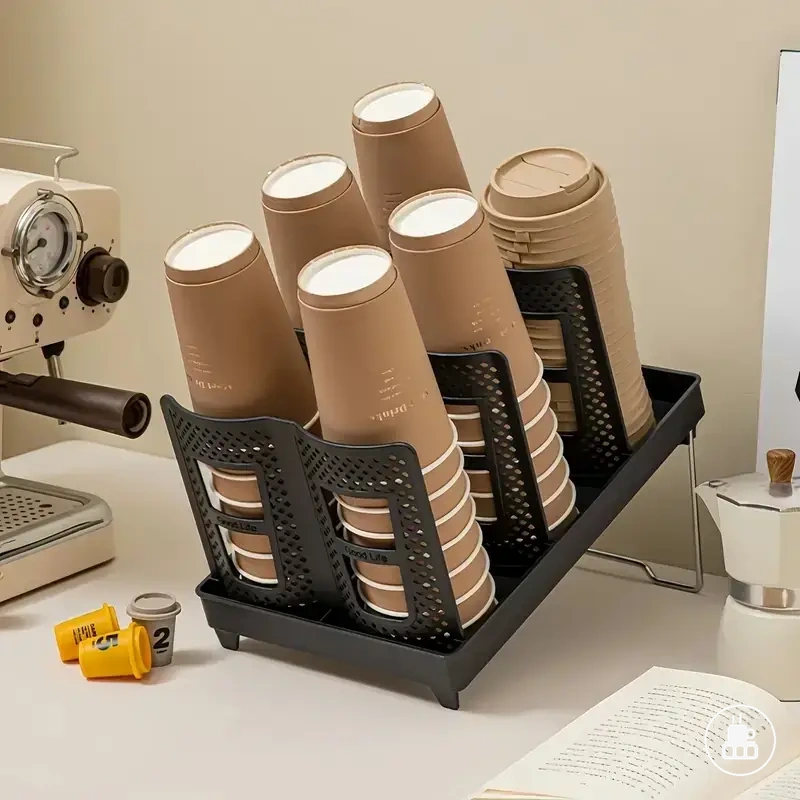
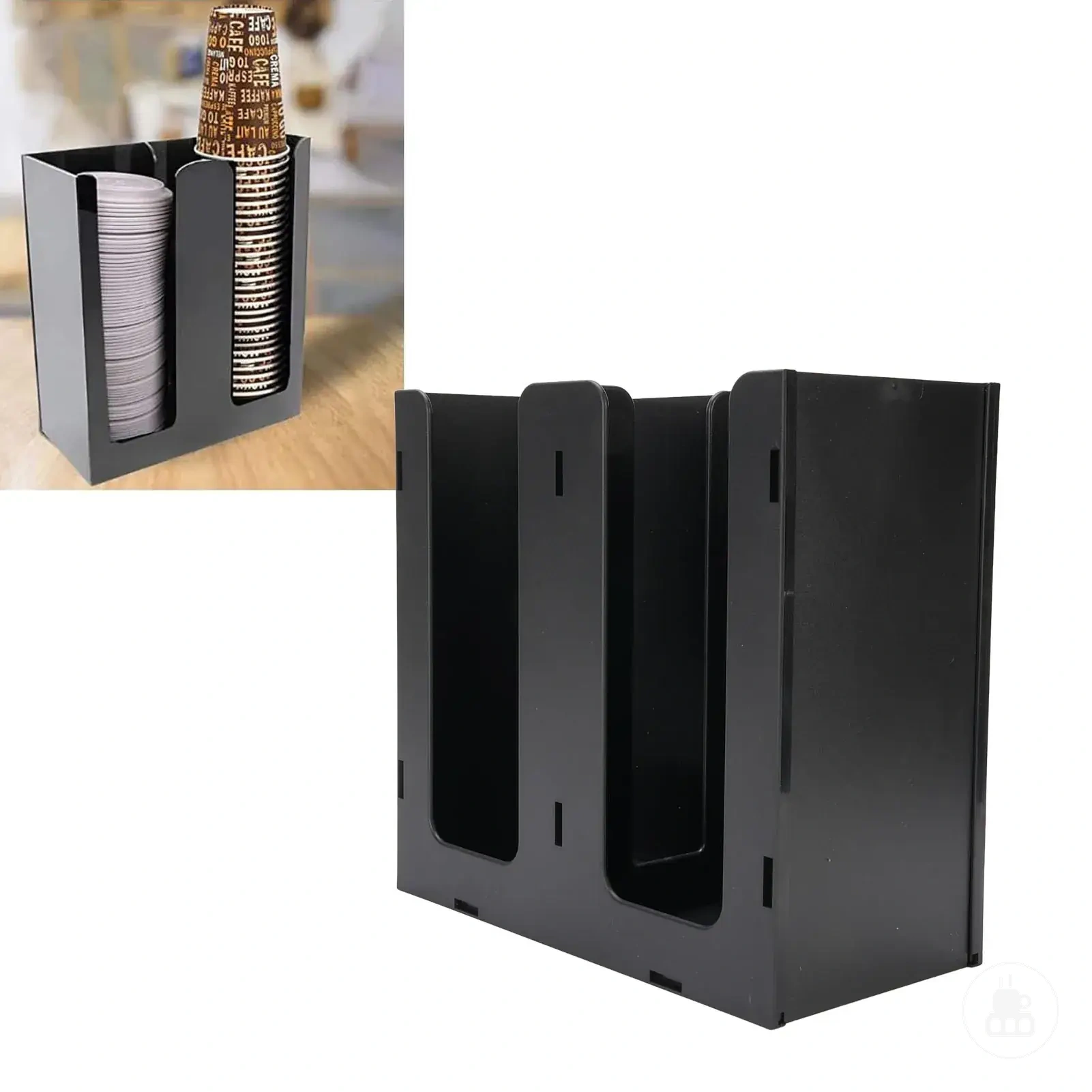
The products below are useful examples for comparing available options. Before buying, check that the compatibility criteria, key features, and product details match your needs.
Value checklist:
- Durable build that maintains structure under repeated daily handling
- Useful compartments that match real supply types and reduce clutter formation
- Cleanable surfaces that reduce cleaning burden and improve wipeability
- Realistic capacity that fits daily use without overfilling or wasted space
- Stable placement that prevents wobble during access and refilling
- High access quality that allows quick reach without workflow interruption
This chart shows the key strong signals, weak signals, and evaluation method for selecting a coffee station organizer based on practical usability.
Selection mistakes that cause clutter or poor fit
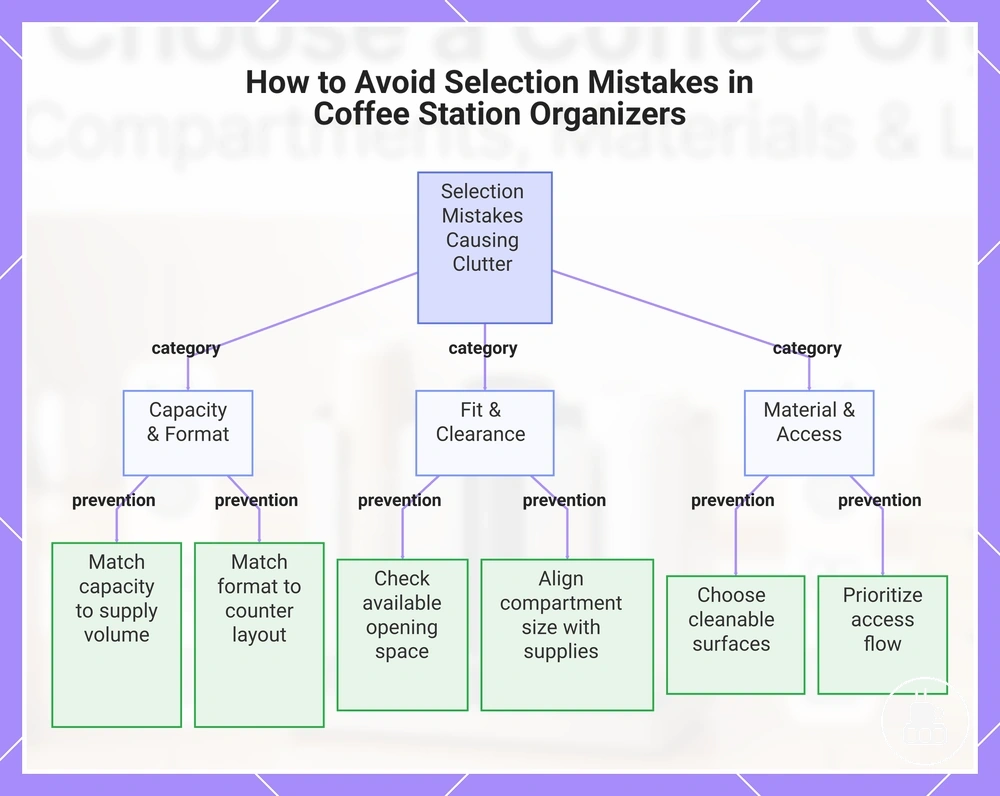
Selection mistakes that cause clutter or poor fit usually come from mismatched fit, capacity, format, or material when choosing a coffee station organizer. These selection mistakes often result in clutter problems, blocked access, or wasted counter space when the organizer does not match real usage needs. Poor fit is often caused by ignoring drawer clearance, supply compatibility, or storage format constraints during selection. The diagnostic focus is on identifying how these mismatches translate into visible daily-use issues.
Selection mistakes often appear in practical scenarios where assumptions override real constraints. Overbuying capacity can create oversized or underused sections that increase clutter instead of reducing it. Ignoring drawer clearance may lead to blocked access and friction during daily use. Mixing incompatible supplies or choosing hard-to-clean materials can increase mess and maintenance burden. Prioritizing appearance over access often results in storage that looks organized but performs poorly in real conditions, which can be prevented by evaluating real workflow needs.
The following diagnostic checklist highlights common selection mistakes and how to prevent them. Each point connects a mistake to a symptom and a prevention step. This helps identify mistakes that cause clutter problems before final selection decisions are made.
- Overbuying capacity: unused or overfilled space → symptom is wasted counter area or clutter → prevent by matching capacity to actual supply volume
- Ignoring drawer clearance: blocked pullout access → symptom is difficulty in use → prevent by checking available opening space before selection
- Incompatible supplies: mismatched compartments → symptom is refill mess → prevent by aligning compartment size with supply types
- Hard-to-clean materials: residue buildup → symptom is higher maintenance burden → prevent by choosing cleanable surfaces
- Appearance over access: visually appealing but inefficient layout → symptom is awkward usage → prevent by prioritizing access flow
- Poor format selection: wrong organizer type → symptom is clutter formation → prevent by matching format to counter layout
This chart categorizes common selection mistakes that lead to clutter or poor fit and shows the specific prevention steps for each category.