Coffee station organizer compatibility for pods, cups, and condiments
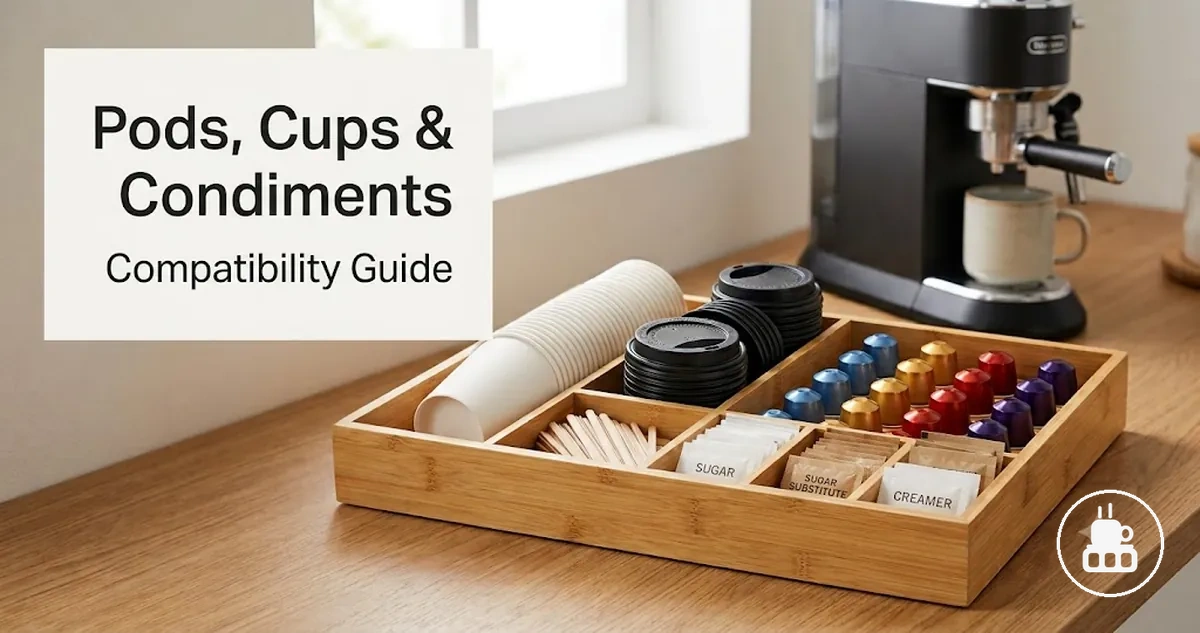
Coffee station organizer compatibility for pods, cups, and condiments depends on supply mix, compartment design, capacity balance, and countertop access conditions. When these elements are not aligned, storage can become restricted or uneven, especially across different pod formats, cup stacks, lid sizes, and condiment packet volumes. The outcome is not fixed and varies based on how each supply is distributed across compartments and how easily users can reach and refill them. In practice, fit and access remain the main decision lens for evaluating whether the setup works smoothly in daily use.
A coffee bar organizer refers to a structured storage unit designed to hold coffee-related supplies such as pods, cups, lids, and small condiments in separated compartments for easier access. The coffee station organizers category covers different layouts that support mixed-supply storage without treating each item as an isolated system. These organizers typically combine compartment zones that separate fast-moving items like pods and cups from smaller refill items such as sweeteners and stirrers. Their purpose is to improve visibility, reduce clutter, and support consistent access on the countertop.
In real use scenarios, compatibility becomes clearer when pods, cups, lids, and condiments are evaluated together rather than individually. A setup may support pods efficiently but still feel constrained if cup stacks or lid storage require more vertical clearance or front access space than available. Similarly, small condiment packets can become harder to manage if compartments are too deep or not visibly separated. These variations show that compatibility is shaped by how evenly supply types are distributed across the organizer structure.
When mismatches occur, the main issue is usually not the organizer itself but how supply types interact with compartment size, visibility, and refill flow. Adjusting layout distribution or prioritizing frequently used items for more accessible zones can improve balance without changing the entire setup. In most cases, performance depends on aligning storage zones with usage frequency and physical supply shape, rather than expecting a uniform fit across all items.
Supply scope for pod, cup, lid, and condiment storage
Supply scope for pod, cup, lid, and condiment storage refers to the defined set of coffee station supplies that a coffee station organizer is designed to hold in shared or separated compartments. It focuses on pod storage, cup storage, lid storage, and condiment storage as the main groups that operate under one same storage job. These groups shape compartment layout, visibility, and refill flow based on how different items need to be accessed during daily use.
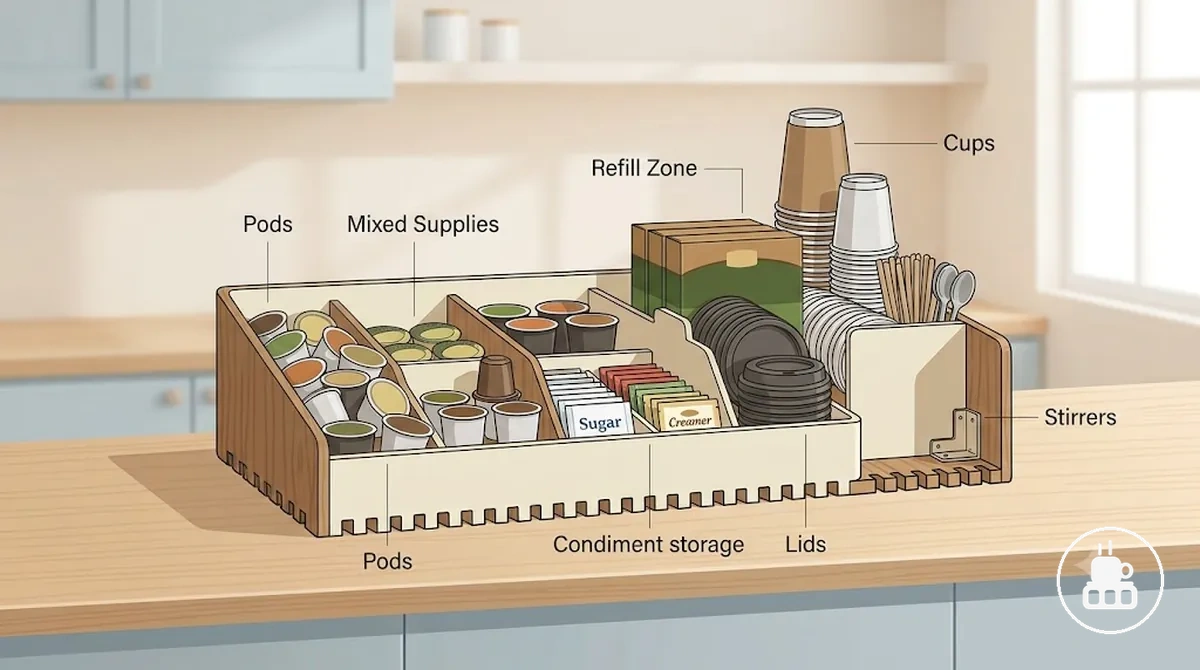
This supply scope determines what belongs inside a coffee station organizer and what sits outside its functional boundary. Pod storage often requires structured compartments for capsules to stay visible and easy to refill, while cup storage depends on stacking height and clearance. Lid storage is shaped by diameter and access alignment, and condiment storage includes smaller items that need shallow, visible placement. This boundary separates mixed-supply storage from a full coffee station setup that may extend beyond core coffee station supplies.
When grouping coffee station supplies into one system, the focus stays on items that share the same storage job and benefit from compartmental separation. The following groups represent the core scope of what typically belongs together in pod, cup, lid, and condiment storage.
- Pods or capsules as pod storage items that require structured and visible compartments for consistent refill access.
- Disposable cups as cup storage elements that rely on stacking support and clearance for easy reach.
- Cup lids as lid storage components that depend on diameter-aligned compartments for smooth access.
- Stirrers as small coffee station supplies that fit shallow compartments for quick daily use.
- Sugar packets as condiment storage items that benefit from visible grouping for fast selection.
- Creamer packets as small supplies that require organized separation to reduce clutter.
- Sweetener packets as compact condiment storage items that share the same storage job and refill flow.
Compatibility factors for mixed coffee station supplies
Compatibility factors for mixed coffee station supplies depend on whether each supply type has a stable, reachable, and appropriately sized storage zone. This determines how mixed coffee station supplies interact inside a shared organizer space without creating overflow or access issues. The balance between compartment depth, compartment width, and reach directly affects the overall fit condition across different items.
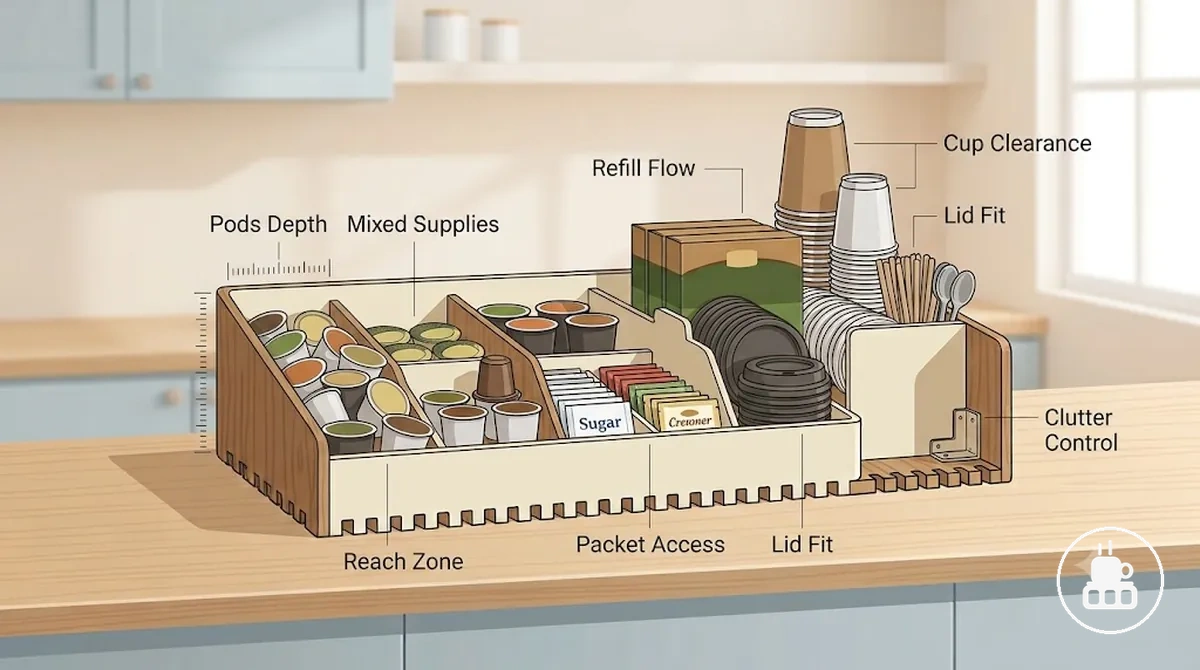
One organizer must handle different supply shapes, so compatibility factors for mixed coffee station supplies are shaped by how compartments support visibility, refill flow, and clutter control. Pods typically rely on depth and visibility, while cups and lids depend on clearance and structured stacking space. Smaller packets and stirrers depend more on shallow reach and quick access, which changes how storage zones are distributed. These differences prepare the EAV structure used to evaluate fit condition across supply types.
| Supply type | Fit attribute | Value or condition | Effect or decision |
|---|---|---|---|
| Pods | Compartment depth & visibility | Medium depth with clear front view | Reduces overflow and improves refill control |
| Cups | Width & clearance | Stable stacking space | Prevents tipping and supports easy reach |
| Lids | Diameter alignment | Matched circular compartments | Improves access and reduces misplacement |
| Stirrers | Shallow access | Low-profile compartment zone | Enables quick grab without clutter buildup |
| Sugar/creamer packets | Reach & visibility | Front-access shallow space | Reduces mess and improves selection speed |
| Mixed refill supplies | Compartment balance | Shared moderate zones | Keeps refill flow organized and reduces clutter |
The table shows that compatibility is driven by how supply type, attribute, and condition interact to influence access and clutter outcomes. When compartment depth supports pods but not packets, or when cup clearance conflicts with lid spacing, the fit condition becomes uneven. A suitable organizer is identified when storage zones remain balanced across reach, visibility, and refill needs rather than favoring only one supply type.
When mixed coffee station supplies compete for limited space, compatibility depends on prioritizing the most frequently accessed items in the most reachable zones. This often requires separating tall stacking needs from shallow packet storage to maintain consistent flow. When these conditions conflict, fit depends on which storage requirement is more critical for daily use.
Pod format and capsule storage fit
Pod format and capsule storage fit depends on how pod format, capsule storage, and K-Cup style units align with compartment depth, opening width, and storage orientation inside the organizer. Loose pods and structured capsules behave differently in visibility and movement, so storage performance changes based on how they are positioned and supported. In most cases, consistent format alignment improves visibility, refill access, and retrieval stability.
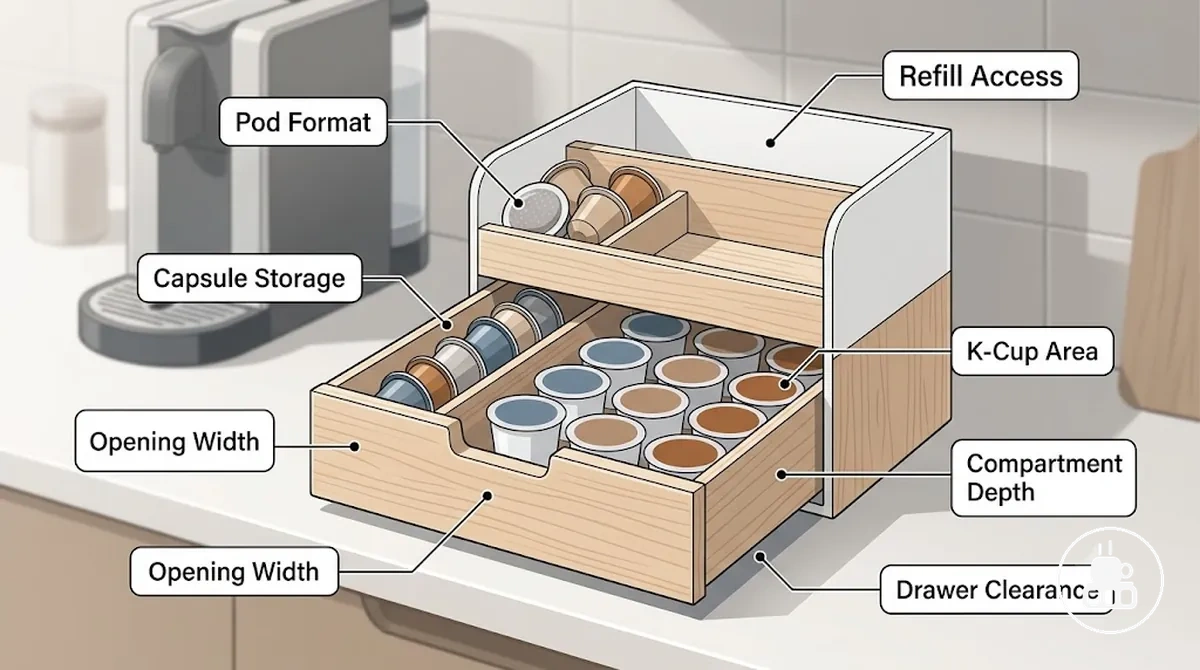
When pod format does not match opening width, drawer clearance, or compartment depth, capsules may shift, stack unevenly, or become hidden behind other units. Loose pods often increase overflow risk if loose pods and structured capsule storage are mixed without clear separation. K-Cup style units may also vary in retrieval speed depending on orientation and how tightly the storage area holds each capsule type. These conditions affect visibility and refill access, especially when the storage zone does not maintain stable orientation or clear front access paths.
Disposable cup and lid size fit
Disposable cup and lid size fit depends on cup stack diameter, lid stack diameter, and height clearance within a cup and lid organizer. The fit between disposable cups and cup lids is shaped by how rim shape, stacking method, and compartment width align with vertical clearance inside the storage zone. In most cases, diameter alignment and height clearance determine whether disposable cups and lids remain stable in the cup stack and lid stack, along with how easily they can be accessed.
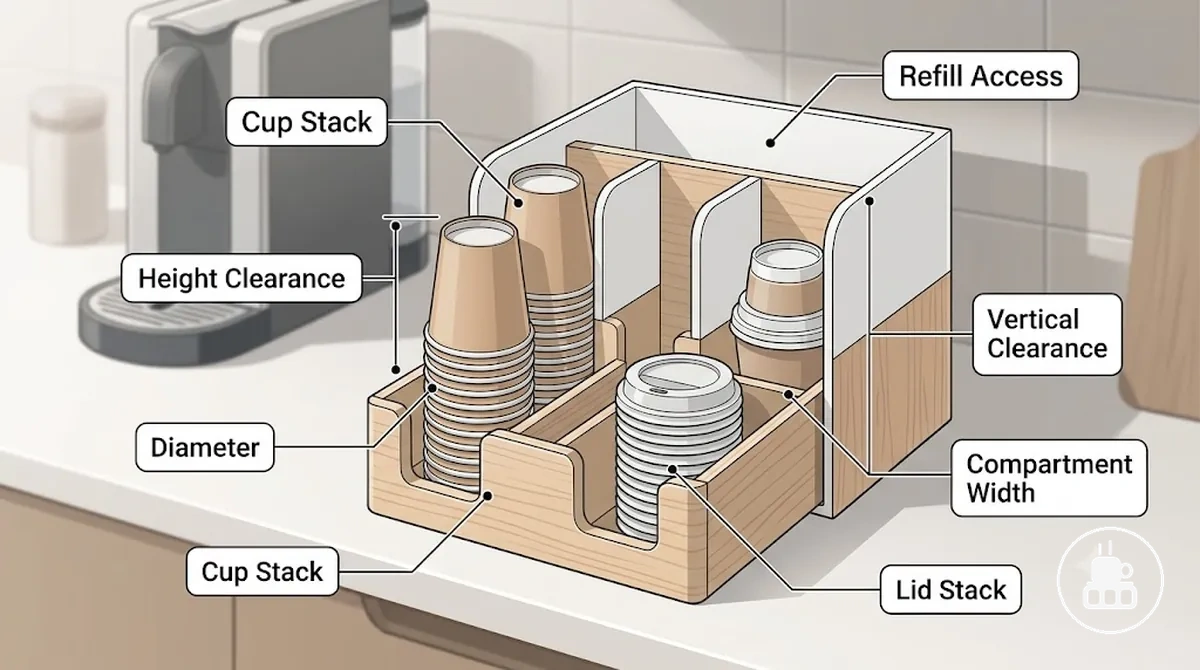
Disposable cup and lid size fit depends on cup stack diameter, lid stack diameter, and vertical clearance, and the checklist below verifies how these factors affect tipping, jamming, or wasted-space risk.
- Cup diameter alignment with compartment width
- Lid diameter alignment with lid holder space
- Cup stack height relative to vertical clearance
- Compartment width for stable placement
- Vertical clearance for smooth stacking movement
- Refill movement space for easy access
When these conditions are not aligned, disposable cups and cup lids may shift within the cup stack or lid stack, which can lead to tipping, jamming, or wasted-space risk depending on how tightly or loosely the storage area supports diameter and height conditions.
Stirrer, sugar, creamer, and packet access fit
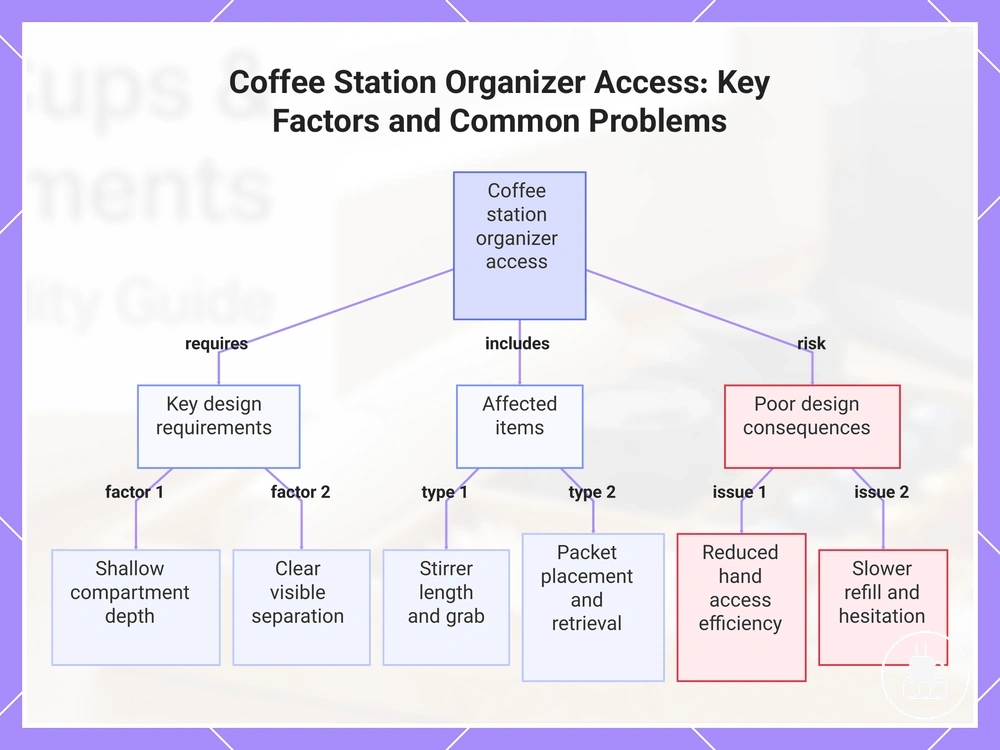
Stirrer, sugar, creamer, and packet access fit depends on how stirrers, sugar packets, creamer packets, and sweetener packets align with shallow compartment depth, hand access, and visible separation inside a coffee station organizer. Longer stirrers and small condiment packets behave differently in storage, so access quality changes based on how clearly each item is divided and reached. In most cases, stable fit relies on shallow reach and visible separation.
When storage is too deep or not clearly separated, stirrers can become harder to grab while small packets may get buried behind others, reducing hand access efficiency. In shared-use setups, this can slow refill timing and increase hesitation during selection.
- Stirrers length relative to shallow compartment depth and easy hand access
- Sugar packets placement based on visible separation for quick selection
- Creamer packets depth alignment affecting reach and retrieval speed
- Sweetener packets positioning to reduce clutter in shallow storage zones
- Packet access clarity to support smooth refill timing and reduce hesitation
In scenarios where compartments are too deep or poorly segmented, stirrer length may interfere with quick access while packet depth can lead to slower refill timing and occasional mess from misplaced or hidden items, especially when visible separation is not maintained.
This chart shows how coffee station organizer access depends on shallow compartment depth and visible separation, and what problems arise when these requirements are not met.
Compartment layouts for keeping supplies separate and reachable
Compartment layout is the structural arrangement that controls how coffee station supplies are separated, seen, reached, and restocked inside a coffee station organizer. It defines how fixed compartments, adjustable dividers, drawers, tiers, and upright slots distribute space for pods, cups, lids, and packets. This arrangement directly shapes separation, visibility, reach, and restocking outcomes across mixed supplies.
When compartment layout does not match supply shape, items can become harder to access or less visible during use. Fixed compartments often provide predictable separation but may create wasted space when supply sizes vary. Adjustable dividers can improve flexibility for mixed items but may reduce efficiency if poorly configured. Drawers, tiers, and upright slots each shift how visibility and reach work, depending on whether items are hidden, stacked, or presented vertically. The comparison below shows how each layout affects access and restocking behavior.
Compartment layouts for keeping supplies separate and reachable vary in how they balance separation, visibility, reach, and restocking. The comparison below outlines how each layout performs under different use conditions.
| Layout option | What it helps store | Access strength | Watch-out |
|---|---|---|---|
| Fixed compartments | Pods, lids, uniform items | Strong separation and predictable reach | May waste space when supply sizes differ |
| Adjustable dividers | Mixed pods, packets, variable supplies | Flexible separation and adaptable reach | Can reduce efficiency if set poorly |
| Drawers | Small packets, stirrers, mixed items | Controlled access with hidden storage | Lower visibility during quick selection |
| Tiers | Cups, lids, stacked supplies | Improved vertical visibility and reach | Can limit restocking flexibility |
| Upright slots | Cups, lids, flat items | Fast reach with clear visibility | May reduce separation for smaller items |
Layout choice depends on how much separation, visibility, reach, and restocking flexibility is needed for mixed supplies. If supply sizes vary, adjustable dividers may improve control, while fixed compartments may suit stable setups. The decision is often guided by compartments and capacity planning, where layout structure is balanced against overall space use and supply requirements.
A common misunderstanding is that more compartment divisions always improve organization. In practice, excessive partitioning can reduce reach and create unused gaps when supplies do not match the layout structure. Effective compartment layout depends on balancing separation with practical access rather than maximizing the number of divided spaces.
Open caddy compartments and adjustable dividers
Open caddy compartments and adjustable dividers are layout attributes that control separation, visibility, and access opening in a coffee station organizer. They influence pod support, cup support, and packet support by changing how space is divided and reached inside the storage area. This structure is mainly used when handling uneven supplies.
In an open caddy, items can shift more freely, so adjustable dividers are used to improve control over placement and separation. Divider stability, access opening, and visibility directly affect pod support, cup support, and packet support depending on how evenly uneven supplies are distributed. When divider stability is low, pods may move out of place and reduce pod support, while inconsistent spacing can weaken packet support and reduce visibility. Wider access opening can improve reach for cup support but may also increase supply migration if the layout is not tightly controlled. Adjustable dividers help when uneven supplies need flexible separation, but they can fail when stability is weak or when open caddy movement is too high, leading to reduced control over placement and organization.
Drawer, tiered, and upright storage layouts
Drawer layout, tiered layout, and upright storage are compartment layout variations that influence how visibility, reach, and countertop footprint behave inside a coffee station organizer. Each layout changes how cups, lids, and small supplies are presented and accessed, which affects whether items remain visible or become partially hidden during use. The way space is divided or exposed directly shapes visibility, reach, and footprint outcomes.
Drawer layout provides enclosed storage that can place items in a hidden supplies condition, reducing surface clutter but limiting immediate visibility. Tiered layout uses vertical stacking that improves visibility across layers, while upright storage presents cups or lids in a vertical position that supports direct reach. These differences affect how quickly items are accessed and how much countertop footprint is required. The comparison below shows how each layout behaves in terms of visibility and reach.
Compartment layouts for keeping supplies separate and reachable include drawer layout, tiered layout, and upright storage layouts. The comparison below highlights their local trade-offs in visibility and reach.
| Layout | Strong use | Limitation |
|---|---|---|
| Drawer layout | Supports hidden supplies and reduces visible clutter | Reduces visibility during quick access |
| Tiered layout | Improves vertical visibility and structured access | Can increase countertop footprint in tight spaces |
| Upright storage | Enables direct reach for cups and lids via cup holder or lid holder setups | May limit flexibility for mixed supply arrangements |
Choice between drawer layout, tiered layout, and upright storage depends on whether the priority is hidden supplies control, vertical visibility, or direct reach. Each layout changes how space is used, so performance varies with supply mix and available countertop footprint conditions.
Capacity balance across daily-use coffee station supplies
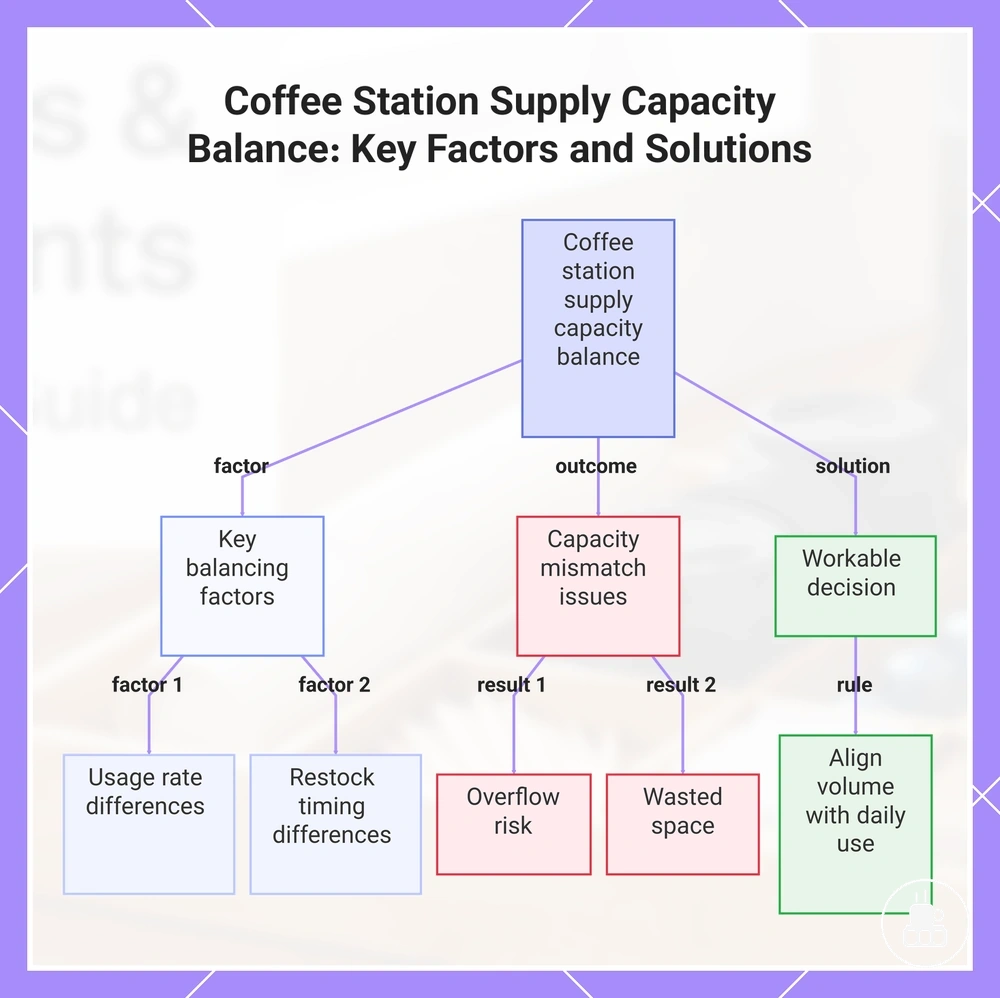
Capacity balance across daily-use coffee station supplies depends on daily use and refill frequency across each supply category. Cups and pods often require different compartment volume than sweeteners and stirrers because their usage rates are not equal in daily routines. This balance is shaped by how fast-moving supplies and slow-moving supplies interact within the same storage system, especially when refill frequency changes across the setup.
Equal-looking compartments may not support equal-use supplies because usage rate and restock timing differ across supply category types. A quick check of daily-use behavior helps clarify how compartment volume should be distributed.
- Daily cup use rate compared to available compartment volume
- Pod consumption frequency within fast-moving supplies
- Lid use consistency relative to storage access cycles
- Packet turnover for sweeteners and other slow-moving supplies
- Refill frequency changes across different supply categories
- Overflow risk when fast-moving supplies exceed allocated space
Capacity issues often appear when fast-moving supplies like cups and pods share similar compartment volume with slow-moving supplies such as sweeteners and stirrers. When this mismatch occurs, overflow or wasted space can develop depending on refill frequency and usage rate differences. A workable capacity decision depends on aligning compartment volume with daily use patterns rather than assuming equal distribution across all supply categories.
This chart shows the main factors shaping capacity balance at a coffee station, the capacity issues that result from misalignment, and the core solution for a workable compartment volume decision.
Countertop access conditions for mixed supply organizers
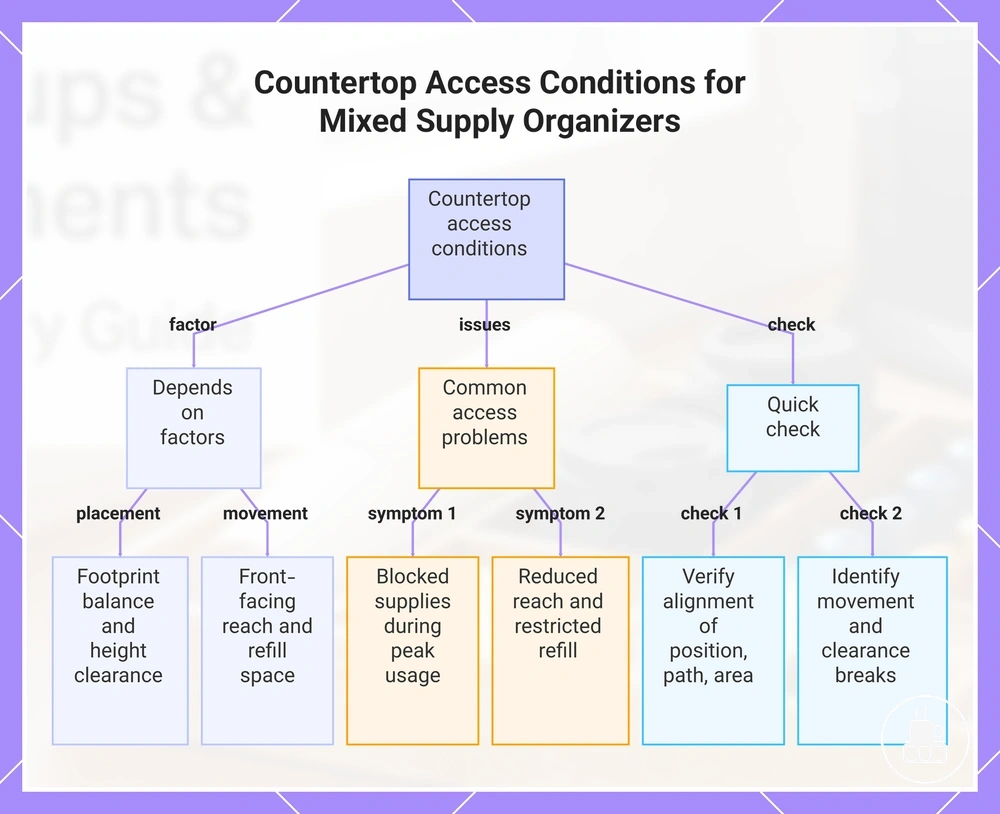
Countertop access conditions for mixed supply organizers depend on counter position, reach path, and machine area alignment with daily coffee use flow. These conditions determine how easily cups, pods, and condiments move through the space without interruption. A stable organizer fit requires alignment between counter position, reach path, and machine area so that access remains consistent during use.
Access problems typically occur when countertop access is not aligned with the reach path or when the machine area limits movement. This can lead to blocked supplies, reduced front-facing reach, and restricted refill space during daily use. A quick check of access conditions helps identify where movement or clearance breaks down before it affects usability.
- Footprint balance relative to counter position
- Height clearance around the machine area
- Front-facing reach for direct access to supplies
- Refill space for smooth restocking flow
- User flow and movement across the counter
- Risk of blocked supplies during peak usage
Even when storage capacity is sufficient, poor countertop access can still reduce effectiveness if the reach path is interrupted or the machine area blocks movement. For example, a suitable organizer may still fail in practice when front-facing reach is limited by equipment placement or heavy user flow. This shows that capacity alone is not enough when access conditions restrict movement or create blocked supplies during use.
This chart shows the key factors, common problems, and quick checks for countertop access conditions that determine the usability of mixed supply organizers.
Material visibility and durability for stored pods, cups, and condiments
Material choice affects material visibility, durability, and day-to-day usability for stored pods, cups, and condiments by changing how clearly items are seen, how surfaces respond to wipe-down cleaning, and how wear develops over time. Acrylic and clear plastic increase material visibility, while wood, bamboo, metal, and mesh vary in durability and surface finish depending on moisture exposure and usage intensity.
Material categories differ in how they balance visibility, durability, and cleaning effort. Acrylic and clear plastic prioritize transparency, which improves quick identification of pods, cups, lids, and condiment packets. Wood and bamboo depend more on surface finish, which influences how they respond to moisture exposure and routine wipe-down care. Metal and mesh focus more on structural durability and shared-use conditions, while mixed-material designs combine these behaviors across different storage zones. These differences define how each material performs in daily use, so the comparison below highlights their storage impact.
| Material | Visibility effect | Cleaning or wear condition | Best-fit supply situation |
|---|---|---|---|
| Acrylic / clear plastic | High material visibility for pods and condiment packets | Typically supports easy wipe-down surfaces but may show surface marks over time | Fast access to small mixed supplies |
| Wood / bamboo | Lower visibility due to opaque surface finish | More dependent on surface finish and may be affected by moisture exposure | Station setups prioritizing natural finish over visibility |
| Metal / mesh | Moderate visibility with open structure and partial view | Often supports higher durability under shared use, with visible wear depending on finish | High-traffic use with cups and lids |
| Mixed-material designs | Variable visibility depending on section material | Varies by component, balancing wipe-down ease and wear resistance | Multi-zone organizers for pods, cups, and condiments |
Material choice directly influences how efficiently stored supplies are recognized and maintained during daily use. Acrylic or clear plastic improves visibility for faster pod and packet identification, while wood and bamboo shift focus toward surface finish and moisture exposure sensitivity. Metal and mesh are better suited for shared-use environments where durability is more important than full concealment. These differences make material selection a balance between visibility, cleaning effort, and durability rather than a single fixed preference.
Choosing a compatible organizer for home, office, or breakroom supply use
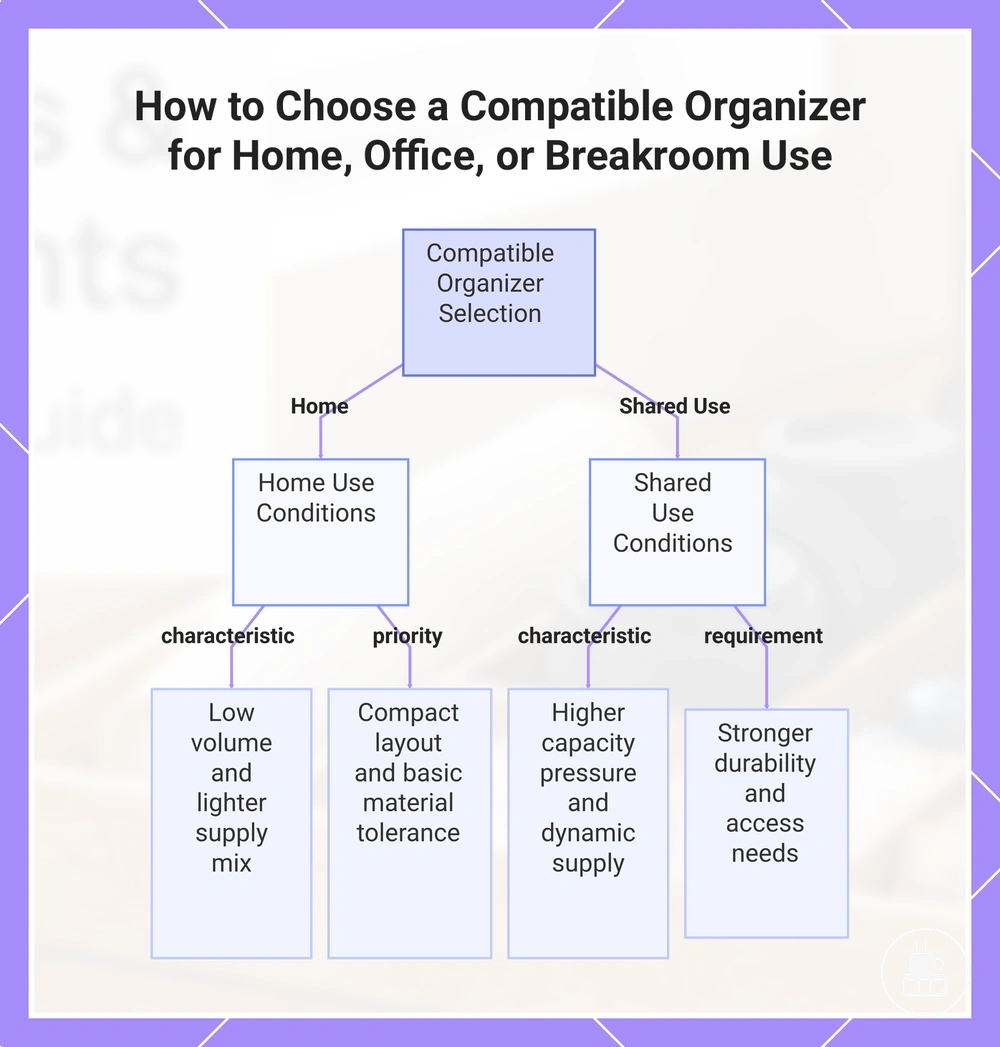
Choosing a compatible organizer depends on supply mix, usage context, capacity pressure, access needs, and material tolerance. These factors determine how well pods, cups, lids, and condiments fit into daily routines while maintaining visibility and smooth access across different environments.
Home use typically involves low volume and lighter supply mix, where countertop access and visibility matter more than high structural durability. Refill frequency is usually lower, and access needs are simpler because fewer users interact with the station. In these conditions, a compatible organizer can prioritise compact layout and basic material tolerance without heavy capacity pressure.
Office use and breakroom use introduce shared station demands where refill frequency increases and supply mix becomes more dynamic across users. In these environments, durability and access needs become more critical due to higher capacity pressure and repeated handling. This is where office and breakroom supply storage becomes essential for maintaining consistent visibility and organised access across shared use conditions.
When capacity pressure rises, mismatches between material tolerance and supply mix can reduce efficiency and create clutter around access points. Higher refill frequency can also expose weaknesses in compartment design, especially where durability is not aligned with shared use. A compatible organizer must therefore balance structural strength with access flow to prevent disruption under continuous use conditions.
The final decision depends on aligning supply mix, refill frequency, visibility, durability, access needs, and material tolerance with the intended use context. Home use prioritises simplicity, while office use and breakroom use require stronger durability and higher capacity handling. These criteria ensure the organizer remains functional under varying pressure levels across different environments. :contentReference[oaicite:0]{index=0}
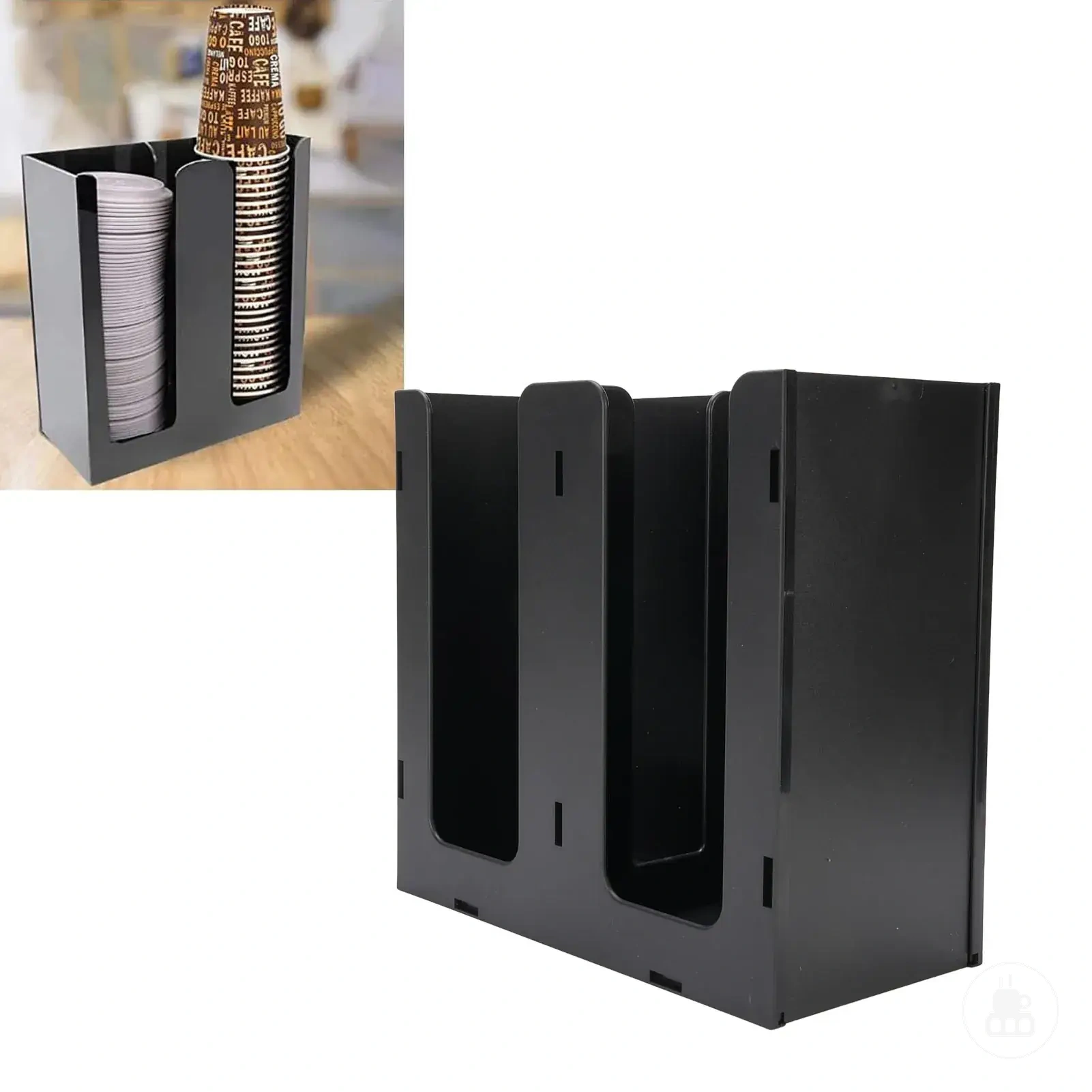
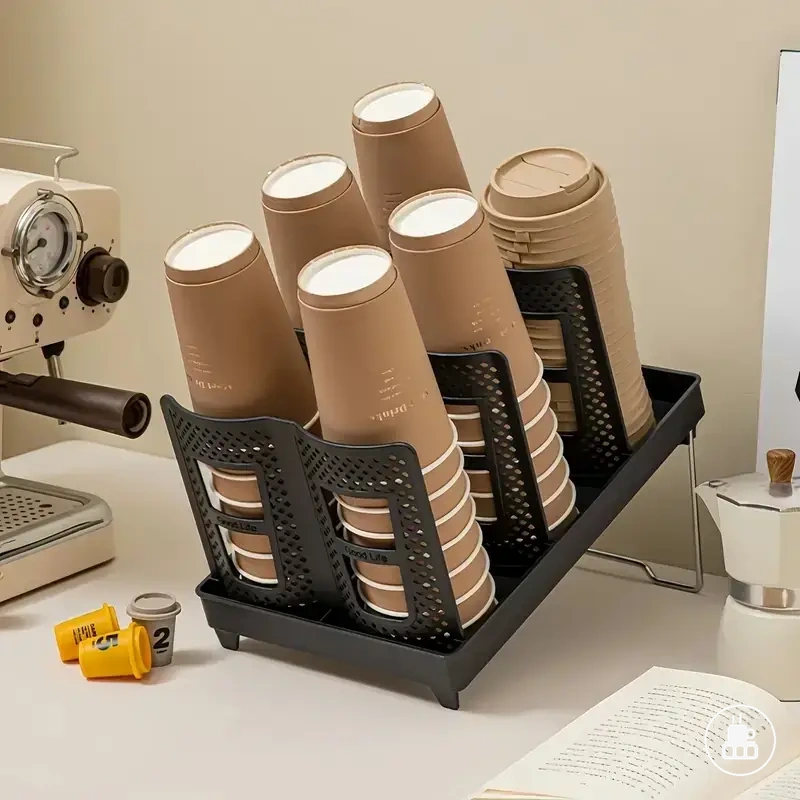
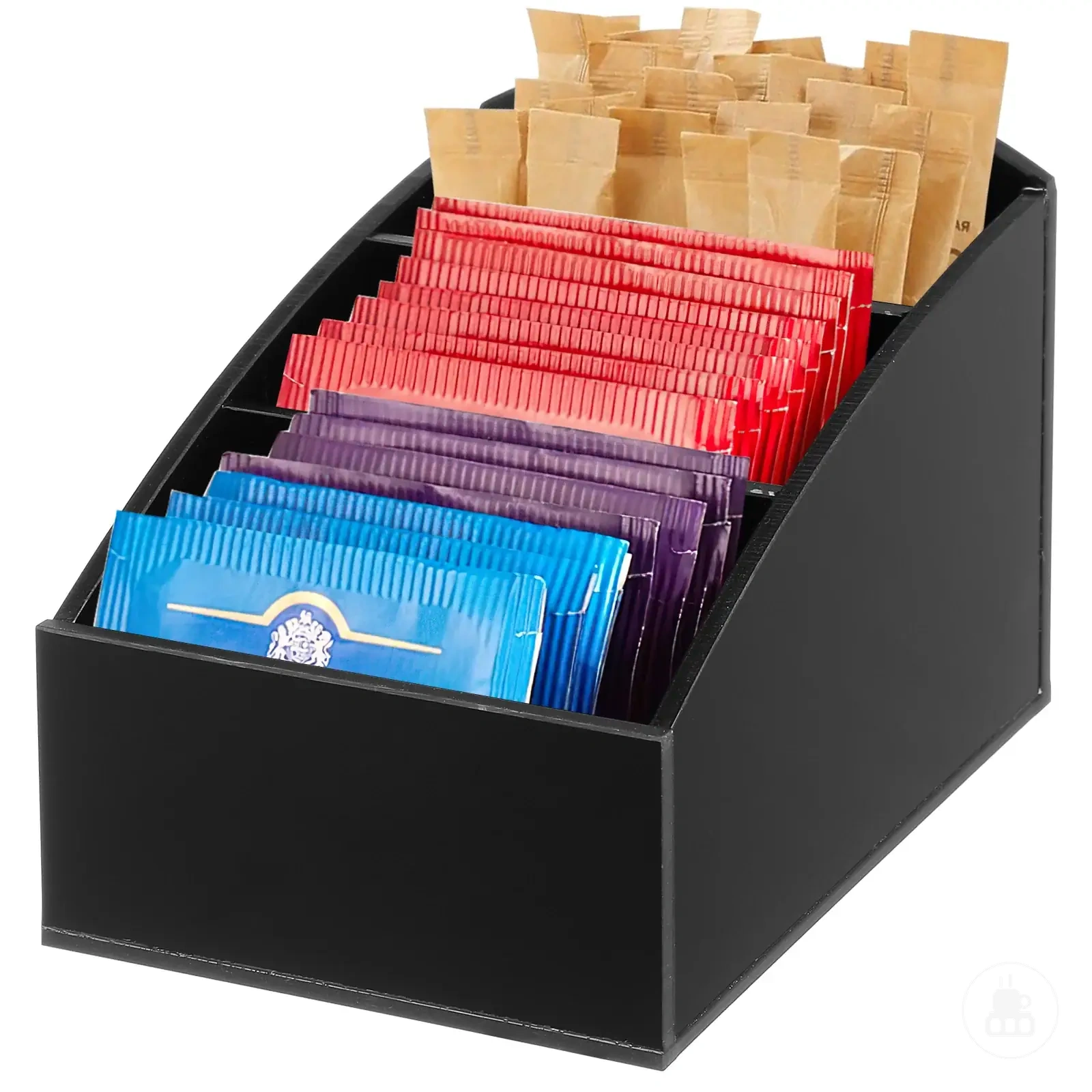
The products below are useful examples for comparing available options. Before buying, check that the compatibility criteria, key features, and product details match your needs.
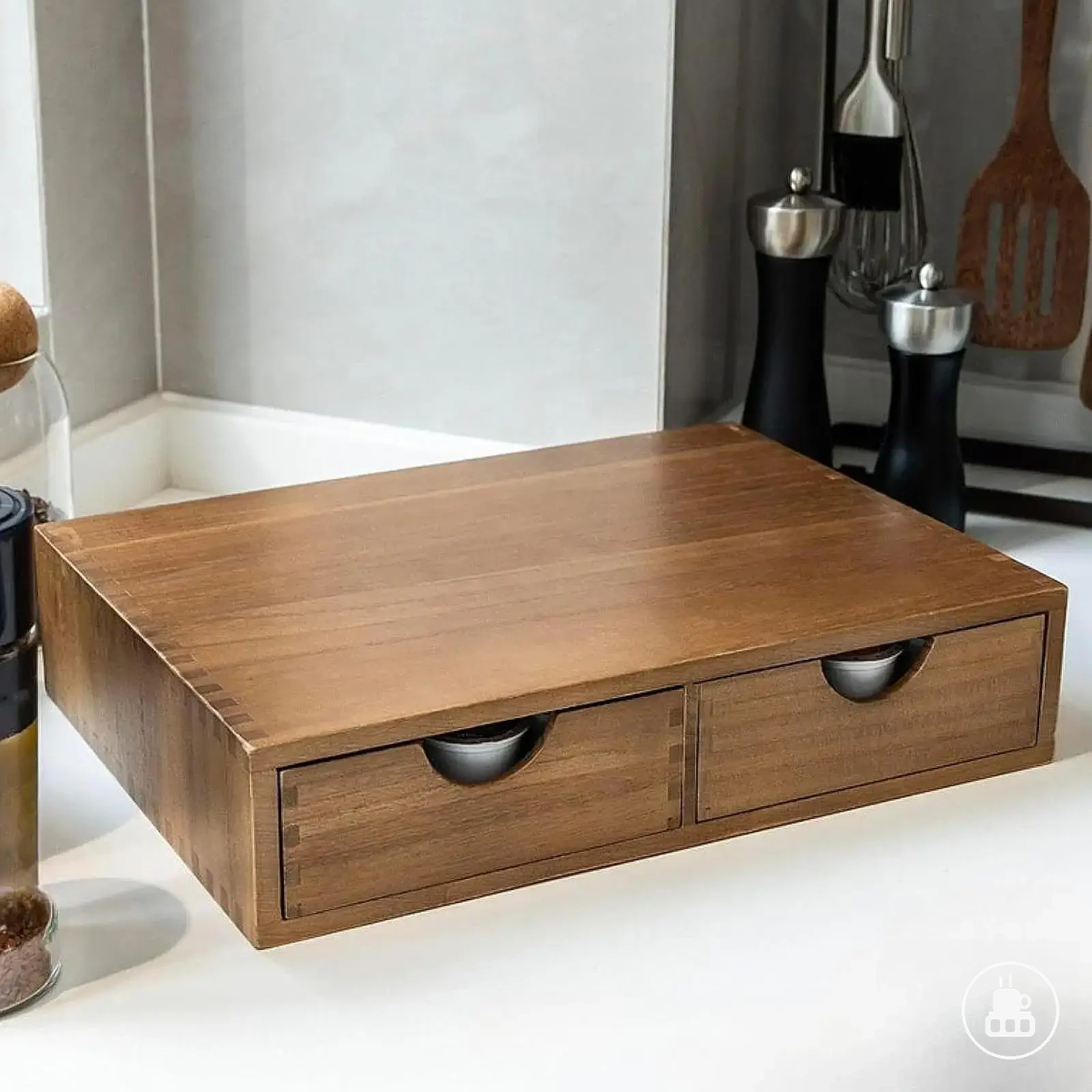
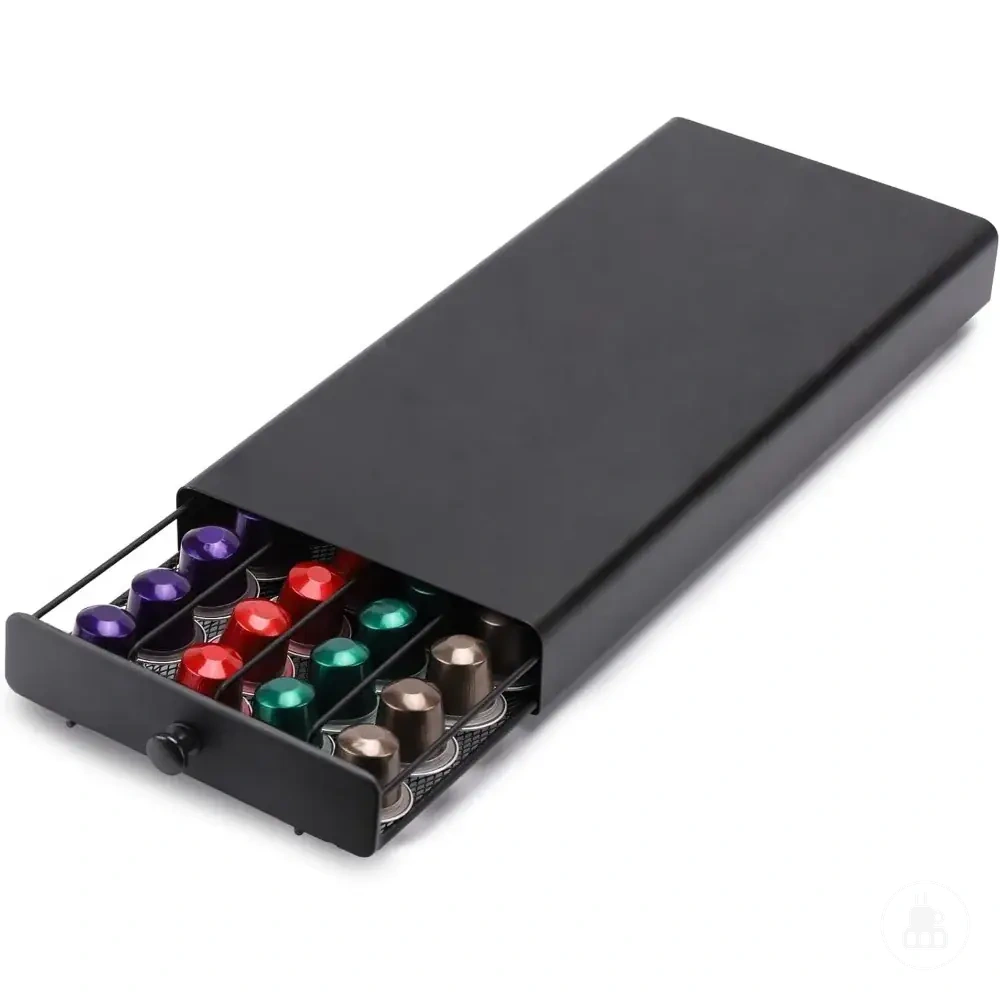
This chart compares the key conditions and priorities for selecting a compatible organizer in home use versus shared office or breakroom environments.
When pods, cups, and condiments need separate storage zones
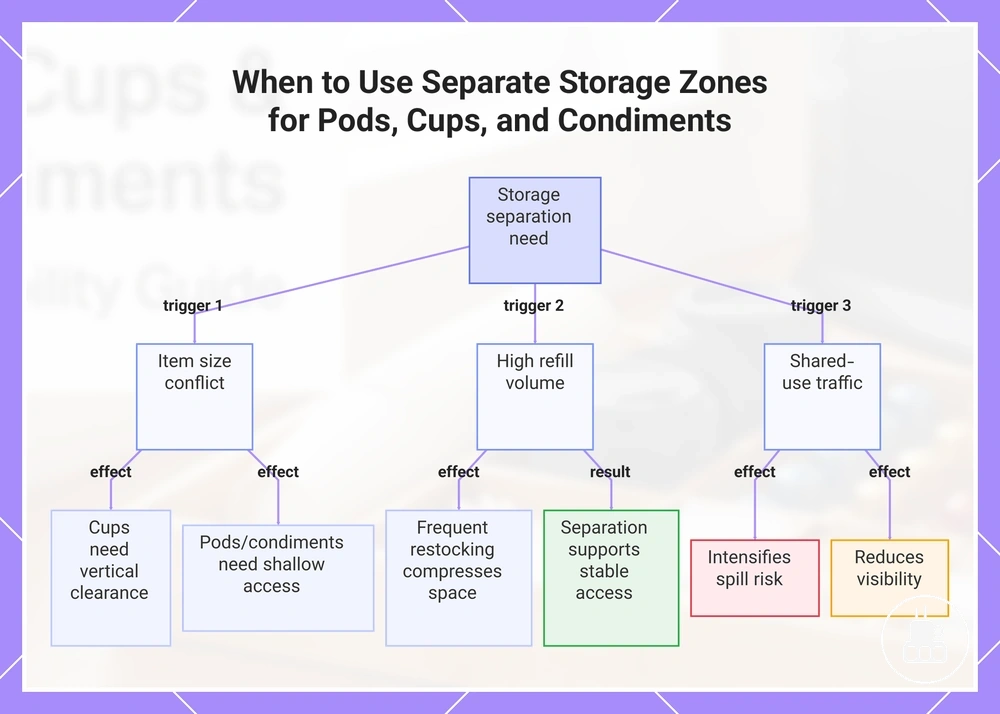
Separate storage zones become relevant when pods, cups, and condiments cannot stay efficiently organized in a single combined organizer due to differences in use patterns and access demands. This decision depends on how item size conflict, high refill volume, and visibility loss affect day-to-day handling across the shared station.
A combined organizer can work when supply movement is balanced, but it becomes less effective when pods, cups, lids, and condiments compete for uneven space. Item size conflict often appears when cups require vertical clearance while pods and condiment packets need shallow access zones. In these cases, separation reduces overlap and improves functional access between different supply types.
Shared-use environments increase shared-use traffic, which can intensify spill risk and visibility loss because multiple users interact with the same storage points. High refill volume can also disrupt a single layout when frequent restocking compresses available space. In these conditions, separate storage zones or nearby separated storage may better support stable access patterns and reduce clutter during peak use conditions.
Choosing between a combined organizer and separate storage zones depends on balancing supply mix complexity, shared-use traffic, and access consistency. When capacity pressure is low, a single organizer may still be sufficient, but as item size conflict and refill frequency increase, separation becomes a more reliable structural choice for maintaining order across pods, cups, lids, and condiments.
The products below are useful examples for comparing available options. Before buying, check that the compatibility criteria, key features, and product details match your needs.
This chart shows the key triggers that determine when separate storage zones are needed instead of a combined organizer for pods, cups, and condiments.