Coffee Station Organizers for Small-Space Counter Fit
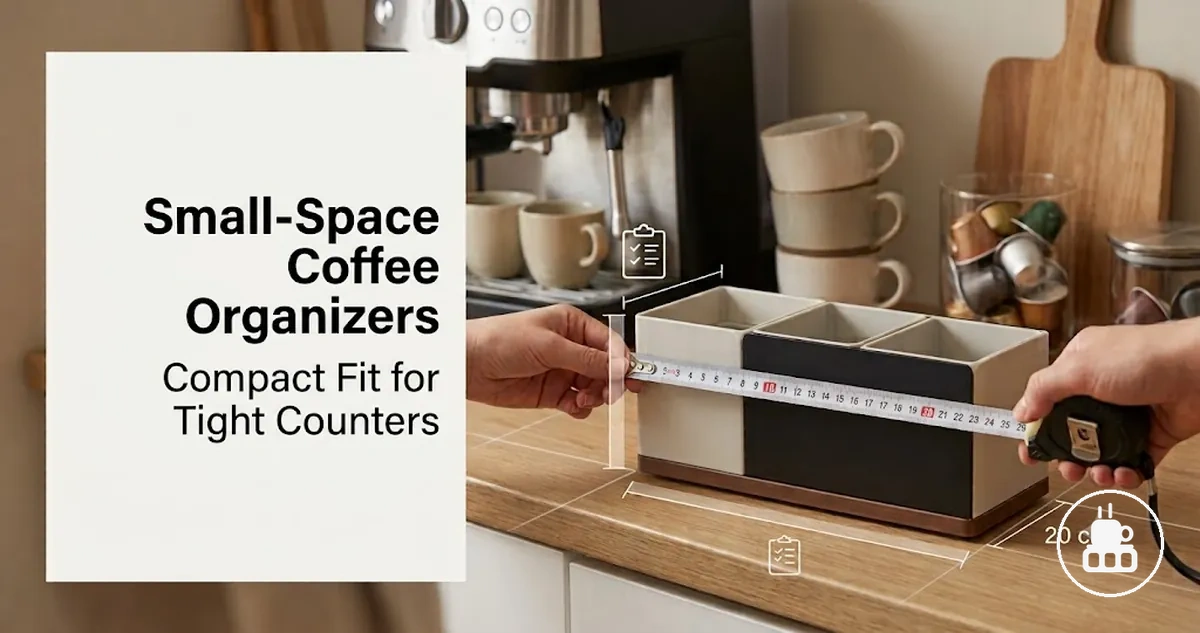
Coffee station organizers for small space counter fit depend on footprint, clearance, storage format, and counter layout rather than compact size alone. Tight counter conditions require balancing access for cups, pods, and supplies with available machine space, so fit is always a conditional decision shaped by layout and usage.
A coffee station organizer is a structured storage solution for arranging coffee machine setups, reachable cups, pods, and daily supplies in a controlled counter layout. A coffee station organizer for small space fit is commonly understood through coffee station organizers as a broader system that organizes countertop zones rather than acting as general coffee bar decor. In small-space environments, the focus stays on how storage format interacts with clearance and machine access, not visual styling alone.
When a tight counter is involved, the main challenge is maintaining usable surface area while avoiding blocked access to machines, cabinets, or frequently used supplies. A compact organizer can still fail if footprint or clearance is not aligned with the counter layout, especially when cups, pods, and other supplies must remain reachable without cluttering movement zones. This makes footprint and clearance the first decision layer before selecting storage format.
What makes a coffee station organizer work in a small space
A small-space coffee station organizer works when it reduces counter spread while keeping reachable supplies close to the coffee machine. It supports compact storage that preserves access instead of blocking daily movement. This balance between function and space use defines whether the setup actually works in a tight counter environment.
A small-space coffee station organizer is a compact countertop system that structures how cups, pods, and supplies are arranged around a coffee machine. It relies on contained storage and vertical use to manage visual clutter while keeping daily items accessible. It works only when counter layout, machine placement, and access path remain coordinated across everyday use conditions, which sets it apart from general coffee bar storage that focuses more on appearance than function.
Problems usually appear when compact storage increases crowding instead of improving flow on a tight counter. When this happens, access to cabinets, outlets, or the machine itself becomes restricted, reducing practical usability. What makes a coffee station organizer work in a small space becomes easier to understand when its function is tied to real movement patterns rather than static placement. What makes a coffee station organizer work in a small space is often clearer when shown visually, especially in relation to how compact boundaries interact with reachable supplies and machine access.
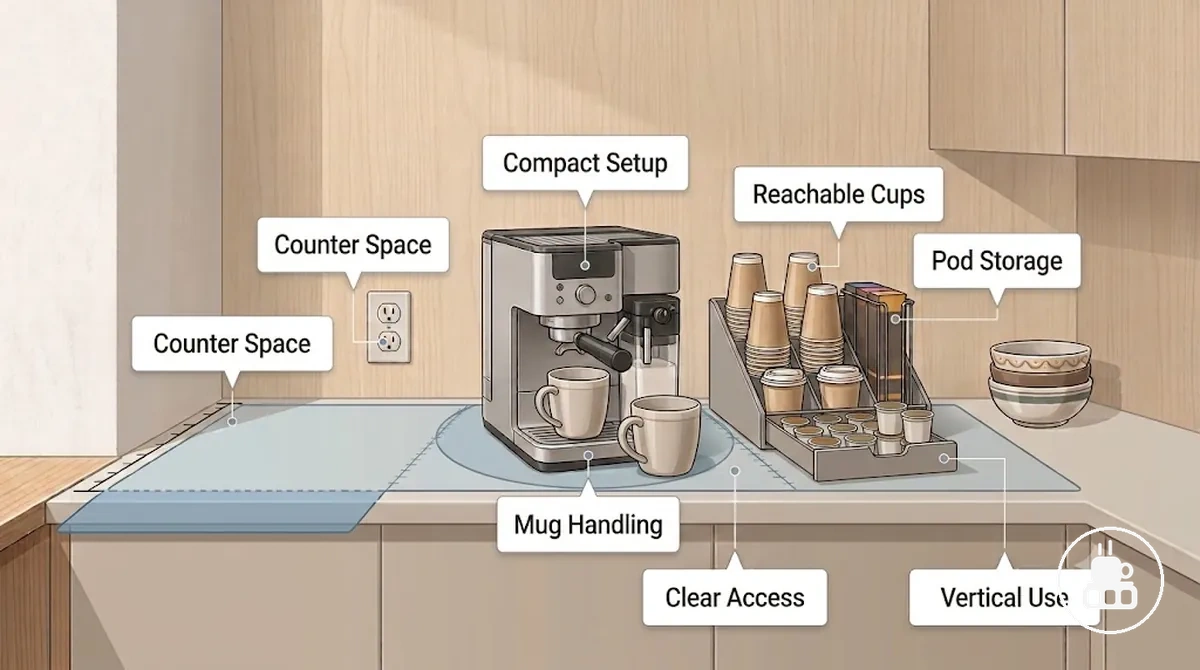
What makes a coffee station organizer work in a small space can be summarized through the conditions that control counter spread and access behavior.
The key working conditions include how storage supports daily use without increasing clutter or blocking movement paths.
- Footprint control that limits counter spread while preserving usable space
- Vertical use that keeps cups, pods, and supplies reachable without spreading outward
- Contained storage that reduces visual clutter while maintaining access paths
- Clear machine access that avoids blocking outlets, cabinets, or operating space
- Realistic supply limits that match daily use instead of overloading compact storage
Counter footprint, clearance, and reach space for compact organizers
A compact organizer fits a tight counter when footprint, clearance, and reach space work together with the overall counter layout. These three factors determine whether the setup stays usable or becomes restrictive in daily use. Fit depends on how space is distributed around the coffee machine, not just the size of the organizer, making this triad the main sizing reference.
The same compact organizer may sit comfortably on one counter but feel restrictive on another due to differences in counter depth and machine-side clearance. A deeper counter can absorb more footprint without reducing access, while shallow layouts increase pressure on reach space and hand movement. Machine-side clearance also shifts how cups, pods, and supplies are positioned around the workflow, affecting usability across different kitchen setups.
Fit variables become easier to evaluate when each element is separated into its function and impact on counter behavior. These variables connect to broader sizing logic in dimensions and counter fit, which helps relate footprint and clearance decisions.
The breakdown below organizes how footprint, clearance, and reach space influence compact organizer performance in real use conditions.
| Entity/part | Attribute/criterion | Value/condition | Effect/risk/decision |
|---|---|---|---|
| Footprint | Counter space usage | Larger or compact base area | Determines counter spread and available working space |
| Counter depth | Surface allowance | Shallow or deep layout | Limits or supports organizer placement stability |
| Machine-side clearance | Adjacent spacing | Open or restricted side zone | Affects access to machine and workflow flow |
| Cabinet height | Vertical restriction | Low or high overhead space | Limits vertical stacking or tiered storage |
| Outlet access | Power reach zone | Accessible or blocked socket | Impacts machine placement flexibility |
| Reach path | Hand movement flow | Clear or obstructed access | Controls ease of grabbing cups, pods, supplies |
| Hand movement | Daily usability | Unrestricted or constrained motion | Defines overall workflow comfort |
The diagram illustrates how footprint, clearance, and reach space interact on a tight counter.
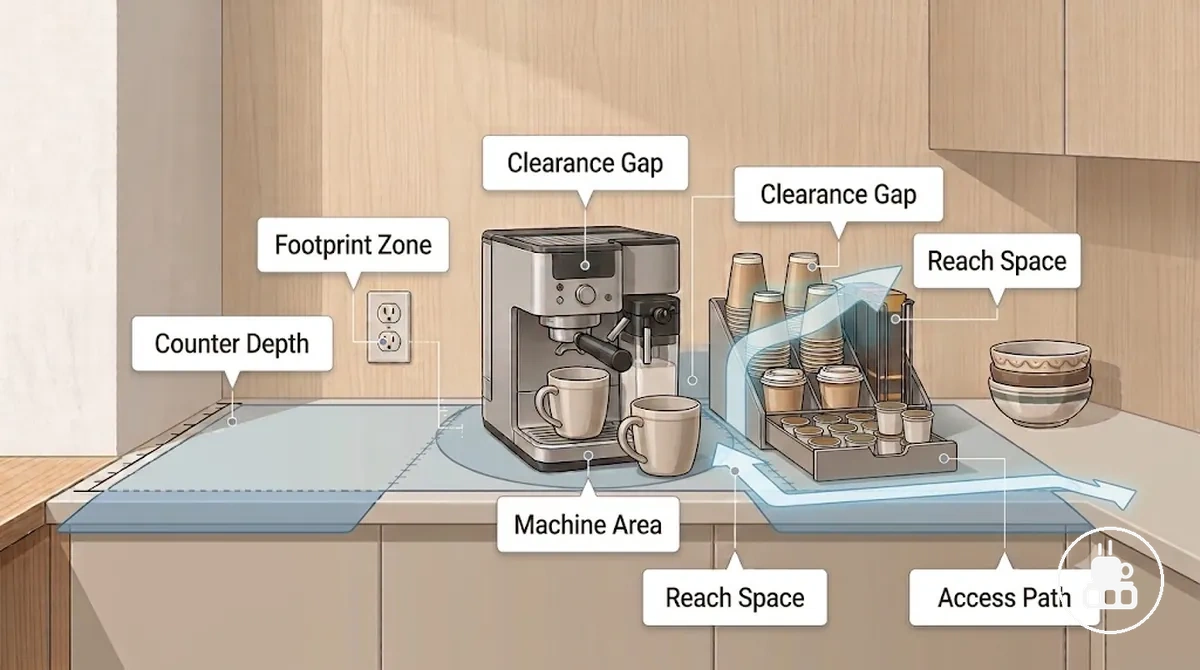
Footprint, clearance, and reach space together determine whether a compact organizer improves or restricts a small coffee setup. Fit is not fixed and shifts with counter depth, machine position, and surrounding access zones. A compact organizer may work well on a wide counter with open clearance but feel constrained on a shallow layout with limited reach space.
Width and depth limits on tight counters
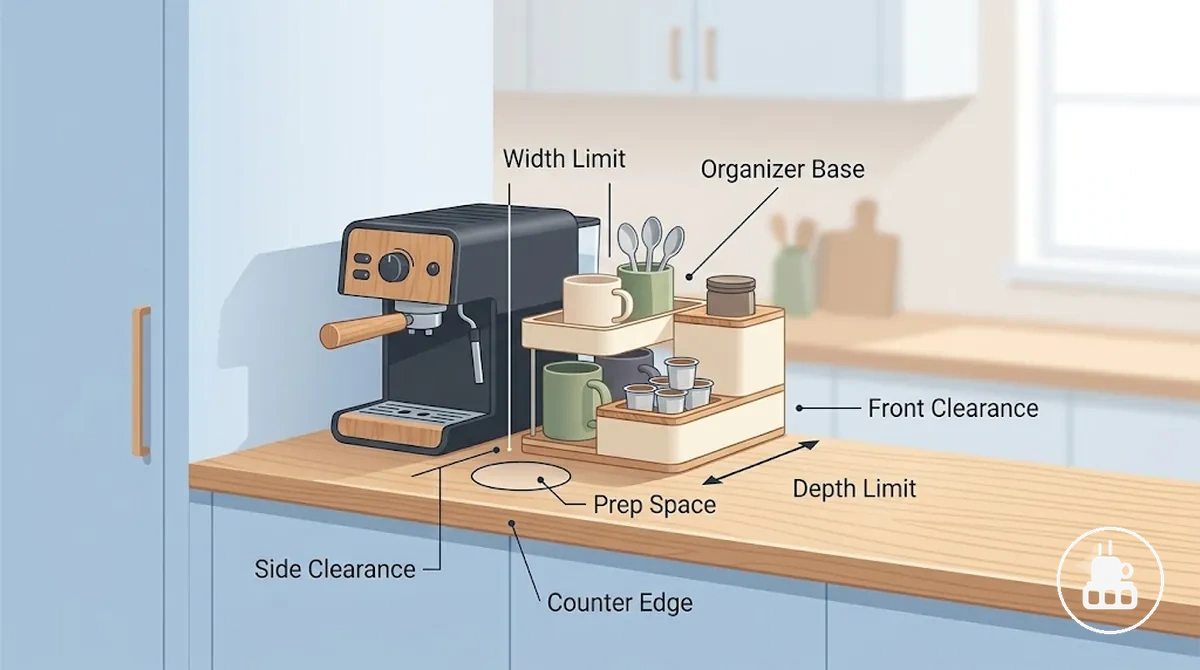
Width and depth on tight counters determine whether a compact organizer can sit near the coffee machine without crowding prep space. The organizer base width controls side-to-side pressure, while depth affects how far it extends into the working surface. When either dimension increases, usable prep space on a narrow counter strip is reduced.
On a narrow counter, a wider organizer base may reduce side clearance next to the coffee machine, while deeper placement can push into front clearance and limit reach space for cups and pods. On a deeper counter, the same setup may fit without disrupting hand movement, depending on how the counter edge is used for layout. This variation shows why width and depth must be evaluated together before placement on a tight counter.
A quick check helps prevent crowding of prep space and blockage of the counter edge during daily use:
- Organizer base width and its impact on side clearance
- Front clearance between organizer and coffee machine
- Side clearance along the machine area and access zone
- Alignment with counter edge for stable placement
- Remaining prep space for cups, pods, and hand movement
Before final placement, review how width and depth interact on the same tight counter layout to avoid unintended restriction of working surface. This check is especially important when counter depth and machine position vary across setups.
Vertical clearance around machines, cabinets, and outlets
Vertical clearance around machines, cabinets, and outlets determines whether a compact coffee station organizer can sit under cabinetry or beside appliances without interfering with machine use. Organizer height interacts with cabinet underside spacing, appliance lid movement, outlet access, cord path, and top shelf reach. In many layouts, vertical clearance becomes a hidden compatibility condition that affects fit beyond counter width or depth.
A compact organizer that saves counter width through vertical storage may still create fit issues if organizer height reduces cabinet clearance or blocks appliance lid swing. Outlet access and cord path alignment can also be restricted when vertical clearance is tight, especially near wall-mounted sockets or low shelving. This creates a direct contrast between gaining working surface width and losing usable height clearance around machine use conditions.
Vertical clearance around machines, cabinets, and outlets defines compatibility issues that are not visible in horizontal layout planning.
A quick clearance check helps identify height-related conflicts before placement:
- Cabinet underside clearance above organizer height
- Appliance lid swing and opening space
- Outlet access and plug positioning
- Cord path direction and strain risk
- Top shelf reach and usability
- Wall clearance around machine use area
Daily reach space for cups, pods, and small supplies
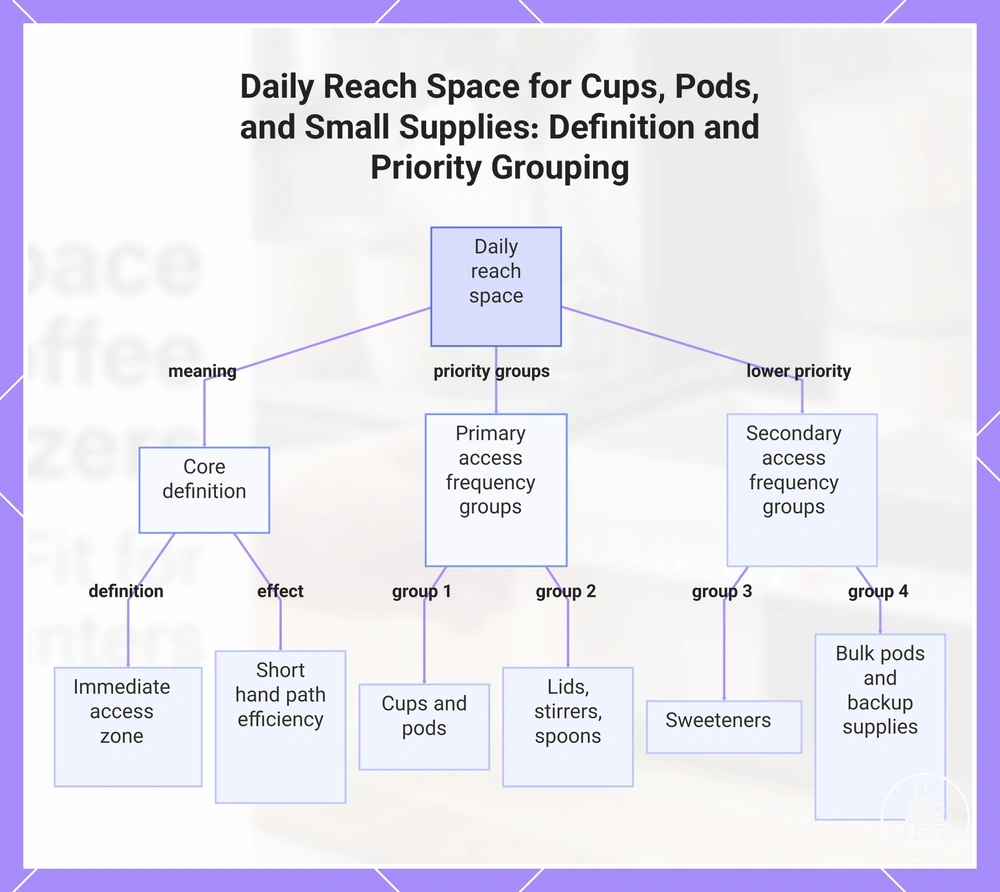
Daily reach space for cups, pods, and small supplies refers to the immediate access zone that keeps frequently used items within a short hand path during routine coffee preparation. It determines how efficiently daily supplies can be reached without disrupting machine use, and it directly ties reach space to access frequency and placement priority.
In everyday use, items with higher access frequency require closer positioning because repeated hand movement increases when reach space is poorly structured. Cups and pods typically sit in the closest zone, while other small supplies shift based on daily use patterns and available surface balance. This helps maintain a clear hand path while separating priority items from lower-use refill items, keeping detailed setup decisions outside this subsection.
To group supplies by access frequency:
- High frequency: cups, pods
- Daily use: lids, stirrers, spoons
- Occasional use: sweeteners
- Refill items: bulk pods and backup supplies
For broader layout decisions, refer to small coffee station setup when planning overall placement structure.
This chart shows the meaning of daily reach space and how to organize supplies by access frequency, highlighting the highest priority groups.
Compact organizer formats for tight counters
Compact organizer formats for tight counters depend on how each layout constraint is handled, especially footprint, access, and vertical clearance within a limited coffee station area. The correct format is determined by the specific space problem rather than visual preference, since each format reshapes how cups, pods, and small supplies fit around machine placement and daily reach zones.
Tight counters rarely fail because of storage capacity alone, but because different compact organizer formats respond differently to access flow, height limits, and surface restriction. Some layouts require vertical efficiency, while others need low-profile containment or improved access distribution across a small footprint. This makes format selection a structured comparison rather than a simple choice, which is why a comparison block is used below to map space problems to suitable solutions.
Each format aligns with a specific constraint pattern, and understanding this improves how compact organizer types relate to real counter limitations. Instead of treating formats as interchangeable, they should be matched to how footprint, access, and capacity interact in the actual setup.
In practice, the right choice depends on whether the main limitation is vertical restriction, limited surface area, or restricted access flow around the machine. Vertical units may work well when height is available, while trays or off-counter storage become more suitable when surface space is heavily constrained, but the final decision depends on overall layout conditions and daily usage patterns.
| Format | Space problem it solves | Main trade-off | Best-fit condition |
|---|---|---|---|
| Vertical units | Maximizes vertical space in small footprint | Can reduce cabinet clearance and upper access | Works when overhead clearance is available |
| Tiered units | Improves visibility and stacking efficiency | May reduce direct access to rear items | Suitable for structured daily-use layouts |
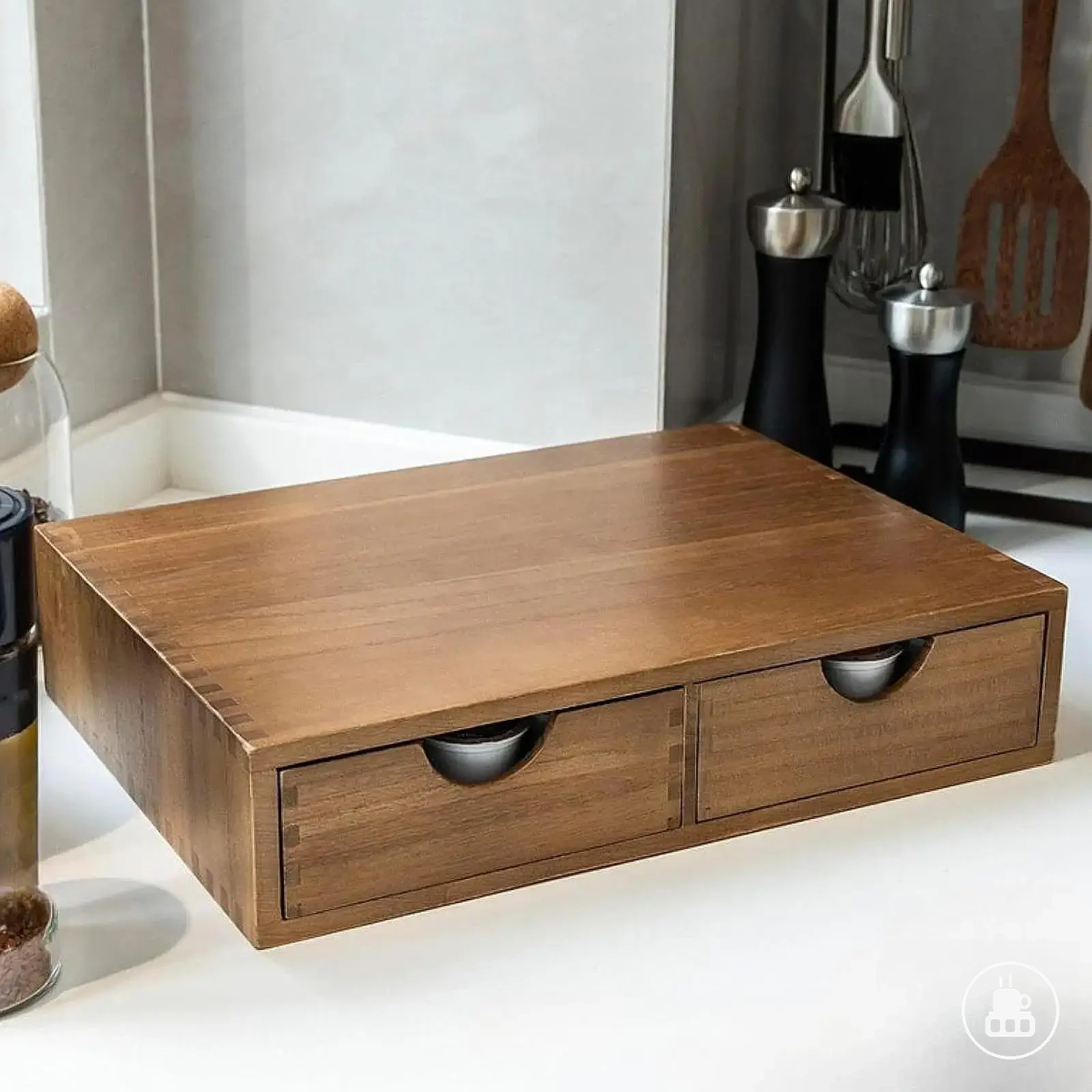
| Slim drawers | Hides small supplies while saving surface space | Slower access during frequent use | Best for organized but less frequent retrieval |
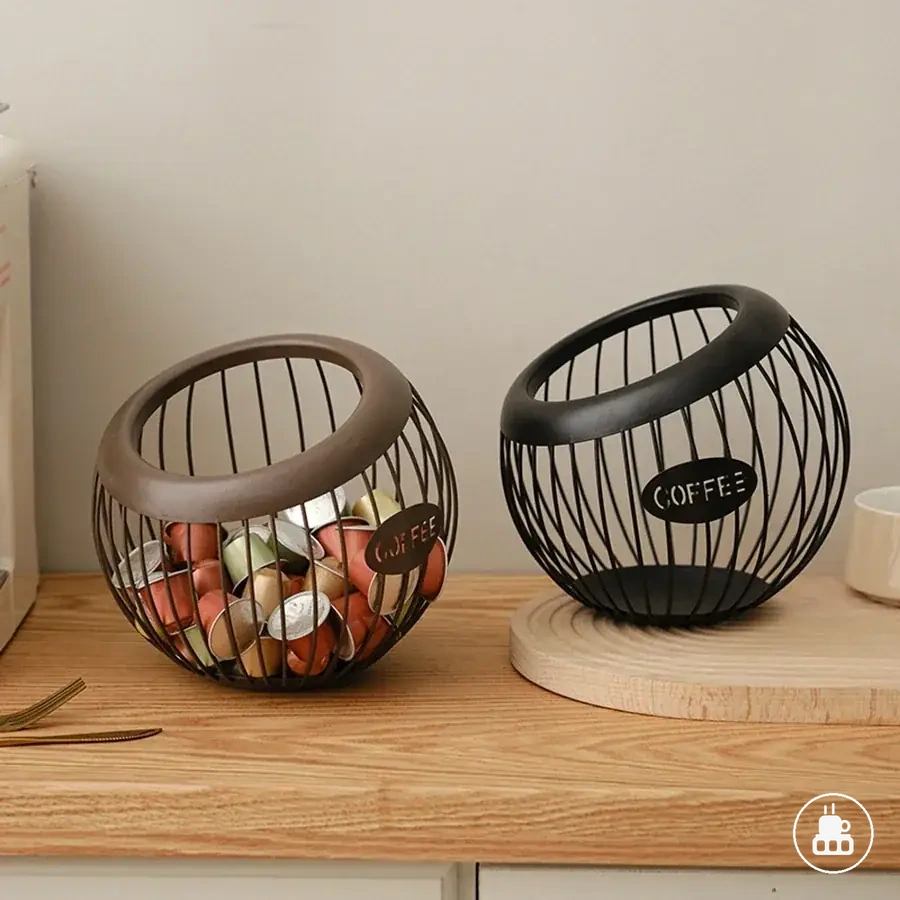
| Narrow pod holders | Reduces pod spread on limited counter area | Limited storage capacity | Works for compact pod-focused setups |
| Trays | Creates contained access zone on counter | No vertical optimization | Useful for flexible and movable arrangements |
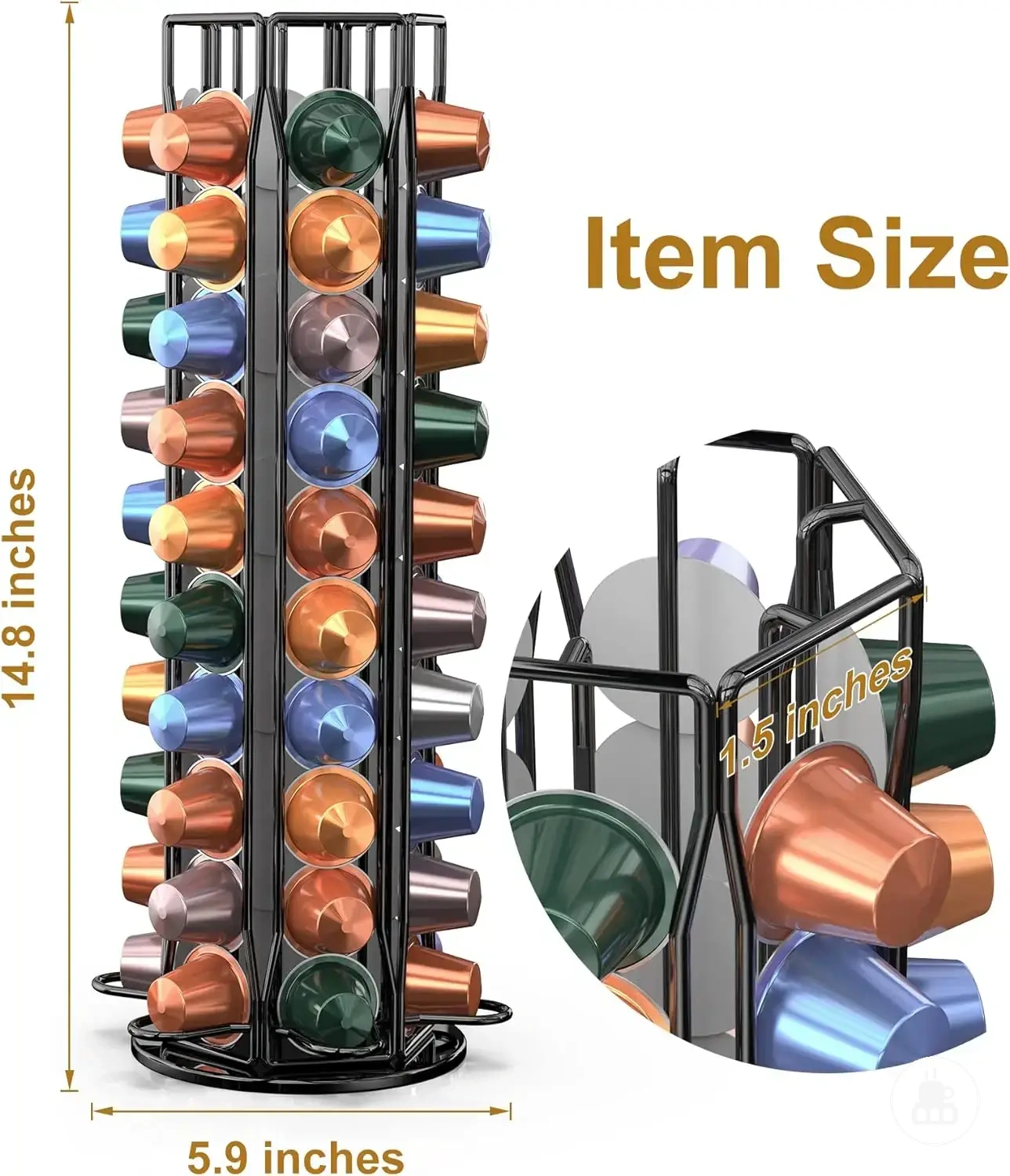
| Turntables | Improves rotational access in tight corners | Can waste edge space | Suitable for corner-based access zones |
| Off-counter storage | Removes clutter from the main counter surface | Reduces immediate access speed | Best when counter space is extremely limited |
Format choice becomes clearer when the dominant constraint is identified first, because compact organizer formats behave differently under pressure from footprint limits, vertical clearance, and access needs. When the setup prioritizes speed of use and direct reach, low-barrier formats may be preferred, but when surface space is the main issue, off-counter or vertical solutions may become more suitable depending on the overall configuration.
Vertical and tiered organizers for upward storage
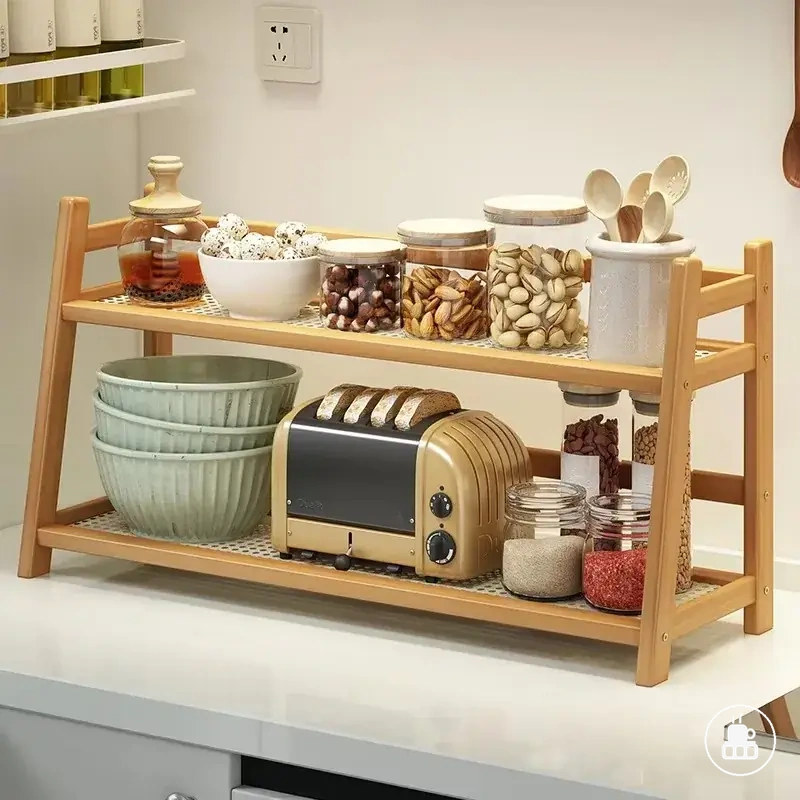
Vertical organizer and tiered organizer formats support upward storage by shifting cups, pods, and small supplies from horizontal spread into stacked or elevated layers when counter width is limited. Shelf height and tier spacing shape how effective this structure is because they influence visibility, refill access, and daily reach. In tight layouts, upward storage reduces footprint usage while introducing conditions such as top-heavy risk and cabinet compatibility depending on available vertical space.
When counter width is restricted, vertical and tiered organizers can improve access by concentrating items upward, but performance depends on how shelf height aligns with cabinet clearance and how stable the structure remains during daily use. Tier spacing also affects visibility and refill access, while imbalance can increase top-heavy risk in narrower setups with limited base support. The trade-off between space efficiency and stability can be summarised below.
| Pros | Limits |
|---|---|
| Reduces horizontal footprint on tight counters | May increase top-heavy risk in narrow setups |
| Improves visibility through tier spacing | Can reduce cabinet compatibility due to height |
| Supports better refill access in stacked layouts | Requires careful shelf height alignment for stability |
Narrow pod holders and slim drawer organizers
Narrow pod holder and slim drawer organizer control pod storage by containing pods in either exposed vertical clusters or enclosed sliding compartments, preventing spread across the counter. Pod capacity and drawer height determine how many pods can be stored without affecting machine placement, while sliding clearance and front access shape how easily pods are reached. Refill convenience depends on whether access is open in a narrow pod holder or pull-out in a slim drawer organizer. These formats mainly differ in how they manage machine placement and counter containment.
In tight coffee station layouts, pod access patterns change depending on how often pods are refilled and how close the storage sits to the machine. A narrow pod holder usually keeps pods visible and immediately reachable, while a slim drawer organizer prioritizes hidden storage with guided sliding access. The distinction between narrow pod holder and slim drawer organizer becomes clearer when evaluating access flow and space control.
| Format | Access style | Space behavior | Main constraint |
|---|---|---|---|
| Narrow pod holder | Front-facing open access | Minimal counter spread, visible pods | Limited pod capacity and exposure to clutter |
| Slim drawer organizer | Sliding pull-out access | Contained storage within drawer height | Requires sliding clearance and machine placement alignment |
Trays and turntables for contained counter zones
Tray and turntable systems define a contained counter zone by grouping coffee supplies within a clear footprint boundary instead of spreading items across the counter. A tray keeps items fixed inside one stable boundary, while a turntable introduces controlled rotation space for access. Handle clearance, spill containment, visual neatness, and supply limits depend on how tightly the contained counter zone is structured around the coffee setup.
In practical use, trays support a fixed layout where items stay aligned within a static zone, while turntables support rotational access that can improve reach in tighter corners when rotation space is available. Both formats rely on how much handle clearance exists around surrounding objects and how much space is available for movement. However, containment does not increase storage capacity in a meaningful way, especially when supply limits and surface area define the usable zone.
| Tray | Turntable |
|---|---|
| Fixed footprint boundary with static placement | Rotational access within defined rotation space |
| Improves visual neatness through stable positioning | Improves access flow through spinning movement |
| Minimal movement, strong stability | Higher access flexibility, needs clearance for rotation |
Wall-mounted and off-counter pod storage
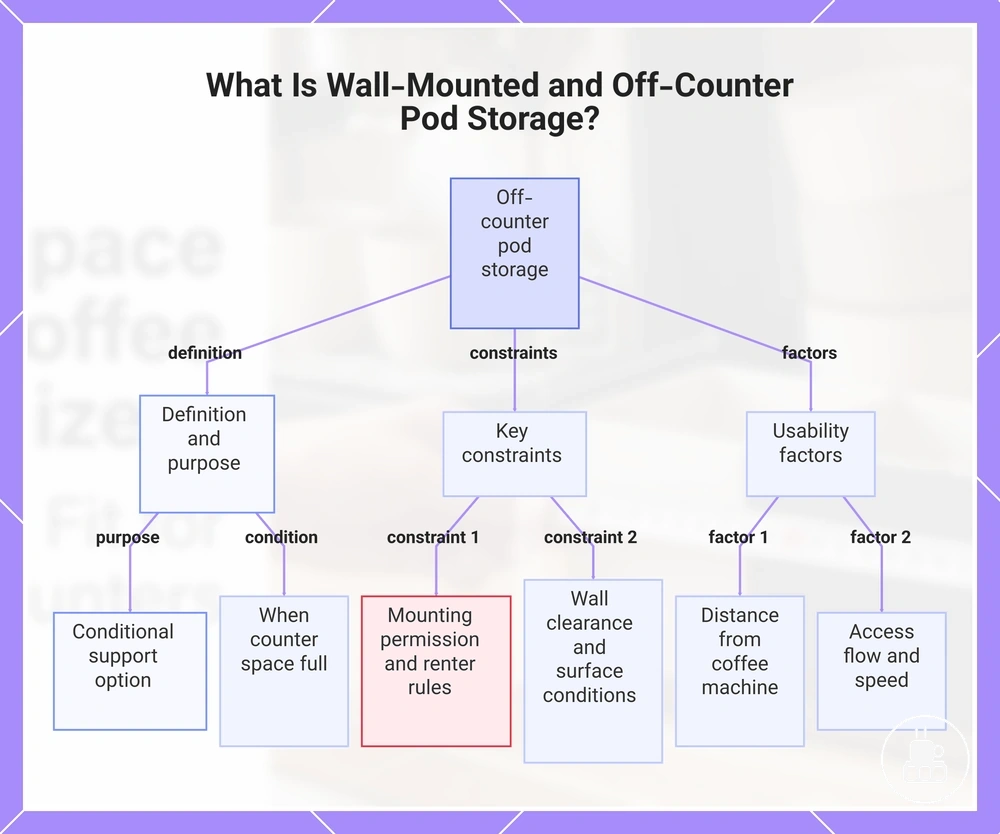
Wall-mounted and off-counter pod storage refers to storage placed outside the main countertop to support pod organisation when daily supplies cannot fit within the available counter space. Off-counter storage depends on wall clearance, mounting surface conditions, pod access proximity, and overall placement relative to the coffee machine. It is typically used as a conditional support option rather than a primary storage method, especially when countertop space is already fully allocated.
When countertop storage is insufficient, wall-mounted pod storage or cabinet storage can reduce surface load but introduces constraints related to refill path, distance from the machine, and daily access flow. Renter constraints may also affect whether a suitable mounting surface is available. While off-counter storage can improve spatial distribution, usability often depends on how far pods are positioned from the machine and whether access remains practical during routine use, especially when wall clearance limits positioning flexibility.
- Mounting permission and renter constraints
- Wall clearance around the storage area
- Distance from the coffee machine
- Refill path efficiency and movement flow
- Pod access speed during daily use
This chart explains the meaning of off-counter pod storage and the key constraints and usability factors that affect its practical use.
Storage capacity without expanding the footprint
Storage capacity without expanding the footprint refers to usable capacity within a fixed counter area, where efficiency is measured by how much daily storage fits into the same footprint rather than how many items can be stored at maximum count. This separates usable capacity from maximum item count alone and focuses on practical storage performance in small layouts.
In compact coffee station setups, usable capacity changes based on how pod count, cup storage, lid storage, and packet compartments are distributed within the same footprint. Increasing drawer depth or vertical stacking may raise storage volume, but it can also increase overflow risk when access becomes restricted or when refill frequency exceeds comfortable handling flow. As more supplies are added into a fixed zone, crowding increases and usable capacity may no longer match daily usability expectations.
Usable capacity should therefore be evaluated through the relationship between storage parts and space behavior rather than total item count. Elements such as drawer depth, vertical stacking, and compartment segmentation influence how efficiently footprint is used. This structure helps identify when storage supports daily use and when it begins to approach overflow risk in a confined counter zone.
Capacity signals across different storage elements can be compared using an entity-attribute-value view to understand how footprint constraints affect decision outcomes.
| Supply area | Capacity signal | Space condition | Decision effect |
|---|---|---|---|
| Pods | Pod count | Drawer depth or container space | Affects refill frequency and access flow |
| Cups | Cup storage | Stacking or rack placement | Can increase counter crowding when overfilled |
| Lids | Lid storage | Small compartment allocation | May create clutter if not structured |
| Packets | Packet compartments | Segmented storage zones | Limits expansion but improves organisation |
| Drawers | Drawer depth | Horizontal enclosure capacity | Balances hidden storage with access speed |
| Vertical shelves | Vertical stacking | Height-based expansion within footprint | Increases capacity with potential stability trade-off |
Storage capacity without expanding the footprint depends on balancing usable capacity and overflow risk within a fixed counter zone. Everyday capacity supports routine access to pods, cups, and lids, while additional storage beyond that level often functions as backup stock that is used less frequently and depends on refill patterns rather than daily workflow needs.
Pod capacity versus organizer size
Pod capacity refers to how pod capacity changes in relation to organizer size, including width, depth, height, and access convenience. It depends on pod row count and compartment depth, which directly affect how efficiently pods are stored within a given organizer size. This relationship determines whether storage supports practical use or becomes limited by wasted internal space and reduced access convenience.
In real usage scenarios, pod capacity is influenced by mixed pod types and how evenly they fit across compartment depth and row structure. A larger organizer size may increase pod count, but it can also create inefficient internal spacing if access convenience is reduced or if storage zones remain partially unused. Refilling behavior also affects this balance, since higher refill frequency may reduce the practical benefit of increased capacity in daily use conditions.
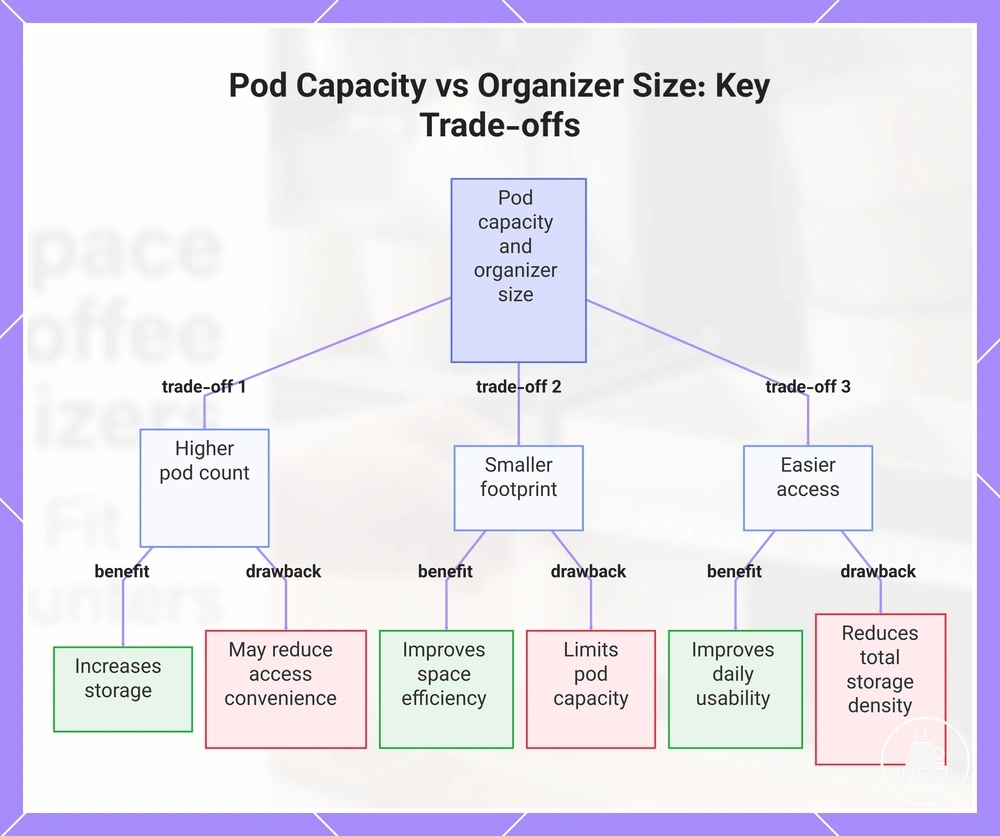
Pod capacity versus organizer size is best evaluated by comparing usable pod storage against physical dimensions rather than assuming more space automatically improves performance. The trade-off usually depends on whether higher pod count justifies increased size, reduced access convenience, or more frequent refilling in everyday use conditions.
- Higher pod count: increases storage but may reduce access convenience
- Smaller footprint: improves space efficiency but limits pod capacity
- Easier access: improves daily usability but may reduce total storage density
This chart shows the main trade-offs between pod capacity and organizer size, including the benefits and drawbacks of higher pod count, smaller footprint, and easier access.
Compartments for cups, lids, stirrers, and packets
Compartments are internal divisions that structure cups, lids, stirrers, and packets by access priority and daily-use relevance inside a coffee station organizer. They separate supplies based on size and frequency so that frequently used items remain easier to reach while small refills stay controlled and grouped. This makes compartments directly responsible for organizing cups, lids, stirrers, and packets according to real usage patterns rather than random placement.
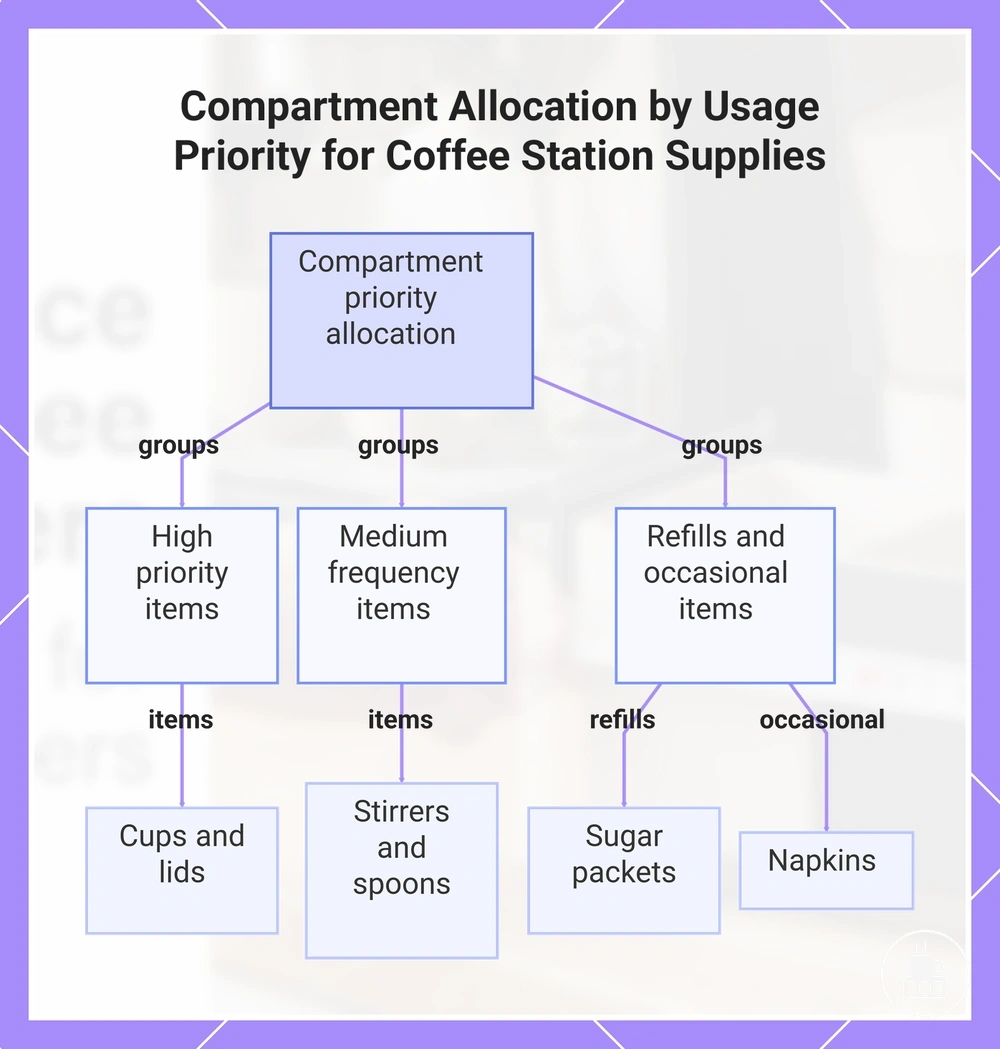
In practical setups, compartments must reflect how supplies are actually consumed during daily routines. Higher-frequency items and small refills create different storage pressure, so grouping becomes essential for maintaining order without overcrowding. A structured allocation typically follows usage priority:
- High access priority: cups and lids used repeatedly during daily preparation
- Medium frequency: stirrers and spoons used for routine mixing tasks
- Small refills: sugar packets and sweeteners requiring compact storage
- Low frequency: napkins stored for occasional or support use
Compartment design remains effective when it matches real household or office supply volume, since higher or lower usage levels can shift how much separation is needed for daily access efficiency.
This chart shows how compartments structure cups, lids, stirrers, packets, and napkins according to daily-use relevance and access priority.
Choosing a small coffee station organizer by counter layout
Choosing a small coffee station organizer depends on how counter layout affects storage behavior and access flow. The same organizer performs differently depending on placement conditions, especially around the coffee machine and surrounding space. In practice, counter layout determines which format works best for daily use.
In compact setups, storage behavior changes based on whether the organizer is placed beside-machine, under-machine, or in a corner layout. A beside-machine position is influenced by outlet placement and direct machine access, while an under-machine position depends on cabinet clearance and vertical height limits. Corner layout setups are shaped by traffic path movement and how easily items can be reached without blocking flow. Refill frequency and visible clutter also affect long-term usability, especially when space is shared. These conditions make layout position, access requirements, and spatial constraints the main decision variables.
When these variables overlap, selection becomes clearer when organizer formats are matched to storage behavior instead of appearance. Vertical, drawer, tray, narrow, and off-counter formats each respond differently to clearance limits, access flow, and space pressure. A structured decision view helps reduce mismatch between layout constraints and daily use.
Visible clutter and traffic path interference become more noticeable when storage is not aligned with layout constraints, especially in shared kitchens. Managing space and clutter problems helps reduce layout conflicts and improves how efficiently the counter arrangement supports daily movement and access flow.
The decision becomes more consistent when counter layout signals such as outlet placement, cabinet clearance, and traffic path are evaluated together. When these conditions are clearly defined, the suitable organizer format becomes easier to identify for different usage environments and refill patterns.
| Layout condition | Main constraint | Format to consider | Risk to check |
|---|---|---|---|
| Beside-machine | Outlet placement and machine access | Tray or narrow organizer | Cord congestion and limited reach |
| Under-machine | Cabinet clearance and vertical height | Drawer or low-profile unit | Fit issues due to height limits |
| Corner layout | Traffic path movement | Turntable or compact vertical unit | Blocked access in tight corners |
| Wall-adjacent | Wall clearance and reach distance | Wall-side slim vertical storage | Reduced side access flexibility |
| Narrow counter-strip | Limited surface width | Off-counter storage | Higher refill effort due to distance |
Beside-machine layouts
Beside-machine layout refers to placing a compact organizer directly next to the coffee machine where compatibility depends on side clearance, hand movement, and brewing flow stability. When side clearance is sufficient, the beside-machine layout can preserve brewing flow by keeping cup placement and pod access within natural reach without interrupting machine-side operation. Cord path alignment and spill zone control determine whether this side placement remains practical during daily use.
When a beside-machine layout is used in tight counter conditions, storage behavior depends on how much space remains between the machine and the organizer and how frequently items are accessed during brewing. Limited side clearance can restrict hand movement, while poor cord path routing may interfere with cup placement and pod access. If the spill zone overlaps with the machine-side organizer area, usability may decrease, so a local compatibility check is required:
- Side clearance supports unrestricted hand movement beside the machine
- Cord path stays clear of the machine-side organizer edge
- Cup placement remains stable within easy reach during brewing flow
- Pod access aligns with direct machine-side handling
- Spill zone remains free to avoid interference with daily use
Under-machine drawer layouts
Under-machine drawer layout depends on how drawer height, machine weight, and cabinet clearance interact with each other to determine safe and usable placement under the coffee machine. It can save footprint by using unused vertical space beneath the machine, but only when structural fit and load conditions are properly aligned. If drawer height is too high or machine weight exceeds stable support conditions, the setup may introduce access or stability limitations, linking footprint savings directly to height and load risk.
When an under-machine drawer is used in compact coffee stations, performance depends on sliding access, refill convenience, and exposure to drip zones beneath the machine. Limited cabinet clearance can restrict fit, while unstable support can affect stability during daily use. Usability improves when load distribution and access flow remain balanced within safe placement conditions.
- Drawer height matches machine base for stable placement
- Machine weight stays within supported load conditions
- Sliding access remains smooth and unobstructed
- Cabinet clearance allows proper fit and ventilation
- Stability remains consistent during operation
- Drip exposure does not interfere with stored items
Corner and wall-adjacent layouts
Corner layout and wall-adjacent layout depend on how awkward counter space is used while balancing reach angle, rotation space, cabinet doors, outlet access, wall clearance, and supply visibility. The corner layout changes how items are approached through angled positioning, while wall-adjacent layout shifts placement toward a fixed side boundary with reduced movement flexibility. These conditions directly shape usability by limiting reach and reducing visibility when clearance is constrained by surrounding surfaces.
When a corner coffee station or wall-side counter is used, storage placement must adapt to restricted movement paths and structural edges. Rotation space may improve access in corner layout setups, but cabinet doors and outlet access can block or narrow usable positioning. In wall-adjacent layout conditions, reduced wall clearance can limit hand movement and reduce supply visibility, making fit dependent on structural space rather than preference.
Lead-in check for corner and wall-adjacent fit:
- Reach angle allows controlled access without obstruction
- Rotation space supports movement in corner zones when needed
- Cabinet door swing does not block placement or retrieval
- Outlet access remains reachable without strain or rerouting
- Wall clearance maintains visible and usable supply space
In compact setups, these constraints determine whether corner layout or wall-adjacent layout remains practical for daily use, especially when evaluated against small-space coffee station ideas for fitting storage into constrained areas.
Stability and surface protection on small counters
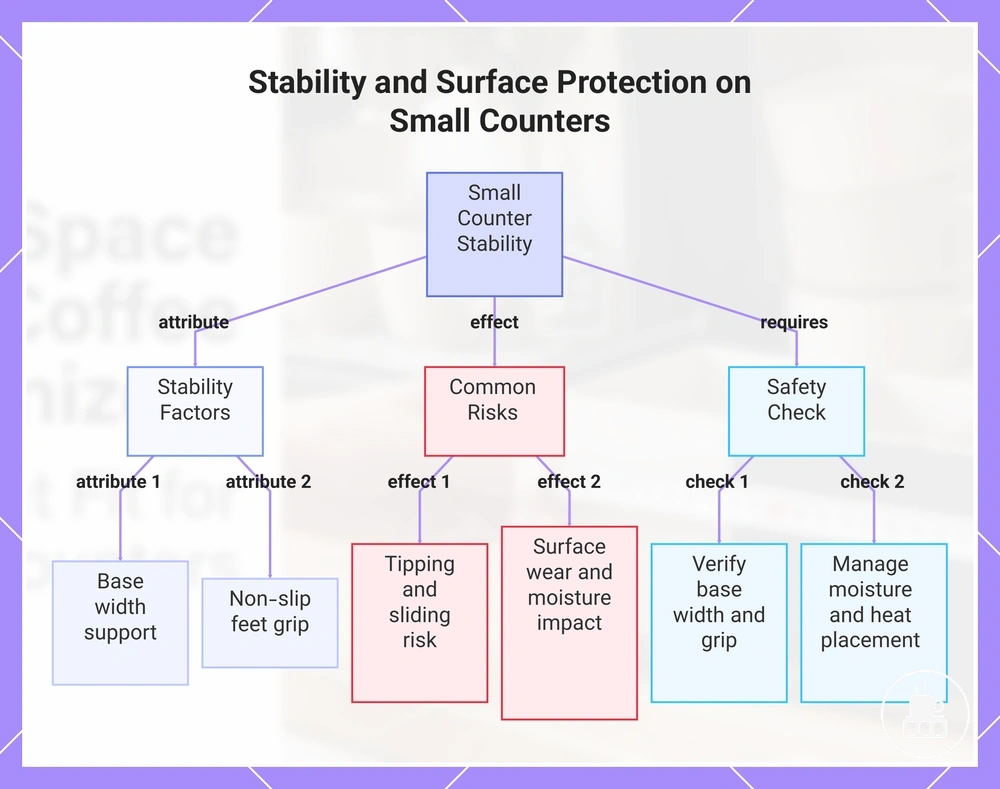
Stability and surface protection on small counters depends on how base width, weight distribution, and non-slip feet behave within limited space. Small counter footprints can increase tipping and sliding potential when load is uneven or contact points are narrow, especially during daily use. These conditions make stability checks necessary whenever compact organizers are placed on restricted surfaces.
On a small counter, reduced space can amplify movement caused by drawer pull force, uneven weight distribution, or frequent access to stored items. If non-slip feet are weak or missing, sliding risk increases, and material contact between the organizer and counter can create surface wear over time. Moisture exposure and hot-drink proximity may also influence surface protection depending on placement and usage patterns. A simple safety check helps evaluate these conditions before use:
- Base width supports stable placement on a small counter
- Non-slip feet maintain grip and reduce sliding movement
- Drawer pull force does not shift or tilt the organizer
- Weight distribution remains balanced during daily use
- Material contact does not damage or mark the counter surface
- Moisture exposure and hot-drink proximity are managed in placement
In compact coffee station setups, stability can vary when items are positioned near sinks or hot-drink zones where moisture exposure and heat are more frequent. In these edge conditions, even small changes in base width or weight distribution may influence surface protection depending on counter material and daily usage intensity.
This chart shows the key factors affecting stability on small counters, common risks, and the recommended safety checks to prevent tipping and surface damage.
Small-space trade-offs before buying
Small-space trade-offs before buying depends on how space savings, capacity, access, stability, material quality, and daily convenience are balanced within a constrained counter layout. The value is defined by price-to-usefulness, where fit and usability matter more than size alone in small-space setups. This makes trade-offs the core factor in the buying decision.
In compact environments, prioritising space savings can reduce access speed and limit how comfortably items are handled during daily use. Higher capacity designs may require more footprint, while slimmer units improve access but often reduce storage flexibility. Stability and material quality also influence long-term daily convenience, especially when cleaning burden increases or when fit failure occurs due to tight layouts. These competing factors shape the overall buying decision.
When evaluating options, comparing trade-offs across footprint efficiency, access, and durability helps clarify where usability loss begins to outweigh space savings. A structured view of value makes it easier to identify when compact-unit choices remain practical versus when they create functional limitations.
| Option type | Space advantage | Usability trade-off | When it is worth considering |
|---|---|---|---|
| Lower-cost tray | Minimal footprint use | Lower capacity and reduced stability | When simple organisation and low footprint are sufficient |
| Slim drawer | Hidden storage in tight space | Reduced immediate access | When reducing visible clutter is a priority |
| Tiered organizer | Improved vertical footprint efficiency | Reduced reach in rear sections | When visibility of multiple items is needed |
| Narrow pod holder | Very small footprint requirement | Limited storage capacity | When pod-focused use dominates the setup |
| Stable compact unit | Balanced footprint efficiency | Higher material and space requirement | When stability and material quality are prioritised |
Lower-cost trays or slim drawers are typically selected when cleaning burden must stay low and when fit failure risk is acceptable in exchange for flexibility. Tiered organizers or more stable compact units are preferred when stability, material quality, and daily convenience outweigh pure space savings.
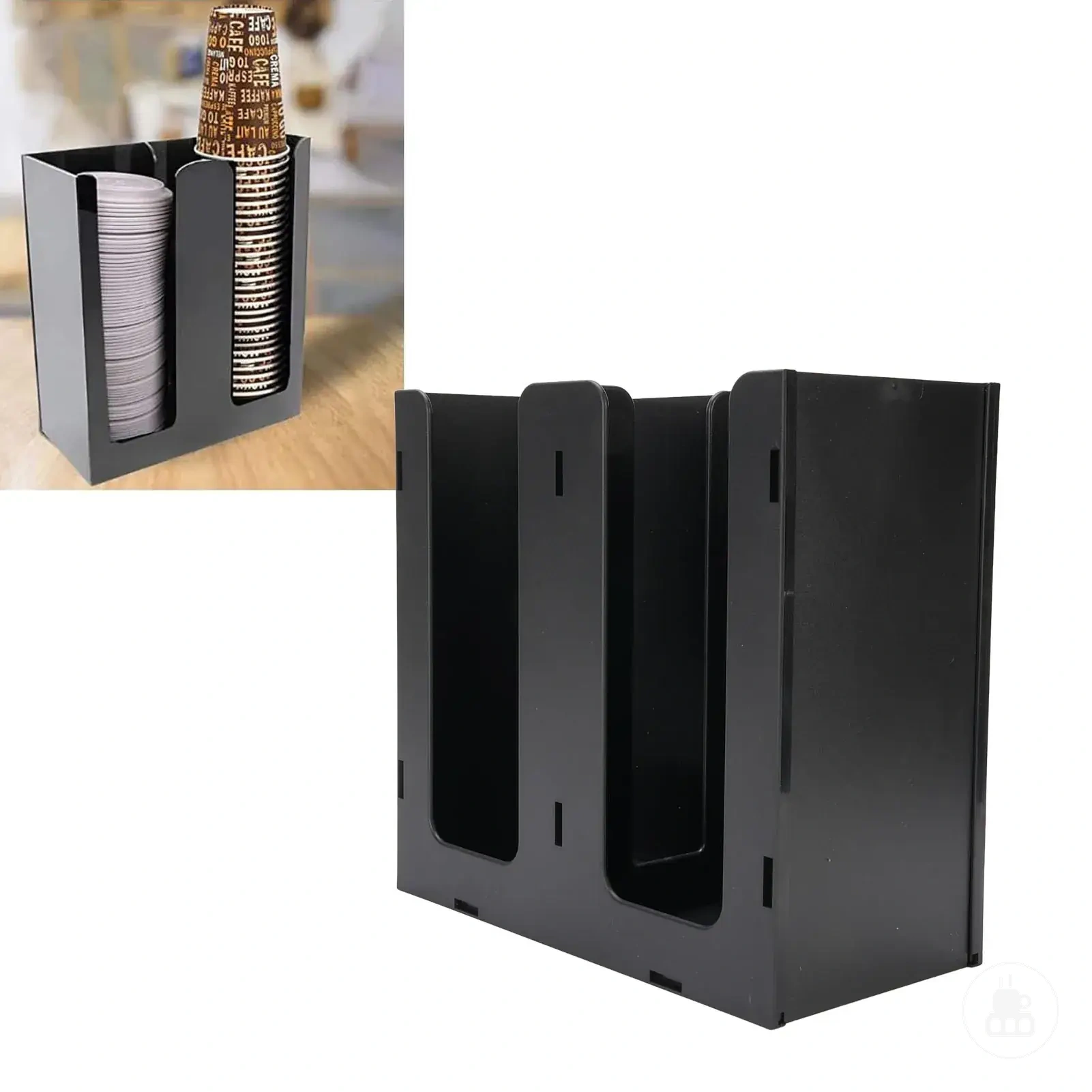
Here are product examples that may make comparison easier. Before buying, always review the compatibility criteria, essential features, and product details.