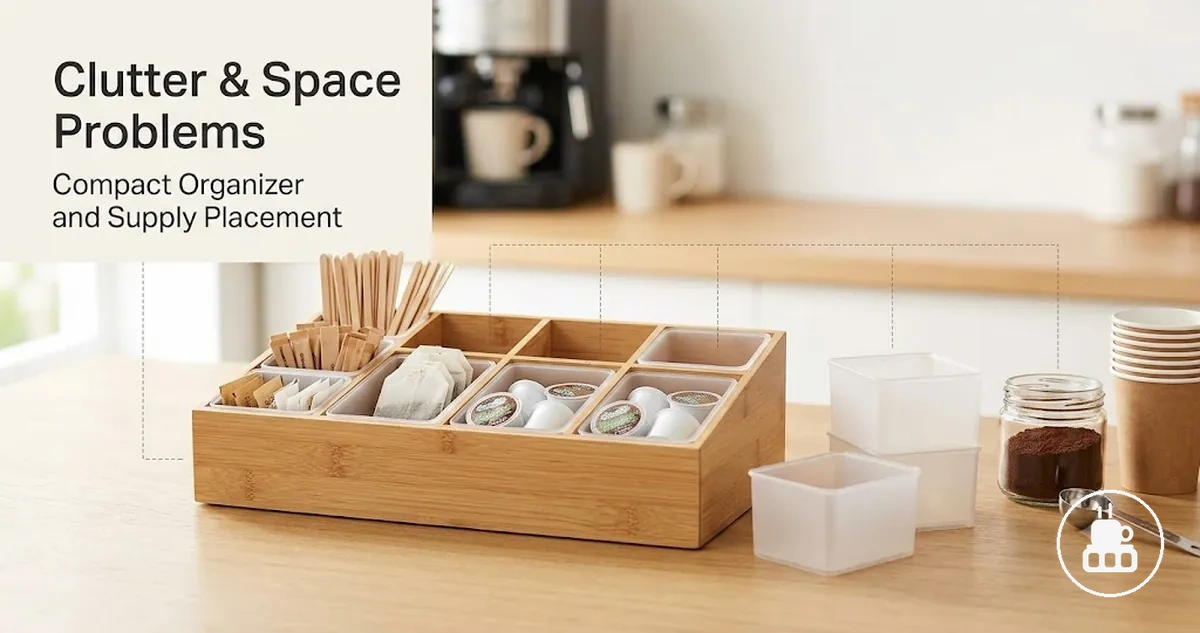
Coffee station organizer clutter, space, and fit problems
A coffee station organizer can still create clutter, counter space, or fit problems when the organizer does not match the coffee station problem it is supposed to control. This page focuses on troubleshooting the organizer, not broad kitchen decor, cafe equipment, or merchant listings.
Clutter usually comes from supply load, counter footprint, compartments, or daily routine rather than from the organizer alone. The same countertop organizer may work in one coffee bar setup and feel crowded in another because counter size, machine placement, organizer style, and household routine can change the result.
Use the first signs as diagnostic cues: visible supplies may point to excess active stock, overfilled compartments may point to capacity or allocation problems, blocked movement may point to fit problems, and repeated resetting may point to a routine mismatch. A storage caddy is not failing just because the counter gets used; the concern is whether the same clutter returns after normal daily use.
The next section grounds the troubleshooting by separating ordinary coffee mess from the routine-storage mismatch that can make a coffee station organizer behave like another source of clutter.
Why a coffee station organizer can still leave the counter cluttered
A routine-storage mismatch is a common reason an organizer does not reduce clutter. A coffee station organizer is most effective when its storage method matches the daily coffee routine, because visible clutter can remain when frequently used supplies are not stored where they are needed.
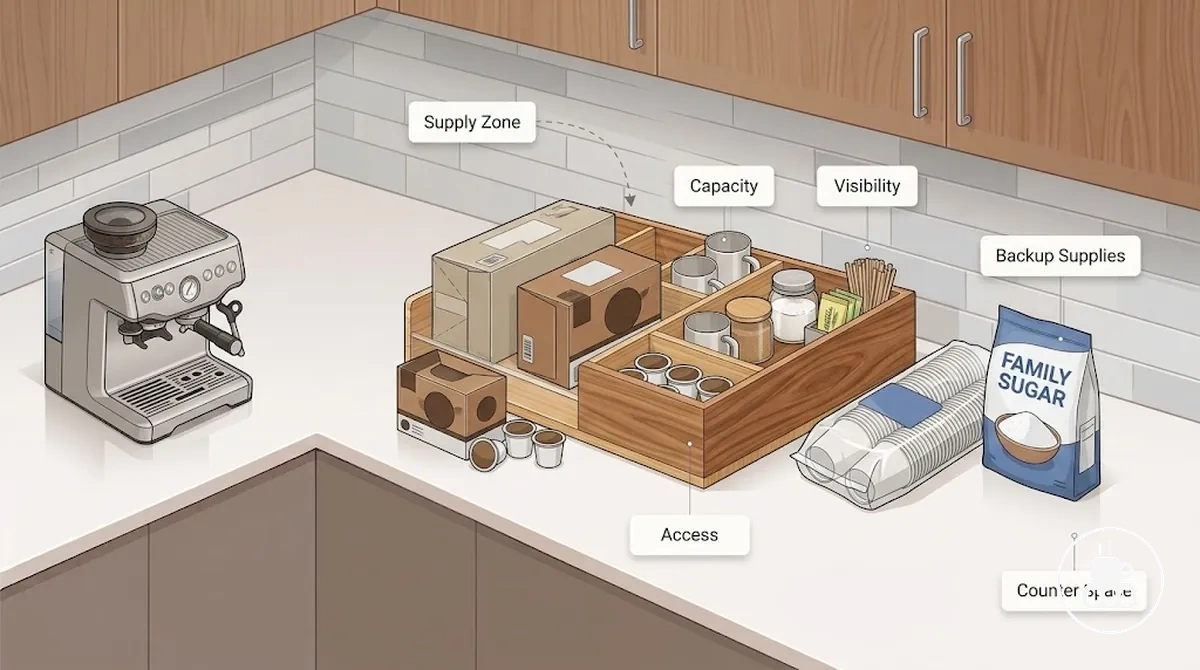
The organizer should balance the supply zone, capacity, footprint, visibility, and access around the coffee machine area instead of simply holding more items. Daily supplies may need immediate access, while backup supplies may be better stored separately when counter space is limited. The same coffee bar organizer can behave differently depending on available space and the household coffee routine. For a broader overview of coffee station organizers, this section focuses only on why clutter can remain rather than on product selection.
The following checks can help distinguish a repeatable organizer mismatch from normal daily coffee mess:
- Supply zone mismatch: Frequently used items are stored too far from the coffee machine area, leading to repeated movement and visible clutter.
- Capacity mismatch: Daily supplies and backup supplies compete for the same space, causing overflow outside the organizer.
- Footprint mismatch: The organizer occupies counter space needed for preparing drinks or accessing the coffee machine.
- Visibility and access mismatch: Items left outside the countertop storage remain easier to reach, so clutter gradually returns during the coffee routine.
Clutter symptoms that show the organizer is not working well
When clutter symptoms continue after normal use, the organizer may no longer support the coffee station effectively. Visible supplies, overfilled compartments, coffee grounds, drips, blocked access, and repeated resetting are practical signals that the current setup should be reviewed before moving on to specific fixes.
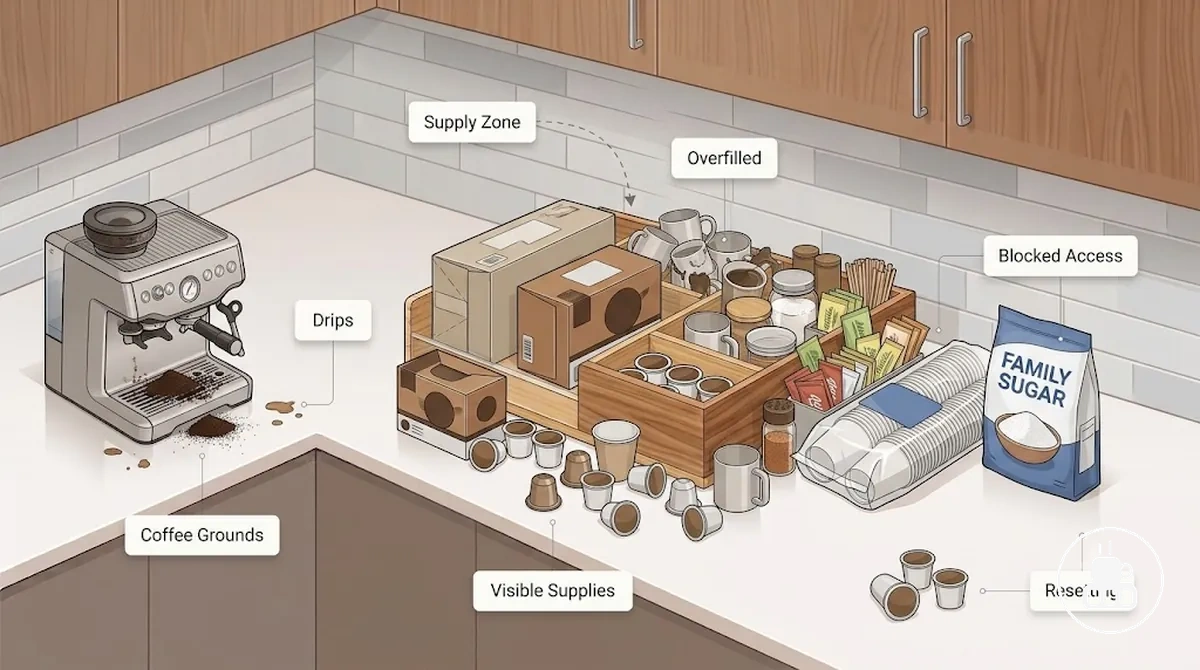
The table below links common clutter symptoms with likely causes and the next point to check. On a small counter or in a high-use coffee area, multiple symptoms may appear together, so the overall pattern is usually more useful than relying on a single visible sign.
| Symptom | Likely cause | What to check next |
|---|---|---|
| Visible supplies outside the organizer | Storage load or item placement may exceed the available space | Check whether frequently used supplies have accessible storage locations |
| Overfilled compartments | Organizer capacity may not match daily and backup supplies | Check whether overflow comes from storage volume or compartment allocation |
| Coffee grounds or drips near the machine | Preparation activities may extend beyond the intended work area | Check the relationship between the drip zone, coffee machine, and nearby storage |
| Blocked access | The organizer footprint may interfere with normal movement | Check whether cups, pods, or machine controls can be reached comfortably |
| Repeated resetting | The layout may not match the daily coffee routine | Check which items repeatedly return to the counter after regular use |
Visible supplies spreading outside the organizer
When visible supplies regularly spread beyond the organizer, the storage setup may no longer match the amount of items used each day. Cups, pods, filters, stirrers, sweeteners, or tools left on the counter can indicate a visible-storage mismatch, although the cause should be confirmed by reviewing daily-use volume and backup inventory first.
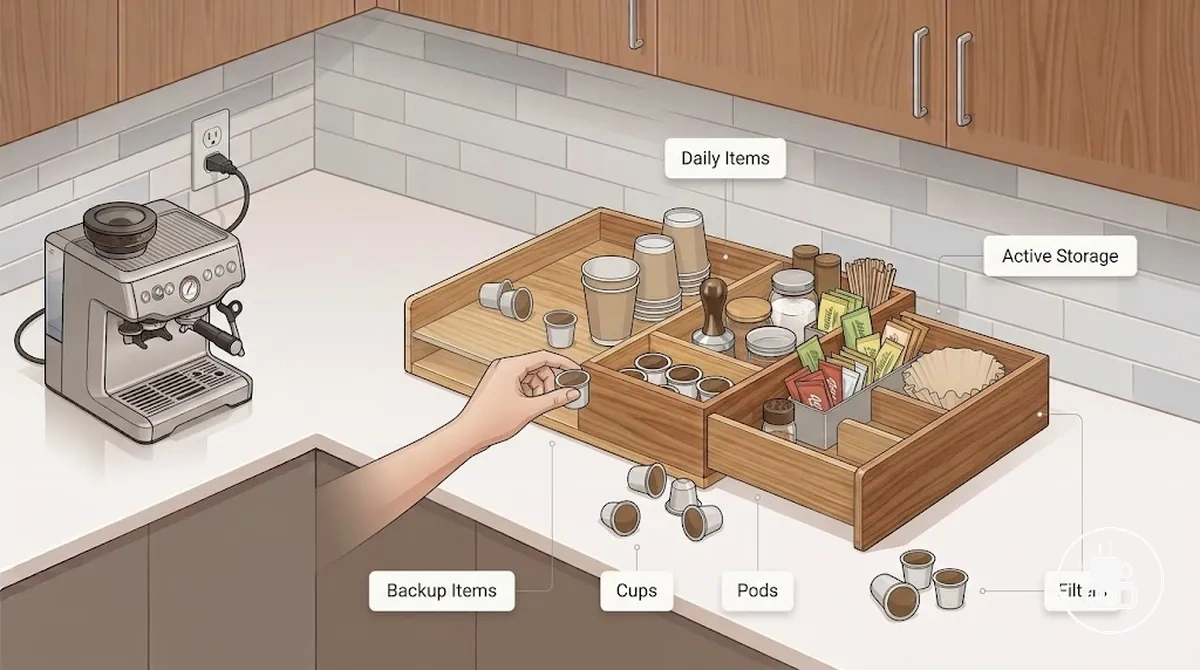
Separate daily-use items from backup inventory before judging the storage layout. For example, keeping one group of pods in active storage while storing reserve pods elsewhere can reduce visible supplies without changing the organizer. Use this checklist to verify the supply load before considering other changes:
- Cups: Verify whether the daily quantity fits inside the organizer and whether extra cups remain on the counter after use.
- Pods and filters: Check that daily-use items stay in active storage while backup inventory is stored separately to limit visible clutter.
- Stirrers and sweeteners: Confirm they have a consistent storage position instead of collecting outside the organizer.
- Tools: Check whether frequently used tools return to the same counter location because they lack a dedicated storage space.
Compartments, drawers, or dividers becoming overfilled
When overfilled compartments, drawers, or dividers reduce access to everyday supplies, the organizer can begin to behave like clutter instead of storage. Crowded compartments may hide items behind one another, reducing usable capacity even when the organizer itself is not completely full.
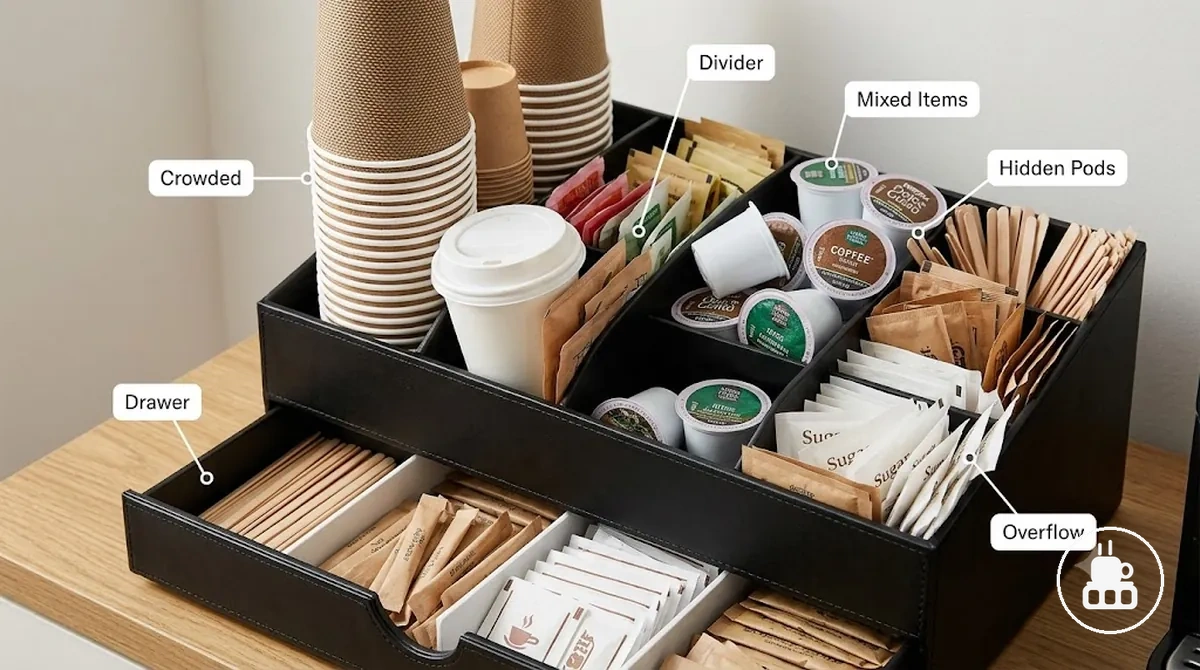
Check whether the problem comes from true capacity shortage or poor category mix within drawers and dividers. Mixed supplies can create the same access problem as limited usable capacity, so review how items are grouped before assuming additional compartments are needed. Use the following signs to verify usable capacity loss:
- Jammed drawers: Check whether crowded drawers make frequently used supplies difficult to reach.
- Mixed categories: Verify whether cups, pods, filters, and sweeteners share the same compartment, reducing clear access.
- Hidden pods: Look for small items becoming concealed beneath larger supplies because of the current divider layout.
- Stacked packets: Confirm that packets are not piled so deeply that everyday items become difficult to retrieve.
- Overflow: Check whether items extend beyond dividers because of limited usable capacity or uneven category allocation.
If access remains difficult after reviewing compartment allocation, see capacity and compartment fixes for guidance on evaluating usable capacity without assuming that additional compartments always solve the issue.
Coffee grounds, drips, and small mess around the setup
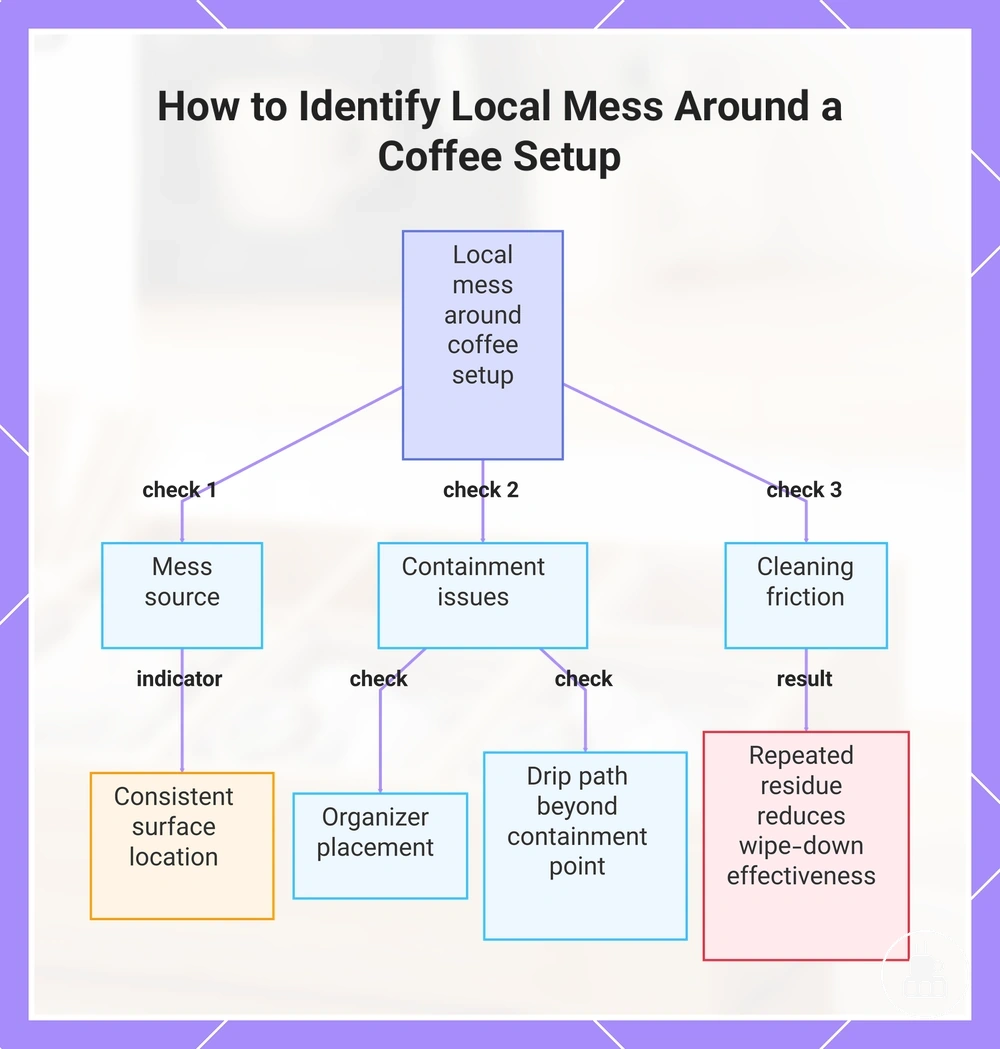
When coffee grounds, drips, or small mess remain around the setup, local containment is often the issue even when supplies appear organized. Residue on the surface, a spill along the drip path, or scattered coffee grounds can create visible clutter because cleaning friction increases when these mess sources spread beyond the intended containment area.
Check where the mess begins before treating it as an equipment problem. Coffee grounds, drips, and residue may collect near the grinder, coffee machine, mat, or nearby accessories, but the focus here is organizer placement and containment rather than appliance repair or deep cleaning. Use the following checks to identify local mess signals:
- Mess source: Check whether coffee grounds or residue consistently collect on the same surface around the setup.
- Containment: Verify that nearby trays, mats, or organizer placement help keep drips and small spills within the immediate work area.
- Surface position: Look for a drip path or spill that extends beyond the intended containment point and creates visible clutter.
- Cleaning friction: Check whether repeated residue in the same location makes quick wipe-downs less effective and leaves the setup looking untidy.
This chart shows the key checks to identify whether local mess around a coffee setup is due to containment issues rather than equipment problems.
Space and fit constraints that make the organizer feel too small
Space constraints and fit constraints can make a coffee station organizer feel too small when the counter footprint, clearance, and supply load compete with the coffee machine area. When machine access or movement is restricted, remeasure the usable space before assuming the organizer is undersized, because clearance depends on the surrounding setup.
The table below shows how common fit constraints can change usable storage and everyday access without relying on fixed size rules.
| Constraint | Measured condition | Usability effect | Next check |
|---|---|---|---|
| Counter footprint | Organizer occupies more usable space than expected | Preparation area feels restricted | Remeasure the available counter fit |
| Height | Limited cabinet clearance above the organizer | Supplies may be harder to reach | Check overhead clearance |
| Width | Organizer extends into the coffee machine area | Machine access may become awkward | Confirm side clearance |
| Depth | Footprint conflict reduces usable space behind or beside the machine | Movement path becomes less comfortable | Measure front and rear clearance |
| Wall or cabinet clearance | Limited space around the setup | Access depends on the surrounding layout | Review nearby obstructions |
If machine access remains blocked or clearance still feels limited after remeasuring, review the criteria in dimensions and fit checks before deciding whether the organizer or the layout needs to change.
Counter footprint conflicts beside the coffee machine
When the counter footprint of an organizer competes with the coffee machine, grinder, kettle, cups, or prep space, the setup can feel crowded even if the organizer is compact. A smaller footprint may still fail on a narrow counter when reach space, adjacent clearance, or the access zone is blocked.
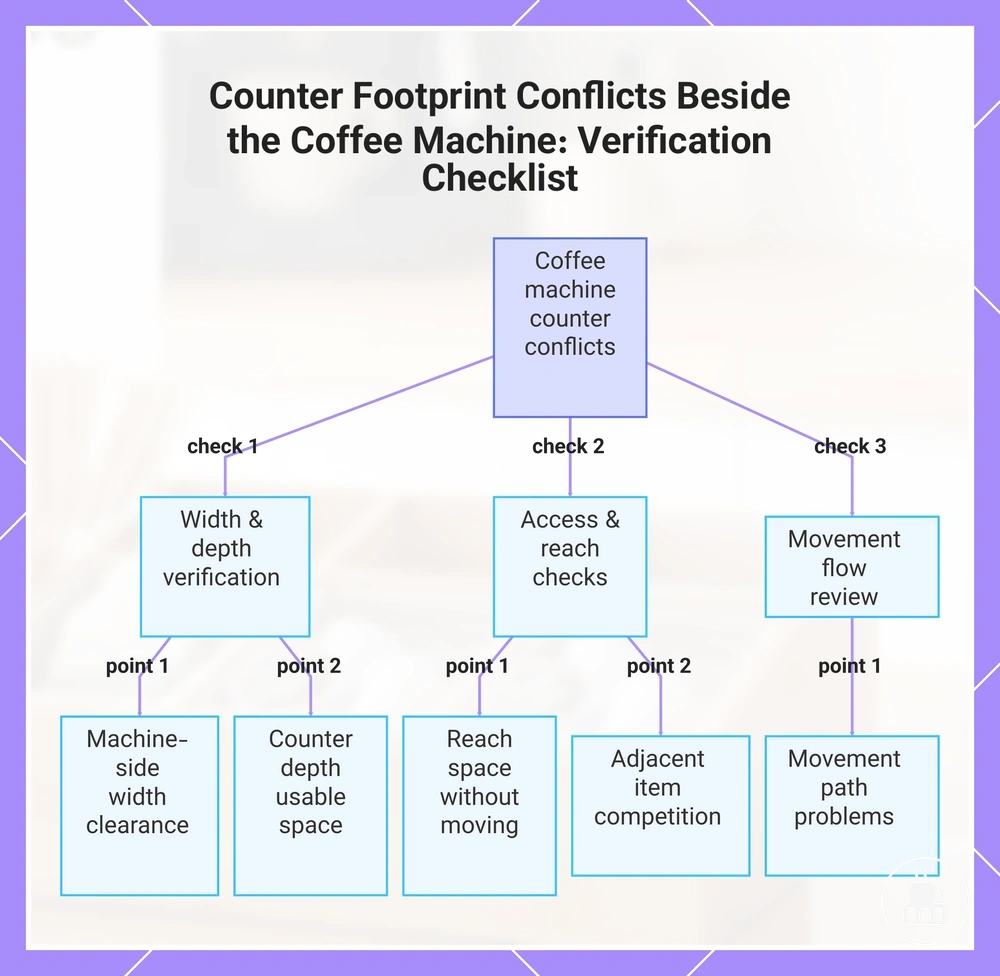
Use the checklist below to verify width, depth, and reach space around the coffee machine before changing the organizer. Each check should focus on the item footprint, adjacent clearance, and whether access becomes restricted during normal use.
- Machine-side width: Check whether the organizer width leaves enough adjacent clearance for the coffee machine and nearby cups.
- Counter depth: Verify whether the organizer depth pushes supplies forward and reduces usable prep space.
- Reach space: Check whether frequently used pods, cups, or controls can be reached without moving other items.
- Adjacent items: Review whether the grinder, kettle, or cup stack competes with the organizer for the same access zone.
- Movement path: Confirm whether the counter spread creates repeated movement problems during the coffee routine.
This chart shows the key verification checks to avoid footprint conflicts between a compact organizer and the coffee machine on a narrow counter.
Tight corner, cabinet, or wall clearance problems
Compatibility depends on whether a corner, upper cabinet, wall, backsplash, or appliance door reduces the usable space around the coffee station organizer. These physical boundaries can restrict opening, refilling, or cleaning even when the organizer fits on the counter, so the issue may relate to clearance rather than storage capacity.
Use the checklist below to verify whether a physical boundary is reducing usability. These checks focus on side, back, top, and door clearance and help distinguish clearance problems from compartment-capacity problems.
- Side clearance: Check whether a nearby wall or corner limits access to frequently used supplies.
- Back clearance: Verify that the backsplash or rear wall does not reduce usable space for placement or cleaning.
- Top clearance: Confirm that an upper cabinet leaves enough room to open containers or refill supplies comfortably.
- Appliance door clearance: Check whether a coffee machine lid, water reservoir, or nearby appliance door can open without contacting the organizer.
- Capacity boundary: If surrounding surfaces block access, address the clearance path before assuming additional organizer capacity is needed.
Storage load problems inside the coffee station organizer
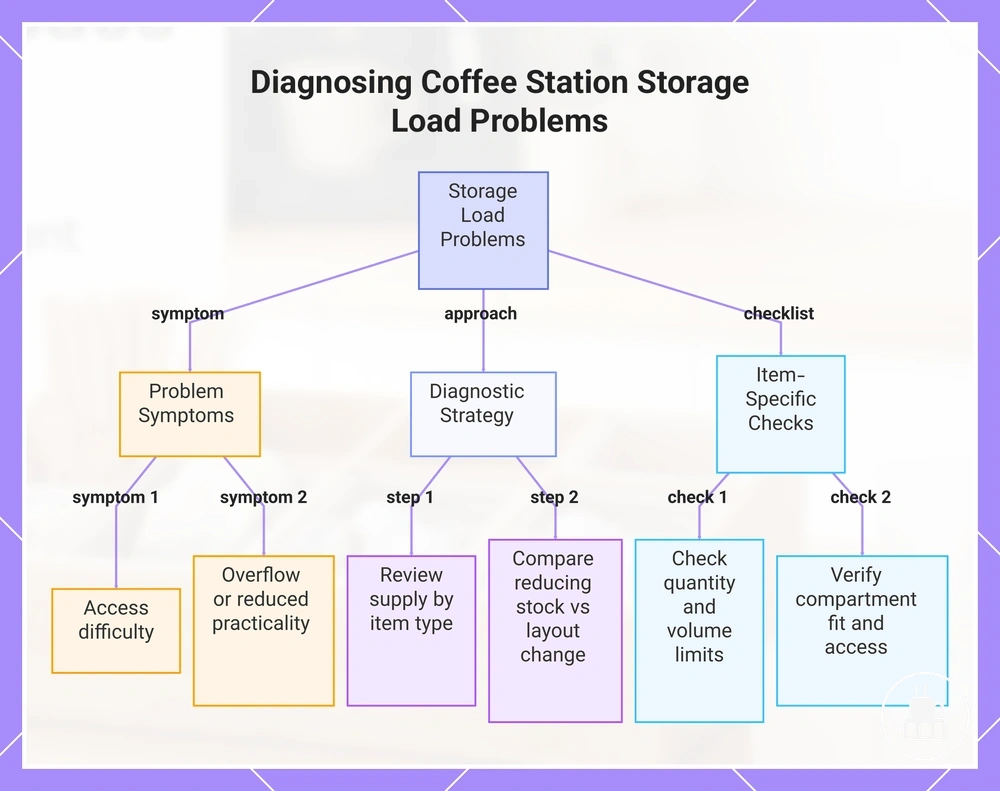
Storage load can exceed compartment usefulness even when the coffee station organizer fits the counter. When stored volume is greater than the compartments can support for everyday use, access may become difficult, items may overflow, and the organizer can become less practical without any change to its footprint.
Review the supply load by item type rather than treating every category the same. Cups, pods, condiments, lids, filters, tools, and accessories may require different amounts of space, so compartment suitability depends on both quantity and how often each item is used.
Before changing the organizer, compare reducing active stock with changing the storage layout. Use the checklist below to diagnose storage load without assuming larger storage is the only solution.
- Cups: Check whether the quantity limits access or causes nearby supplies to become difficult to reach.
- Pods: Verify that stored volume matches regular use and does not overflow the intended compartment.
- Condiments: Confirm that packets, jars, or containers have suitable storage positions instead of competing with cups or pods.
- Lids: Check whether lid quantity creates overflow or blocks access to other daily stock.
- Filters: Verify that filters fit their compartment without covering frequently used supplies.
- Tools: Review whether coffee tools fit without blocking nearby items.
- Accessories: Check whether less frequently used accessories reduce access to everyday supplies.
This chart outlines the symptoms of storage overload in a coffee station organizer and the diagnostic steps to identify the root cause without assuming a larger organizer is needed.
Too many cups, pods, condiments, or accessories in daily reach
When too many cups, pods, condiments, or accessories stay within daily reach, clutter pressure can build inside and around the active coffee station. The amount that should remain visible depends on household routine, cup or pod usage, and restock habits rather than keeping every available supply close at hand.
Separate supplies by how often they are used before deciding where to store them. Daily-use items belong in active storage, while backup supplies, such as spare pods or extra cups, can often be kept outside the active coffee station so they do not compete with frequently used items for access.
Use the following checklist to sort supplies by frequency instead of storing everything within daily reach.
- Daily items: Keep only cups, pods, condiments, and accessories used during regular coffee preparation within easy reach.
- Weekly items: Store less frequently used supplies where they remain accessible without filling active storage.
- Backup supplies: Move spare stock out of the active coffee station when it increases clutter pressure or blocks access to daily-use items.
- Rarely used items: Relocate occasional accessories if they occupy space needed for regularly used cups, pods, or condiments.
Compartment layout that does not match the supply mix
A compartment layout can make a coffee station organizer feel crowded even when total capacity seems adequate. If the supply mix does not match compartment shape, drawer depth, or divider flexibility, usable capacity can drop because items fit poorly or become difficult to access.
Check how the storage layout handles pod size, cup size, packet quantity, and tool length before assuming the organizer needs more capacity. Fixed dividers may work for consistent item shapes, while flexible zones may suit a category mix that changes by size or frequency, but either option depends on the actual supplies being stored.
Use the comparison below to diagnose how supply mix changes compartment usefulness.
| Fixed or shallow layout | Flexible or deeper layout |
|---|---|
| May crowd mixed pod sizes when divider spacing does not match the category mix. | May handle varied pod size more easily when zones can adjust to the supply mix. |
| May limit cup size or tool length when drawer depth is shallow. | May improve access when deeper storage matches taller cups or longer tools. |
| May create packet overflow when small condiments share narrow compartments. | May reduce crowding when packet quantity can be grouped by use frequency. |
Practical fixes for a cluttered coffee station organizer
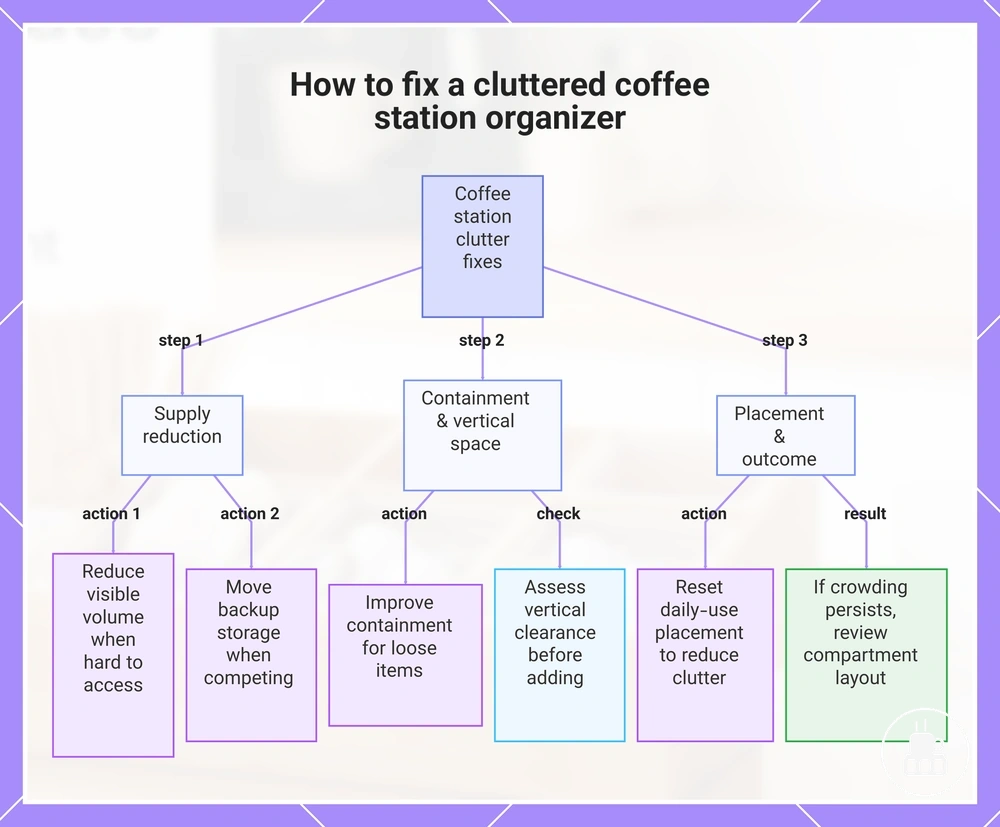
Practical fixes should begin with low-risk changes before replacing the organizer. Reducing visible supply volume, separating backup storage, and improving daily-use placement can often reduce clutter when the current organizer is overloaded rather than unsuitable.
Work through the following actions in sequence. Each step connects an adjustment with the condition that justifies it and the potential effect on clutter, while keeping trays, baskets, drawers, and vertical storage as supporting tools rather than automatic solutions.
- Reduce visible supply volume: Remove extra cups, pods, or condiments from active storage when frequently used items become difficult to access, helping reduce crowding.
- Move backup storage: Keep reserve supplies outside the active coffee station if they compete with everyday items for the same compartments.
- Improve containment: Use trays, baskets, or drawers when loose packets and small accessories regularly spread across the counter, helping keep related items together.
- Assess vertical storage: Add vertical storage only if available clearance allows comfortable access without restricting the surrounding workspace.
- Reset daily-use placement: Position the most frequently used supplies within easy reach and relocate less-used items when repeated movement creates clutter.
If these practical fixes improve access and reduce visible clutter, the existing organizer may still be suitable. If crowding continues despite supply reduction and placement changes, the next step may be to review compartment layout or overall fit instead of adding more storage accessories.
This chart shows the sequence of practical fixes for a cluttered coffee station organizer, from supply reduction to outcome evaluation.
Reduce visible supply volume before adding more storage
Reduce visible supply volume before adding another organizer when active stock exceeds everyday needs. Lowering the visible quantity of frequently displayed items can reduce counter impact by freeing space already available in the current organizer, especially when duplicates or backup stock occupy compartments intended for daily use.
Review each item category by frequency of use rather than removing items indiscriminately. The appropriate daily amount depends on household routine and restocking patterns. For example, keeping only the pods or cups typically used during the day while relocating spare supplies elsewhere can reduce visible stock without limiting normal access.
Use the checklist below to decide what to reduce first:
- Duplicates: Relocate duplicate cups or accessories when they are not part of the daily routine to reduce counter pressure.
- Backup stock: Store backup stock separately if it occupies space needed for everyday supplies.
- Packets: Keep only the active quantity of sugar, sweetener, or creamer packets within easy reach when extra packets increase visible clutter.
- Rarely used items: Move occasional accessories away from the active coffee station so frequently used items remain easier to access.
Separate daily-use items from backup supplies
Daily-use items belong in the active coffee routine zone, which is the storage area that supports normal coffee preparation without extra searching or movement. Separating these frequently used supplies from backup supplies can improve access and reduce visible clutter because reserve stock no longer competes with the items used most often.
Place active storage around the supplies used during the regular routine, then move spare stock to a backup location when larger restocks of pods, cups, or condiments crowd the coffee station. The backup location should stay practical for refilling, but it does not need to occupy the same visible space as the active routine.
- Daily-use pods: Keep the pods used during normal preparation in the active coffee routine zone so access stays clear.
- Cups and lids: Store frequently used cups nearby, and move extra cups or lids to backup storage when they crowd the active area.
- Condiments: Keep regularly used condiments within reach, and relocate spare stock when restock quantities increase visible clutter.
- Backup supplies: Place reserve items outside the active zone so they remain available for refilling without blocking daily-use items.
Use trays, baskets, drawers, or vertical storage without overloading them
Trays, baskets, drawers, and vertical storage work best when each one has a clear storage job instead of collecting every loose item. Assigning each storage aid to a specific purpose can improve containment and reduce clutter, while overloading any one of them may simply shift or hide the problem.
Use trays, baskets, and drawers to contain loose items, and use vertical storage for footprint relief only when height clearance and access remain practical. Each storage aid works best when matched to its intended role rather than being used to compensate for poor fit or excessive storage load.
| Storage aid | Best use condition | Overload risk | Better outcome |
|---|---|---|---|
| Trays | Containing loose packets and small accessories | Mixed items spread beyond the tray | Clearer containment for frequently used loose items |
| Baskets | Grouping related supplies by category | Too many items reduce quick access | More defined storage zones |
| Drawers | Keeping regularly used supplies accessible without leaving them exposed | Hidden clutter from overcrowding | Improved access with organized contents |
| Vertical storage | Reducing counter footprint when height clearance is available | Limited access if stacked too high | Footprint relief while maintaining usable access |
After assigning each storage aid a clear job, you can set up a cleaner workflow without relying on additional accessories to solve every clutter problem.
When the problem needs a different organizer layout
Recurring clutter after a reset can indicate a layout mismatch rather than a simple storage habit problem. A different organizer layout may be needed when the current storage style no longer matches counter constraints, supply behavior, or machine access.
Use the criteria below to compare organizer format against the problem it needs to solve. Treat each option as a diagnostic match, not as a ranking or buying recommendation.
| Layout option | Constraint it addresses | Capacity effect | Decision signal |
|---|---|---|---|
| Compact | Small counter pressure and limited footprint | May reduce counter spread but can limit active supply volume | Consider when the counter is crowded but supply load is modest |
| Drawer | Visible clutter from items needing contained access | May hide supplies while keeping them reachable | Consider when items overflow visually but machine access remains clear |
| Tiered | Competing horizontal space and grouped supplies | May add usable levels if height clearance allows | Consider when width is limited but vertical access is still practical |
| Vertical | Footprint conflict beside the coffee machine | May shift storage upward instead of outward | Consider when counter space is limited and upper clearance is not blocked |
| Tray | Loose items spreading across the setup | May improve containment without adding much capacity | Consider when clutter comes from small loose items rather than heavy supply load |
| Multi-compartment | Mixed supplies with different access needs | May separate categories if compartment sizes match the supply mix | Consider when overfilled compartments come from poor category separation |
If the table points to blocked access, overfilled compartments, or small-counter pressure that a reset cannot solve, the issue is likely layout criteria rather than tidying alone. At that point, use the diagnosed constraint to choose a better-fitting organizer.
When a compact organizer cannot hold the real supply load
A compact organizer is undersized only when the real supply load exceeds its usable storage after daily-use items have already been sorted. Overflow, repeated access friction, or frequent refilling can indicate a capacity problem, but a compact organizer is not inherently inadequate if the active load matches its intended storage space.
Check the real supply load before deciding that a compact counter organizer has reached its practical limit. Use the criteria below to distinguish true capacity failure from poor daily-use sorting.
- Supply count: Verify whether the active number of cups, pods, condiments, and accessories regularly exceeds the available compartments.
- Refill frequency: Check whether frequent refilling results from limited active storage rather than a deliberate choice to keep fewer supplies within reach.
- Overflow: Look for supplies that consistently spill onto the counter or into unrelated compartments after normal use.
- Access friction: Confirm whether reaching everyday items requires moving other supplies because usable storage is already full.
- Boundary check: If these conditions remain after daily-use sorting, the compact organizer may no longer match the real supply load. Otherwise, review small-space organizer options before deciding that a different organizer size is needed.
When drawer, tiered, or vertical storage solves the space conflict
Drawer storage, tiered storage, and vertical storage can help solve a space conflict by changing storage direction rather than increasing counter spread. The most suitable layout depends on the available footprint, access conditions, and whether height clearance allows comfortable everyday use.
Compare each layout by the type of space conflict it addresses before changing the organizer. The table below focuses on storage direction, access requirements, and the main risk to check for each layout.
| Layout | Space conflict addressed | Access condition | Risk to check |
|---|---|---|---|
| Drawer storage | Uses pull-out storage to reduce visible counter clutter without expanding the footprint | Works when the drawer opens fully and contents remain easy to reach | Restricted pull-out access |
| Tiered storage | Uses layered storage to improve visibility while keeping a similar counter footprint | Works when items stay stable and remain easy to see | Reduced visibility or stability if tiers become overcrowded |
| Vertical storage | Moves storage upward instead of outward to reduce counter spread | Works when height clearance and reach access remain practical | Limited usability if upper storage becomes difficult to reach or overhead clearance is restricted |
How to keep the coffee station from becoming cluttered again
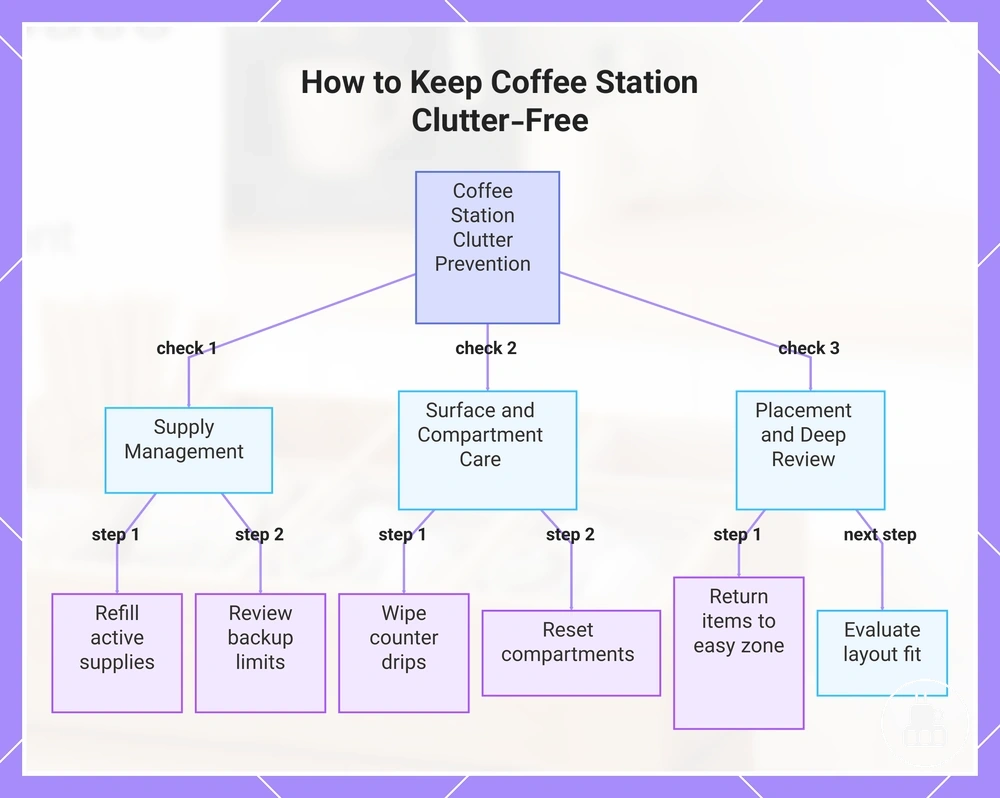
Recurring clutter is less likely to return when the coffee station organizer has a simple maintenance habit tied to the daily coffee routine. A steady restocking rhythm, clear backup supply limits, light surface wipe-down, compartment reset, and consistent routine placement can keep the reset from slowly becoming crowded again.
Use the recurring checks below after normal use or when supplies begin to drift from their intended positions. The frequency can vary by household use and mess level, so treat each check as a condition-based maintenance step rather than a fixed schedule.
- Restocking rhythm: Refill active supplies when daily-use items run low, preventing backup stock from crowding the organizer.
- Backup supply limits: Review spare pods, cups, or condiments when reserve items move into active storage, reducing visible clutter before it spreads.
- Surface wipe-down: Wipe the local counter area when drips, grounds, or residue collect, keeping small mess from making the station look cluttered.
- Compartment reset: Return cups, pods, packets, and tools to their assigned compartments when access starts to feel blocked.
- Routine placement: Move frequently used supplies back into the easiest access zone when repeated movement leaves items outside the organizer.
If the same clutter returns after these checks, review whether the organizer still fits the available space, capacity needs, and workflow. Ongoing fit, capacity, and workflow checks help separate routine maintenance from a deeper layout problem.
This chart shows the condition-based maintenance checks and deeper layout review to prevent recurring clutter at a coffee station.